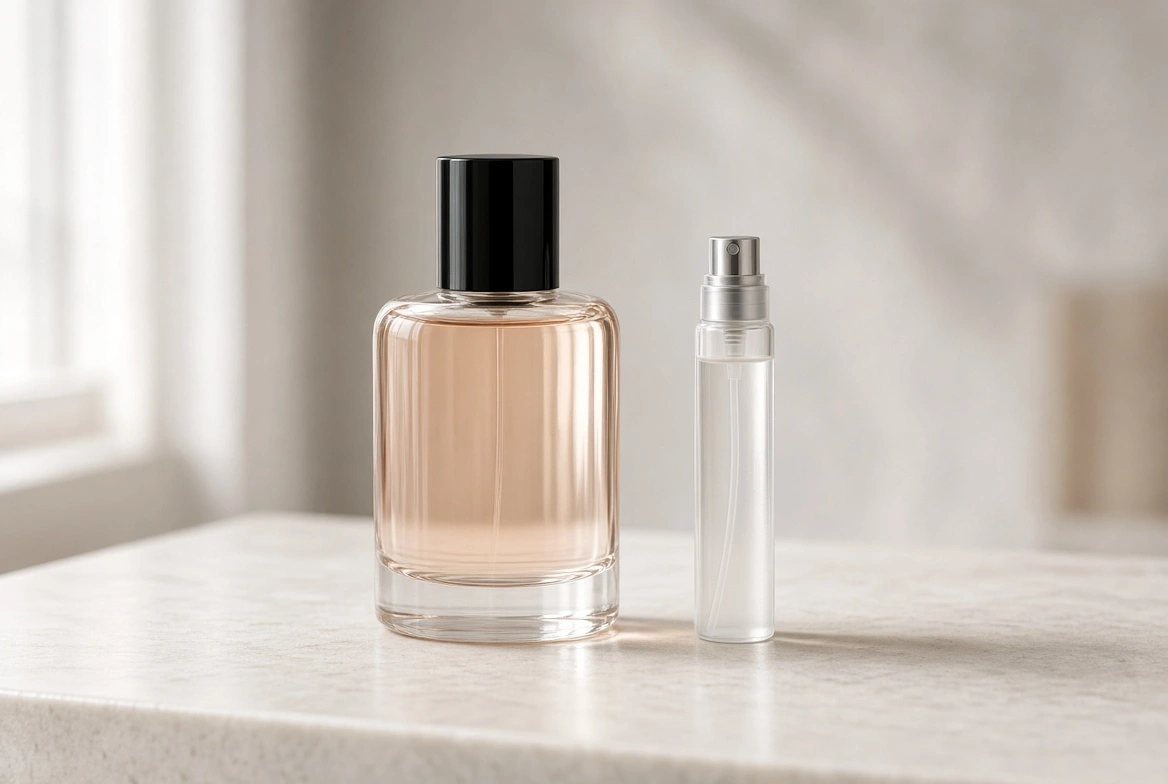
You do not want to carry a full glass bottle for four days, and you do not want to arrive with something that smells wrong. Both concerns are reasonable and they pull in opposite directions.
Here is what a decant actually exposes a fragrance to, and what follows from it. What this page will not do is tell you how your specific fragrance behaves, because that is a formulation question and this site has not tested anything.
What decanting exposes it to
Four things, and they are the same four whatever the fragrance.
Air. Filling a small bottle means air in the headspace above the liquid, and the smaller the bottle, the greater the ratio of air to liquid. It also means air introduced during the transfer.
Light. A decant is frequently going into something clearer than the original bottle. Original fragrance packaging is often tinted or boxed, and that is not only presentation.
Temperature swings. A bottle that lives in a bathroom cupboard is in a stable environment. One that travels is in a car, a bag, an aircraft hold, a hotel window.
Whatever was in the container. The most under-appreciated one, and the most controllable. Residue, water, or a previous fragrance in the atomizer.
The last of those is the only one you can eliminate completely, which is why the practical advice below spends more time on it than on the others.
What this page will not claim
No claim is made about how long a decanted fragrance lasts, or about whether it changes.
Fragrances vary enormously in composition and in how they are stabilized, and manufacturers do not generally publish the information that would settle it. Any page telling you a decant lasts a particular number of weeks is stating something it cannot know about a product it has not seen.
Two things are safe to say, and they are both about direction rather than magnitude.
More air, more light, more temperature variation and more time all point the same way, so a smaller decant used sooner is a lower-risk proposition than a larger one kept longer.
And you are the instrument. If it smells right to you, it is right for your purposes. There is no external standard being violated, and the question only matters if you can tell.
The practical rules
Decant for the trip, not for storage. Enough for the days you will be away and a little spare. This single decision handles the air, the light and the time problem at once.
Fill it as full as the closure allows, if air is your concern. Less headspace means less air.
That advice conflicts directly with the pressure argument that governs everything else on this site, where the instruction is to leave headspace so expanding air has somewhere to go. When you are flying, the leak risk wins, because a leaked fragrance bottle is a certain and expensive loss and everything else is a maybe. How to fill and close a travel bottle so it survives the flight covers that mechanism, and it applies to fragrance more sharply than to shampoo because of what a leak costs.
Use an opaque or tinted atomizer if you have the option. It is one variable removed for no effort.
Clean and dry the atomizer completely before filling. Water in the bottle dilutes the fragrance directly, and a previous fragrance in the mechanism blends with the new one. This is the failure people notice first and blame on the decanting rather than on the container. How to clean silicone travel bottles and get the smell out covers the general problem, and fragrance is the case where a residual scent is not cosmetic but the entire point of the product.
Keep it out of the light and out of heat while travelling. Inside the bag, not in a window, not in a car on a hot day.
Do not decant back into the original bottle, ever.
The atomizer itself
Two practical points that decide whether the thing works.
A spray mechanism has a very small opening, and anything in the liquid or dried in the nozzle blocks it. Fragrance is thin and clean so this is less of a problem than with other products, and it is not zero, particularly if the atomizer previously held something else. The general mechanism is the same one described in continuous mist sprayers and why they clog.
A refillable atomizer with a bottom-fill valve is a different object from one you unscrew. The bottom-fill type transfers directly from the original bottle’s own sprayer, which means the fragrance never meets the open air, a funnel, or your hands. If the question you came here with is about air exposure, that is the answer to it.
And the closure is what fails, not the bottle. A fragrance leaking into a bag is a closure story, and it is worth taking seriously because of what fragrance does to fabric and to everything packed with it. Why travel bottles leak on a plane covers what actually goes wrong.
Carrying it, which this page does not have rules for
Fragrance contains alcohol, it is flammable, and aviation and security authorities treat it accordingly.
No rule about carrying fragrance appears anywhere on this page. No volume, no container limit, no quantity, no statement about cabin or hold.
That is not caution for its own sake. Our own attempts to read the relevant primary sources returned an access error to our fetcher on 2026-08-28, repeating a result recorded on 2026-08-24, so we have no current primary-source read to publish. That is our retrieval failing rather than any authority withholding anything.
Check the authority’s own current page for your departure airport, and check with your carrier, and remember that a connecting airport may apply something different from the one you left. Rules on flammable liquids are one of the areas where the difference between airports and between carriers is real.
A note on gifts and sharing
Two things worth knowing if the decant is for someone else.
Decanting removes the labeling. The recipient has a liquid with no name, no batch, and no ingredient list on it. Label it with what it is and when you filled it, at minimum.
Fragrance is one of the products where the packaging is a meaningful part of what was bought. A decant is a practical object rather than a present, and treating it as one avoids an awkward moment.
The short version
- Decanting exposes a fragrance to air, light, temperature swings and whatever was in the container.
- Only the last of those is fully in your control, and it is the one that causes the failure people notice.
- No claim is made here about how long a decant lasts or whether it changes. That is a formulation question.
- Smaller and sooner is lower risk. You are the instrument: if it smells right, it is right.
- Clean and dry the atomizer completely. A previous fragrance in the mechanism blends with the new one.
- A bottom-fill atomizer transfers without the liquid meeting open air, which is the cleanest method.
- No carriage rule appears here. Our fetcher could not reach the authority’s page; read it yourself and check your carrier.