Travel bottles leak on planes because cabin pressure drops as the aircraft climbs, and the air trapped inside a sealed bottle expands with it. In a rigid container that air has nowhere to go, so it pushes shampoo or lotion past the seal instead. It is not a defect and it is not really about price. It comes down to two things you control: how much air you sealed inside, and whether the bottle itself can flex to absorb that expansion.
That single distinction, rigid versus flexible, explains why you will find two pieces of advice online that flatly contradict each other. This article reconciles them instead of picking one.
The mechanism: what actually happens at altitude
Airplane cabins are pressurized, but not to sea-level pressure. Most cabins sit at an equivalent altitude of roughly 6,000 to 8,000 feet once cruising, which means the air pressure around you, and around your sealed bottle, is meaningfully lower than it was on the ground.
Any bottle you sealed at ground level trapped a pocket of ground-pressure air inside it, whether that pocket is a visible gap at the top or just the air dissolved and mixed in with the product. As the cabin pressure drops, that trapped air expands to try to reach equilibrium with the lower pressure outside. A rigid container cannot expand to make room, so the only way to relieve the pressure is for something to give: the seal, the cap threads, or a valve. Liquid gets forced out through whichever of those is weakest.
The University of Illinois Physics Van, a public physics education resource run by the university’s physics department, answers this exact question directly: if a bottle holds a small amount of trapped air that becomes over-pressured relative to the surrounding cabin, a small amount of liquid leakage is enough to relieve that overpressure. The reverse is also true. A bottle with a larger air pocket needs to release proportionally more liquid to reach the same equilibrium.
Why “fill it completely” and “leave headspace” are both correct advice
This is the part most travel-bottle articles skip, and it is the actual information gap in this topic. Search around and you will find confident advice in both directions: some sources tell you to fill bottles almost to the brim, others insist on leaving 10 to 20 percent headspace. Neither is wrong. They are answers to two different container types.
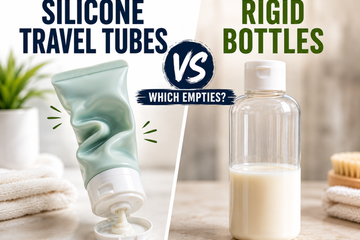
Rigid bottles (hard plastic, aluminum, glass). The walls do not flex. Any trapped air pocket has to expand somewhere, and the only path available is past the seal. The Physics Van’s logic points to minimizing that air pocket: fill as close to full as the cap design allows, so there is as little trapped air as possible to expand in the first place.
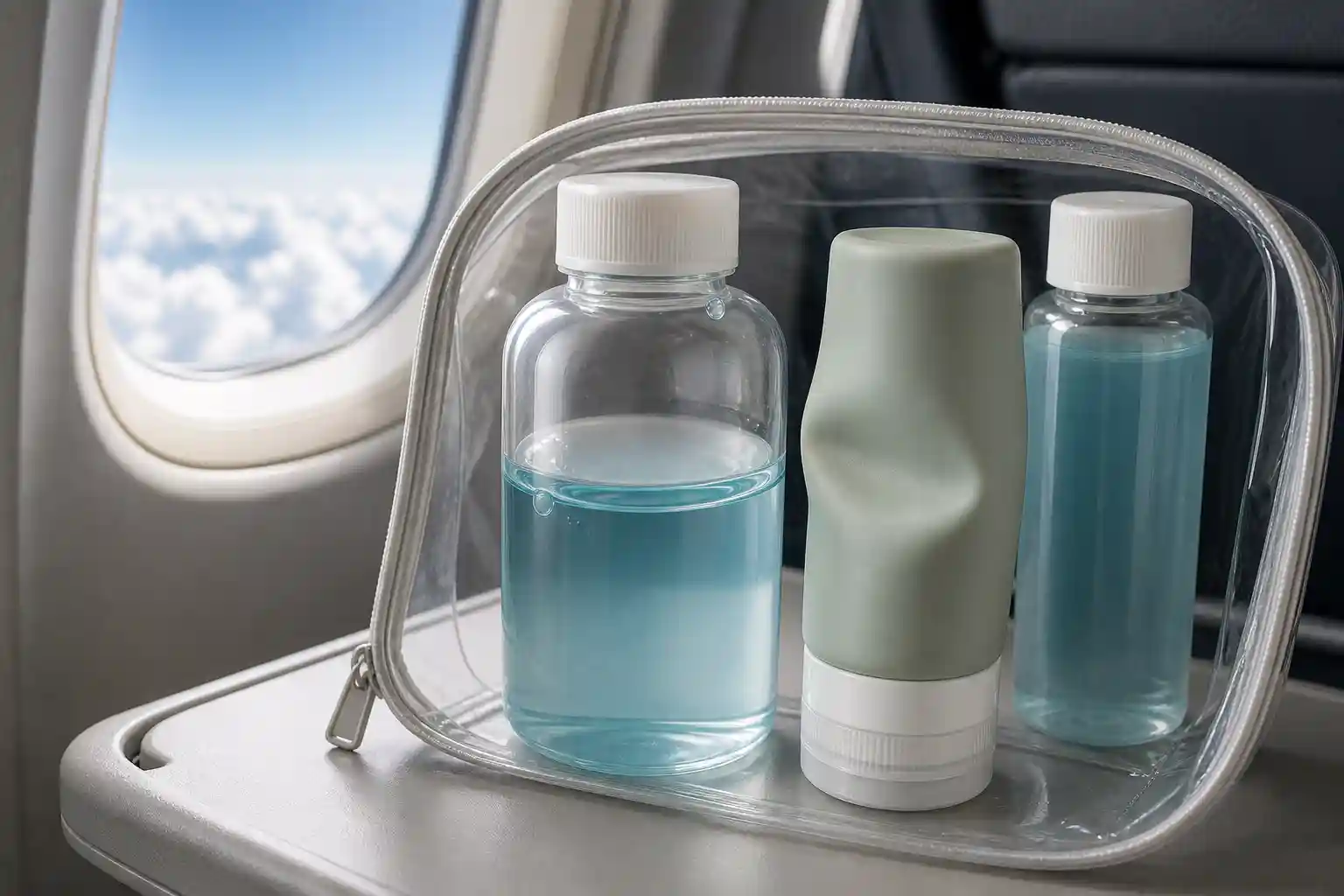
Flexible bottles (silicone, soft squeeze plastic). The walls can bulge outward under internal pressure. A small pocket of trapped, compressed air, created by squeezing air out before sealing, gives the expanding gas room to grow into as the walls flex, rather than forcing it against a full column of liquid with nowhere else to go. This is why the “squeeze the air out, then seal” method is standard advice specifically for soft, flexible bottles, not for rigid ones.
| Bottle type | What actually helps | Why |
|---|---|---|
| Rigid (hard plastic, aluminum) | Fill nearly full, minimal air pocket | Walls can’t expand; less trapped air means less liquid needs to escape to equalize pressure |
| Flexible (silicone, soft plastic) | Squeeze out air before sealing, leave a small compressed pocket | Flexible walls absorb the expansion; a pre-compressed air pocket has room to grow before it pushes on the seal |
| Either type | Tight, fully seated cap; screw-top over flip-top where possible | A loose or partial seal is the actual failure point, not the pressure itself |
Closure type matters as much as fill level
A pressure differential only causes a mess if it has somewhere to escape through. Screw-top closures with a full thread engagement generally hold a tighter seal than flip-top or snap caps, because the compression is distributed evenly around the whole rim rather than concentrated at a single hinge point. A cap that is not seated all the way, even by a partial turn, gives the expanding air a direct path out. We cover fill technique and sealing checks in detail in how to fill a travel bottle.
Material also changes how forgiving a bottle is of a slightly imperfect seal, which is why silicone, plastic and aluminum travel bottles behave differently under the same amount of trapped air.
What this does not fix
Correct fill level and a tight seal address the pressure mechanism. They do not address a bottle that is already degraded: a gasket that has hardened, a thread that is cross-cut, or a cap that no longer seats flush after repeated use. A bottle in that condition will leak at ground level too, pressure or no pressure. If a bottle leaks even when it is filled correctly and sealed tight, the honest answer is that the bottle itself has failed, not that you did something wrong. We walk through the actual replace signals separately, because “buy a new one” is not always the answer either. Sometimes a stuck cap just needs cleaning, which is also where mold under the seal tends to start.
What we have not tested
This is desk research built on a public physics explanation and closure mechanics, not a lab result. We have not flown bottles ourselves, filled and weighed them before and after a flight, or run a pressure chamber test. If you want a source that has done controlled testing of pressure-related leaks specifically, we have not found one that publishes its methodology, which is itself worth knowing before you trust a confident number on this topic.
FAQ
Does altitude alone cause leaks, or does it need heat too?
Pressure change is the primary driver. Temperature swings inside checked baggage can add to it, but a bottle in a climate-controlled cabin that leaks is almost always a pressure and seal issue, not a heat issue.
Will a bottle leak on every flight?
Not necessarily. A bottle filled correctly for its type, with a properly seated cap, may complete many flights without leaking. Leaks tend to show up when fill level, cap seating, or seal condition is already marginal.
Does putting the bottle in a sealed bag actually stop the leak?
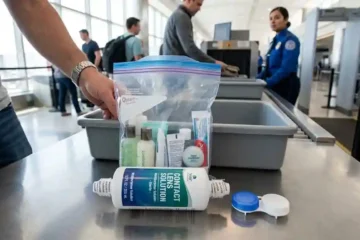
No. A bag contains the mess; it does not change the pressure mechanism. It is still worth doing as a backup, but it is not a fix for the underlying cause.
Do rigid metal water bottles have this problem too?
Less often, because most are not fully sealed airtight and many have a valve rather than a simple screw cap. The mechanism still applies to any fully sealed rigid container.
Is this specific to checked bags versus carry-on?
No. Cabin pressure affects the whole aircraft, so both checked and carry-on bags experience the same pressure drop. Checked-bag temperature swings are a separate, additional factor.
See how PackRefills researches and sources articles like this one on our About page.