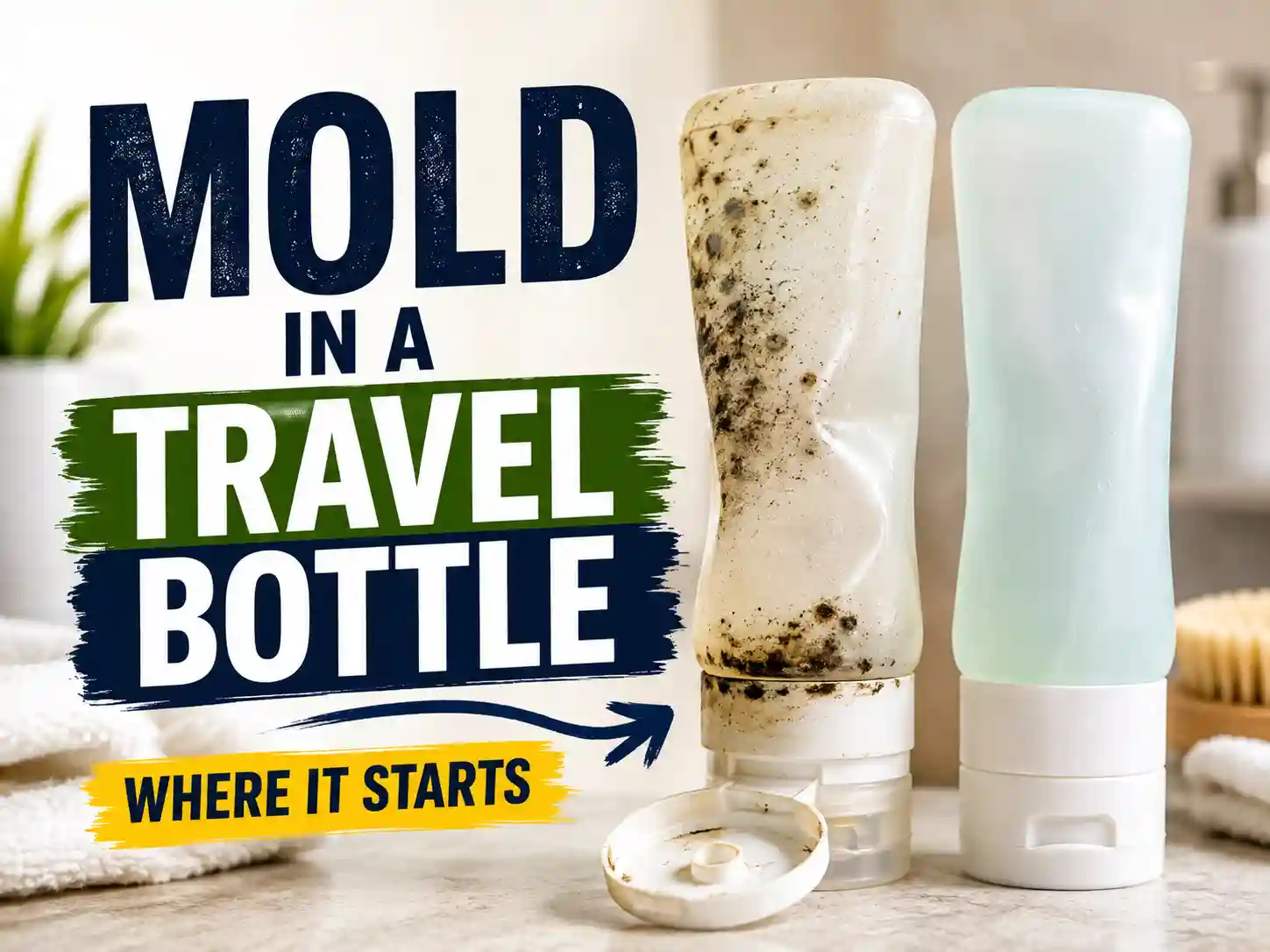
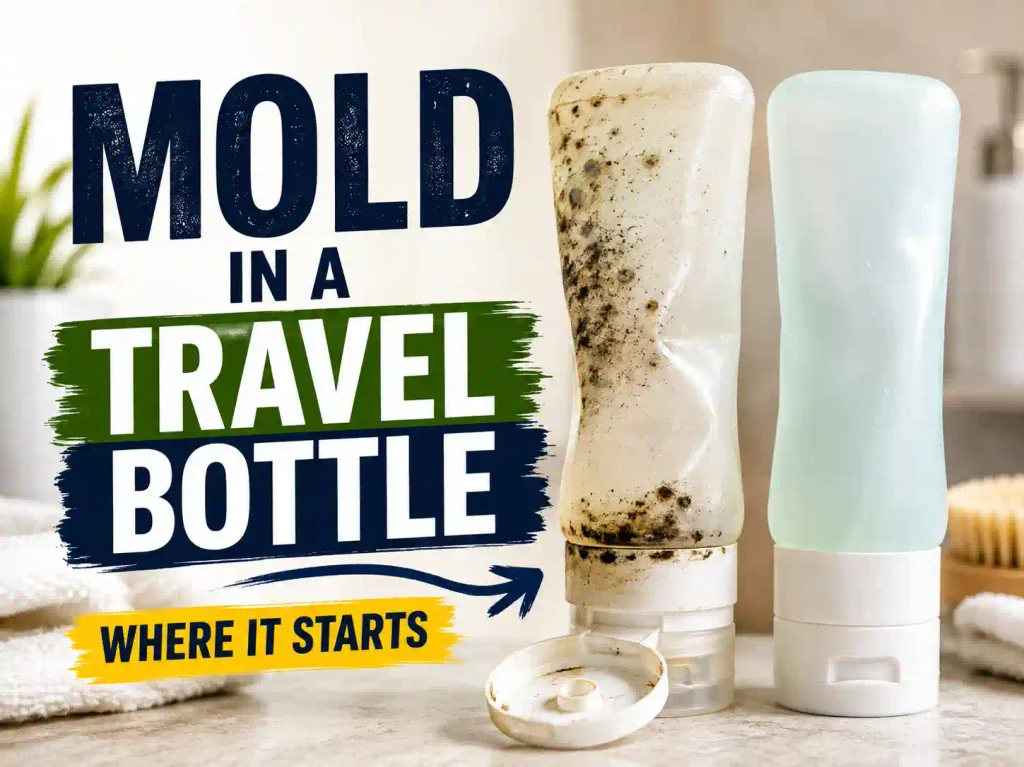
Black or dark specks under the cap of a travel bottle are almost always mold, and it grows there for a simple reason: the space under a cap or gasket stays dark, moist and warm, which is exactly what mold needs. Product residue left behind after a refill gives it something to feed on, and the textured or porous surface of some materials, silicone in particular, gives it somewhere to hold on even after a rinse. This article explains the mechanism and a cleaning routine. It is not medical advice; if you have a health concern about mold exposure, talk to a doctor.
Why it starts under the cap, not in the bottle itself
The main chamber of a travel bottle gets rinsed and dried far more often than the underside of the cap, the threads, or a gasket seal. That gap in cleaning habit is the whole story. Three conditions have to be present for mold to establish itself, and the cap area typically has all three at once:
- Moisture that does not fully dry. A cap that gets screwed back on while still slightly damp traps that moisture against a surface that never sees open air.
- A food source. Product residue, shampoo, lotion, conditioner, left behind in the threads or under a gasket, is organic material mold can feed on.
- A surface it can grip. Smooth, hard plastic is relatively inhospitable. Silicone’s microscopically textured surface, and any rubber gasket, gives mold spores something to anchor to that a quick rinse does not remove.
This is also why the main bottle body can look perfectly clean while the cap tells a different story. They are not the same environment.
The cleaning routine
For routine maintenance, rinse the bottle and cap thoroughly with warm water after each use, and let both dry fully, separated, before you put them away or refill. Fully means air-dried, not wiped and immediately closed.
For visible mold, a general practice recommended for reusable bottles is a soak in a solution of equal parts white vinegar and water, followed by a full rinse and complete air drying. Disassemble every removable piece first, gasket, straw, valve, anything that comes apart, because mold hiding inside an assembled cap will not be reached by soaking the outside alone.
One safety note that matters: never combine bleach and vinegar in the same cleaning session. Mixing the two produces chlorine gas, which is dangerous in an enclosed space like a bathroom. Pick one method and rinse thoroughly before switching to a different cleaning agent, if you switch at all.
After cleaning, store the bottle and cap apart, or with the cap loosely resting rather than screwed tight, until your next trip. A sealed, dry environment does not grow mold; a sealed, slightly damp one does.
What Cleveland Clinic reports about the health side
We are not a medical authority and this is not medical advice. For the health question, Cleveland Clinic (health.clevelandclinic.org) has reported that consuming mold from a contaminated bottle can, in some people, cause digestive irritation, and that mold allergies exist and can trigger reactions in sensitive individuals, along with respiratory symptoms particularly for people with asthma. The same source reports that infections from mold exposure are rare and generally associated with a weakened immune system, not a routine risk for most healthy adults using a normally maintained bottle. If you notice a persistent reaction after using a bottle, or you have a relevant health condition and are unsure whether it matters, that is a question for a clinician, not a travel gear article. See our Disclaimer for how we handle topics like this one.
Which materials show it fastest, and why
Silicone bottles tend to show mold sooner and more stubbornly than smooth hard plastic, for the same porosity reason covered in silicone vs plastic vs aluminum travel bottles. That is not a reason to avoid silicone; it is a reason to dry it more deliberately than you might a plastic bottle, since a quick rinse is less likely to fully clear its surface texture. Bottles with a separate gasket ring, regardless of material, are the single most common place we would expect mold to be missed during a routine wipe-down, simply because the gasket is easy to forget is even removable.
When cleaning is not enough
Mold that returns within days of a thorough cleaning, especially after a full disassembly and soak, usually means the surface it is anchored to has degraded enough to hold onto spores no matter how well you clean it, a worn gasket with visible pitting or a cap that no longer seats flush being the most common culprits. At that point, cleaning the same spot repeatedly is treating a symptom of a bottle that has reached the end of its useful life. We cover the fuller set of replace signals in when a refillable bottle is finished.
The routine that prevents most of this
The single habit that prevents the majority of mold problems in travel bottles: never seal a bottle, or its cap, while any part of it is still wet. Everything else, vinegar soaks, disassembly, gasket checks, matters more once that habit has already been skipped a few times in a row.
What we have not tested
We have not cultured or lab-tested mold from a travel bottle ourselves. The cleaning practice above reflects generally recommended maintenance for reusable bottles, not a controlled experiment we ran, and the health information is Cleveland Clinic’s reporting, cited as such, not our own medical assessment.
FAQ
Is a little mold in a bottle actually dangerous?
Per Cleveland Clinic’s reporting, serious health consequences from mold exposure are uncommon in healthy adults and mostly associated with immune-compromised individuals or existing respiratory conditions like asthma. That is not a reason to ignore visible mold, just a reason not to panic over it.
Does bleach work better than vinegar?
Diluted bleach is sometimes used for stubborn mold in plastic bottles, but never combine it with vinegar in the same session, since the mix produces dangerous chlorine gas. If you are unsure which to use, a thorough vinegar soak followed by complete air drying is the more conservative starting point.
Why does my bottle smell moldy even when I can’t see anything?
Smell without visible mold often means residue or early-stage mold is present in a spot you cannot see directly, most often under a gasket or inside cap threads. Full disassembly for cleaning usually resolves this.
Can I put a bottle with mold in the dishwasher instead?
A hot dishwasher cycle can help for parts that are dishwasher-safe, but check the manufacturer’s guidance first, since heat can degrade some silicone gaskets or plastic components over repeated cycles.
How often should I actually be doing the deep clean, not just a rinse?
A commonly recommended baseline is a deeper clean, full disassembly and soak, on a weekly basis for a bottle in regular rotation, with a quick rinse and full air-dry after every individual use in between.
Read our sourcing standard on About us and our Disclaimer for topics like this one.