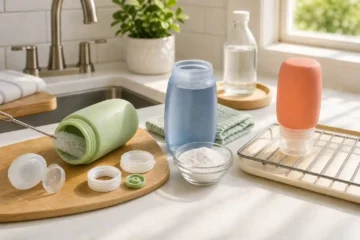
You are standing at a sink with a full-size bottle of conditioner in one hand and a travel bottle in the other, and nothing is moving in either direction. It will not pour in, and once it is in, it will not come out.
The variable is not the material and it is not the size. It is the aperture. How wide the opening is decides both halves of this problem, and once you look at containers that way the answer becomes obvious and the shopping gets much easier.
Why the narrow neck exists at all
A narrow neck is a leak feature. Less opening means less sealing surface to fail, a smaller area for pressure to act on, and a cap that is easier to get right.
For a thin liquid that is a good trade. For a thick one it is a bad trade in both directions.
Filling requires the product to flow through the opening, which thick products will not do under gravity.
Dispensing requires the product to flow back out, which it will not do either, so the last third stays in the bottle. That is the same problem in reverse and it is why people end up throwing away bottles that still have product in them.
So the real choice is between a container optimized for not leaking and one optimized for getting the product in and out, and thick products need the second.
The four shapes that work
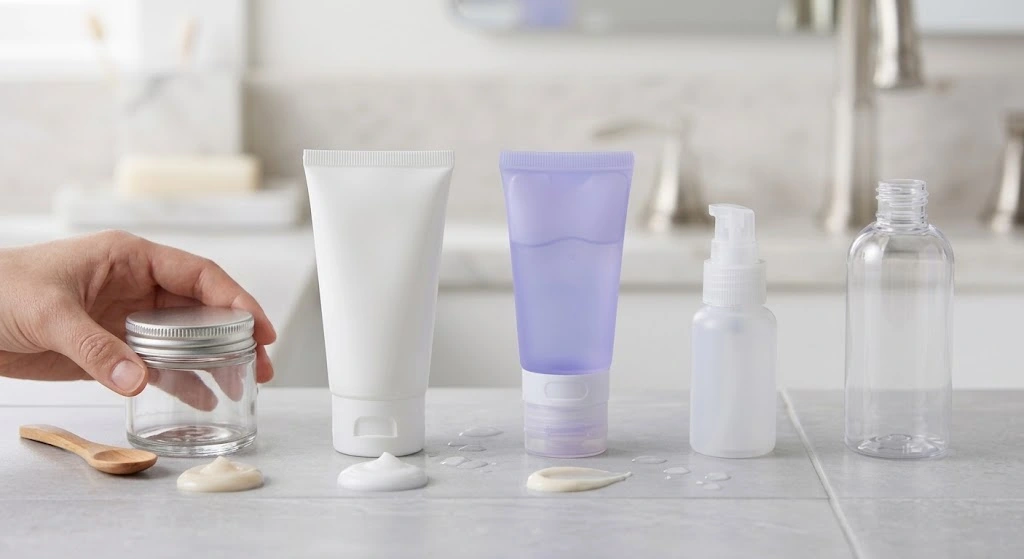
A jar with a screw lid. The widest possible aperture, so filling and dispensing are both trivial: you spoon it in and you scoop it out. The cost is that the seal is a large one and it needs a good lid, and there is a hygiene consideration since fingers go into it repeatedly.
For creams, balms, thick masks and anything you would apply with your hands, this is usually the right answer and it is the one people skip because it looks less like a travel product.
A squeeze tube with a wide neck. The best compromise for conditioner and lotions. Wide enough to fill from the bottom or with a small funnel, and a squeezable body means you are pushing the product out rather than waiting for it to pour.
A flexible silicone tube. The same principle with more give, and the wall does more of the work in getting the last of it out. Which shapes actually empty properly is worth understanding before you buy, and flexible silicone tubes vs rigid bottles is the comparison.
A pump, but only for the right thickness. A pump handles moderately thick products well and very thick ones badly, because the mechanism has to draw the product up a tube. If your product does not run at all, the pump will not either, and you will have a container you cannot open easily to get the rest out.
The general trade-off between closure types, including which ones survive a suitcase, is its own question: why travel bottles leak on a plane covers what actually fails, and it is usually the closure rather than the container.
What does not work
A narrow-necked bottle, for the reasons above. This is the container most travel sets are made of.
A funnel, mostly. Funnels solve filling for thin liquids and they clog with thick ones, and then you have a mess plus a funnel to clean.
Decanting into anything you cannot open again. If your plan for the last third is to cut the container open, plan it now rather than in a hotel bathroom.
Getting it in
Three approaches, and they scale with how thick the product is.
Fill from the bottom. For a squeeze tube with a removable base, or for a tube you fill and then seal. This is the method that makes conditioner practical.
Spoon or spatula it. For a jar, and for anything genuinely paste-like. Unglamorous, fast, and it makes no mess.
Use the full-size pump. If the original bottle has a pump, pump directly into the travel container. This is by far the cleanest method for anything the pump can move, and almost nobody thinks of it.
Warm it slightly, in the sense of running the outside of the original bottle under warm water for a moment. Most products flow better slightly warmed. Do not heat anything, and do not do this to a product whose label says to keep it cool.
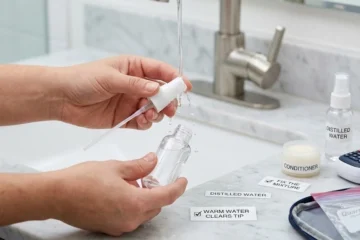
The general routine for refilling, including how to make it take four minutes rather than an evening, is in refilling from full-size bottles.
Getting it out
Squeeze, do not pour. The whole point of a flexible container is that the wall does the work.
Store it cap-down between uses so the product is already at the opening. This is one of the few genuinely universal tips here, and it costs nothing.
Decant less than you think. A container that is 60 percent full is much easier to work with than one that is completely full, and for a short trip you probably need less than you packed. There is also a headspace question at altitude, which is a separate mechanism and is covered in how to fill and close a travel bottle so it survives the flight.
Cut it open at the end, if you use a squeeze tube and there is product left. Slicing the tube gets the last of it, and it costs you a container you were finishing anyway.
Sunscreen, and the thing this page will not tell you
Sunscreen is the thickest thing most people try to decant and it is the one where this article stops giving advice.
Whether decanting sunscreen affects how it performs is a formulation question and this page makes no claim about it. Sunscreens are regulated products, their manufacturers state their own storage requirements, and there is no general answer that covers every formulation.
Read the label of the specific product, and where the label says something about storage, containers or temperature, that is the source. If the label says nothing and you are unsure, buying a small size of the same product is the answer that removes the question entirely.
The same principle applies to any product whose performance matters rather than just its convenience: the label knows, and a general article does not.
The hygiene point
Thick products and wide apertures mean fingers, and fingers mean the container is being reinoculated every time it is opened.
Two practical consequences.
Decant only what you need for the trip, rather than filling a jar you will keep for a year.
Wash and dry the container thoroughly between trips, and check the parts you cannot see. A cap assembly and a fold at the base of a squeeze tube are the two places that stay damp, and both are where trouble starts. Mold in a travel bottle covers what to look for and the rule when you find it, which is that a container is a cheap object.
The short version
- The aperture decides this, not the material and not the size.
- Narrow necks are a leak feature and a thick-product problem in both directions.
- Jars for creams and balms, wide-neck squeeze tubes for conditioner and lotion, flexible tubes for the last third, pumps only for moderately thick products.
- Fill from the bottom, spoon it in, or pump directly from the full-size bottle.
- Store cap-down, decant less than you think, and cut the tube open at the end.
- Sunscreen: no claim is made here. Read the product’s label, or buy a small size.
- Wide apertures mean fingers. Decant per trip and dry the container properly afterward.