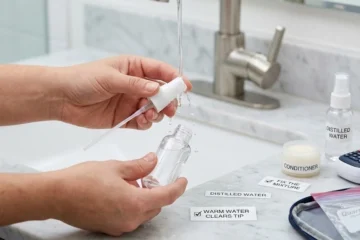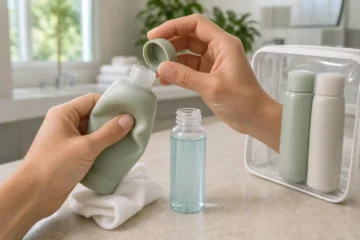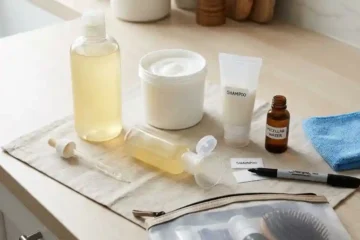
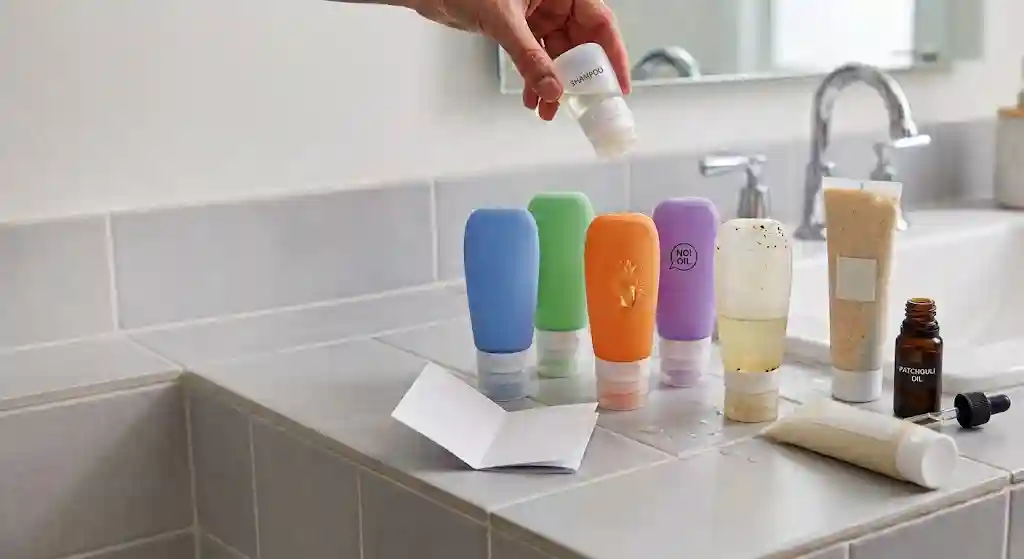
The bottle is squeezable, it does not shatter, and it goes in the wash. So the assumption is that it takes anything, and mostly it does.
The exceptions matter, and they fall into three groups that get muddled together. Some products change the bottle. Some products are changed by the bottle. And some problems people blame on silicone are actually about the cap or the contents rather than the material.
Sorting your particular case into one of the three tells you what to do.
Group one: things that stain or scent the bottle permanently
Silicone is porous in a way rigid plastic is not, which is part of why it feels different and why it squeezes back into shape. The trade is that some things get into the surface and do not come out.
The usual culprits are strongly colored products and strongly fragranced ones. Anything with a deep pigment, anything with a heavy scent, and anything with a high proportion of essential or fragrance oils.
This is a cosmetic problem rather than a safety one, and the reason to care is practical: a bottle that permanently smells of last year’s conditioner is a bottle you cannot reuse for anything else. If you have a favorite bottle you want to keep neutral, it does not get the strongly scented product.
One bottle, one job is the rule that follows, and it is why labeling matters more on a silicone kit than on a clear plastic one. If your bottles are opaque and identical, that decision interacts with which bottles you carry at all, and what actually belongs in a refillable travel bottle kit is the page for that.
Whether a stain or a smell can be got out at all is a cleaning question with a real answer, and how to clean silicone travel bottles and get the smell out covers what actually works and what does not.
Group two: things the manufacturer says no to
This is the group where this page will not give you a list, and it is worth explaining why rather than just declining.
Compatibility between a container material and a product depends on the specific formulation, the specific silicone, and the specific additives, and none of that is knowable from a general article. A category that is fine in one bottle may not be in another.
So the instruction is not a list, it is a habit: read what came with the bottle. Silicone travel bottles are frequently sold with a short statement about what they are and are not intended for, and that statement is written by the people who know what the bottle is made of. If the bottle came with nothing at all, that absence is itself information about the product.
Two categories that come up repeatedly in that guidance and are worth checking for specifically before you decant:
High-alcohol products. Perfumes, some toners, some sanitizers. Whether these are appropriate for a given bottle is a manufacturer question, and it matters enough to check before decanting anything of that kind.
Concentrated oils. Essential oils in particular, which is a group where both the staining problem above and a material-compatibility question can apply at once.
If the manufacturer’s guidance does not mention your product, the honest answer is that you are making a judgment, and a small test with an old bottle is a better way to make it than a full trip.
Group three: the problem is not the material
A large share of what gets blamed on silicone is not about silicone.
Thick products. Conditioner, heavy creams, foundation and thick sunscreen are difficult to get into a narrow-necked bottle and difficult to get out again, and that is a geometry problem rather than a material one. The aperture is the variable, not the wall. Flexible silicone tubes vs rigid bottles covers which shapes actually empty, which is the same variable.
Leaks. If a closed bottle emptied into your bag, the material almost certainly did not fail. The closure, the fill level, or the pressure change did, and those are separate mechanisms with separate fixes. Why travel bottles leak on a plane is the page for that, and the short version is that the thing that failed is rarely the thing people replace.
Anything that has to stay sterile. Contact lens solution is the clearest case, and it is not a silicone question at all: it is a question about whether decanting that particular product is appropriate in any container. Contact lens cases and solution covers it.
Product going bad. Decanting exposes a product to air and to a container that is not the one it was packaged in, and how a particular formulation responds to that is a formulation question. The label on the product is the source, not the bottle.
The one genuine safety line
Everything above is about performance and mess. There is one category that is different in kind.
A bottle with mold in it does not get reused, whatever the material. Silicone bottles are more prone to this than they look, because the cap assembly and the fold at the base are damp, dark and difficult to inspect, and because the bottle is opaque so you cannot see in. Mold in a travel bottle covers where it starts and what to do, and the honest answer for anything you find is that a bottle is a cheap object and your skin is not.
The related question of when a bottle is simply finished, cloudy, sticky, or with a cap that no longer seals, is covered in when a refillable bottle is finished.
Before you decant anything
A short pass that prevents most of this.
- Read the bottle’s own instructions, if it came with any, and note what it does not mention.
- Read the product’s label for anything about storage and containers.
- Assume strongly colored and strongly scented products claim that bottle permanently.
- Check the aperture against the product’s thickness before you commit, not with a full bottle in your hand over a sink.
- Test at home first, filled, closed, and left upside down on a plate for a day. That tells you more about your specific combination than any article can.
- Label it, on the day you fill it, including what it is and roughly when you filled it.
The short version
- Three different problems get called the same thing: the bottle changes, the product changes, or neither and it is the cap.
- Strong colors and strong scents claim a silicone bottle permanently. One bottle, one job.
- No compatibility list appears here. Read the bottle’s own instructions and the product’s label.
- High-alcohol products and concentrated oils are the two worth checking for specifically.
- Thick products and leaks are geometry and closure problems, not material problems.
- Mold is the one genuine line. A bottle is cheap.