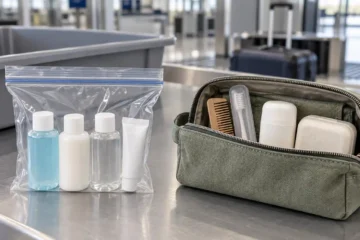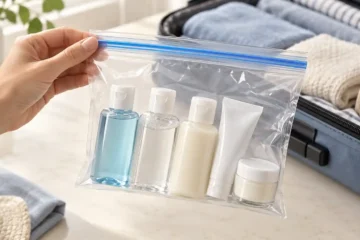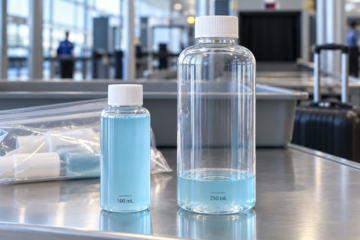
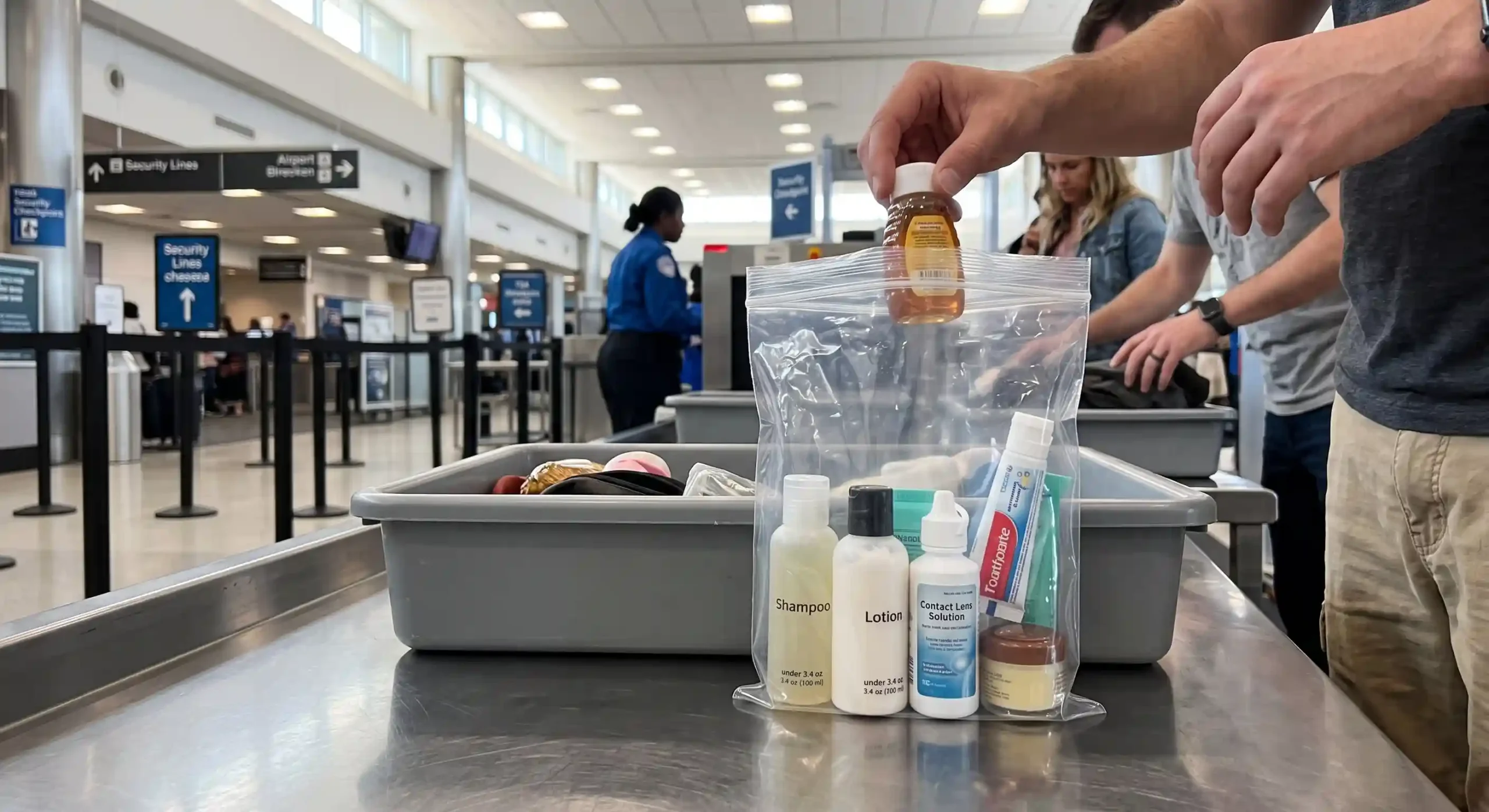
TSA does not screen by the word liquid. Its published rule covers liquids, aerosols, gels, creams and pastes, so the question at a US checkpoint is not whether something pours, it is whether it sprays, spreads, squeezes or gels. That is why peanut butter, mascara, honey, yogurt and creamy cheese are all capped at 3.4 ounces (100 ml) per container on TSA’s own item pages, while solid deodorant, lipstick, chapstick and a block of hard cheese are listed with no size limit at all. If you can spread it, assume it is in.
Last checked: 2 September 2026. Every rule below was read on tsa.gov on that date and is stated as at the time of writing. Screening rules change without notice. Open tsa.gov again before you fly.
Two Things That Come Before Any List
These are TSA’s rules, and TSA screens airports in the United States. They do not govern your departure from Heathrow, Narita, Dubai or Toronto. Other countries set their own container limits, their own bag rules and their own exemptions, and the item lists genuinely differ. If any leg of your trip departs from outside the US, read the rule published by that airport’s own screening authority for that leg. Clearing a US checkpoint on the way out tells you nothing about the way back.
And the published rule is not the last word. TSA prints a standing line on its item pages: “The final decision rests with the TSA officer on whether an item is allowed through the checkpoint.” That sentence appears on the peanut butter page, the mascara page, the lipstick page and the snow globe page, checked 2 September 2026. It means an item listed as allowed can still be refused. It also means the answer you got in Denver last month is not a rule you can quote in Atlanta. Pack so you would not mind losing an argument.
What Does TSA Consider a Liquid, in TSA’s Own Words
TSA’s liquids rule page states: “You are allowed to bring a quart-sized bag of liquids, aerosols, gels, creams and pastes in your carry-on bag and through the checkpoint,” with containers “3.4 ounces (100 milliliters) or less per item.” Its plain-language FAQ version of the same rule says: “Each passenger may carry liquids, gels and aerosols in travel-size containers that are 3.4 ounces or 100 milliliters. Each passenger is limited to one quart-size bag of liquids, gels and aerosols.” Both read 2 September 2026.
Five words do the work: liquid, aerosol, gel, cream, paste. TSA’s FAQ names the everyday cases directly, listing “toothpaste, shampoo, conditioner, mouthwash and lotion” as items that must comply. Toothpaste is the tell. Nobody thinks of a tube as a liquid, and TSA does not care, because paste is on the list.
The liquids rule page adds one more sentence worth holding on to: “Any liquid, aerosol, gel, cream or paste that alarms during screening will require additional screening.” Being under the size limit is not the same as being waved through.
Our read of the 3-1-1 rule itself covers the three numbers and what each one constrains. This page is only about which items fall inside them.
The Food That Counts as a Liquid
This is where the category surprises people, because none of these pour.
| Item | TSA carry-on ruling, read 2 September 2026 | Checked |
|---|---|---|
| Peanut butter | Yes, less than or equal to 3.4 oz / 100 ml | Yes |
| Honey | Yes, less than or equal to 3.4 oz / 100 ml | Yes |
| Yogurt | Yes, less than or equal to 3.4 oz / 100 ml | Yes |
| Creamy cheese | Yes, less than or equal to 3.4 oz / 100 ml | Yes |
| Solid cheese | Yes, no size limit stated | Yes |
The line runs through texture, not through the food aisle. Cheese has two item pages on tsa.gov and they give opposite answers: solid cheese is listed as a plain yes, creamy cheese is capped. A jar of peanut butter is a paste, so the jar is the problem, not the peanuts.
TSA also flags a second issue on the yogurt and cheese pages that has nothing to do with the liquids rule. Officers may ask you to separate foods and powders from your carry-on bag because they clutter the image on the X-ray. That is a screening convenience, not a prohibition, and it is the reason food often comes out of the bag even when it is well under the limit.
The Cosmetics Where the Format Decides Everything
Two products can do the same job on your face and land on opposite sides of the rule.
| Item | TSA carry-on ruling, read 2 September 2026 |
|---|---|
| Mascara | Yes, less than or equal to 3.4 oz / 100 ml |
| Lipstick | Yes, no size limit stated |
| Chapstick | Yes, no size limit stated |
| Solid deodorant | Yes, no size limit stated |
| Liquid or roll-on deodorant | Yes, less than or equal to 3.4 oz / 100 ml |
| Aerosol deodorant | Yes, less than or equal to 3.4 oz / 100 ml |
| Aerosol dry shampoo | Yes, less than or equal to 3.4 oz / 100 ml |
Deodorant is the cleanest example in the whole category. The same product in three formats gets three different treatments, and the only variable is what it does when you push on it. A stick is a solid. A roll-on is a liquid. A spray is an aerosol.
Both aerosol pages carry an extra instruction: “Permitted aerosol release devices (button/nozzle) must be protected by caps or other suitable means to prevent accidental release.” That is a physical requirement about the cap rather than a size one, and TSA prints it as the standing special instruction on those item pages.
The practical consequence for packing is that switching format is the only legitimate way to shrink your liquids load. A stick antiperspirant and a bar of soap do not compete for space in the quart bag; their liquid equivalents do. Decanting has limits as well, and thick products behave badly in the wrong container, which is a separate problem we cover in the piece on what actually fits into travel-size bottles and in the notes on squeezable silicone tubes for pastes and thick creams.
The Ones That Are Liquids for Reasons You Would Not Guess
Snow globes. TSA’s snow globe page states that a snow globe of 3.4 ounces or less is permitted in carry-on if it fits entirely, base included, inside the single quart-size resealable bag. Anything larger goes in checked baggage. The base is the part that catches people, because the glass may look small and the assembly does not fit.
Contact lens solution. It is a liquid with no special carry-on status, which is why a small bottle is the standard answer and why it is worth planning before departure rather than at the gate. We go through the sizes and the refill question in the piece on carrying contact lens solution.
Alcohol. TSA lists alcoholic beverages as carry-on permitted at 3.4 ounces or less, which is why miniatures pass and a bought bottle does not. Its list also shows alcoholic beverages over 140 proof as a no in carry-on and a no in checked baggage. For checked bags, TSA states that drinks between 24 percent and 70 percent alcohol are limited to 5 liters per passenger in unopened retail packaging, and that drinks at 24 percent or less carry no quantity restriction. This is the case where the checked bag has a rule of its own, and it is easy to miss.
Anything frozen. TSA’s ice and gel ice pack pages both state: “Frozen liquid items are allowed through the checkpoint as long as they are frozen solid when presented for screening.” If the item is partly melted or slushy, or there is liquid pooled at the bottom, it goes back under the 3.4 ounce rule. So the state of the item at the moment it reaches the belt is what decides it, not the state it left your freezer in.
Powders Are Not Liquids, and They Still Have a Threshold
This is the most common wrong assumption in the opposite direction. Powder is not on TSA’s list of liquids, aerosols, gels, creams and pastes, so powder foundation, protein powder and baby powder do not go in the quart bag. They have their own handling.
TSA’s powders FAQ, read 2 September 2026, states that “Powder-like substances over 12 oz. or 350mL in carry-on that cannot be resolved at the central checkpoint will not be allowed onto the cabin of the aircraft and will be disposed of,” and recommends putting powders in checked baggage.
We are going to be honest about one thing on that page rather than tidy it up. The same FAQ frames its additional-screening sentence around passengers “traveling from an international last-point-of-departure to the U.S.”, while the 12 ounce disposal sentence is written without that qualifier. Whether the threshold is meant to apply identically to a purely domestic departure is not stated plainly on the page we read. We are not resolving it for you. If you are carrying a large powder domestically, the safe reading is the strict one.
Where TSA’s Own Wording Runs Out
TSA publishes categories and per-item answers. It does not publish a definition of liquid, and it does not publish a test for the point at which a soft solid becomes a paste. That gap is real, and every page that claims to give you a clean rule for it is filling it in on its own authority.
Three specific places we could not get a published answer, checked 2 September 2026:
- Why lipstick is unrestricted and mascara is not. Both are cosmetics applied with a wand or a stick, both are listed on tsa.gov, and the rulings differ. TSA does not explain the boundary, so do not extrapolate from lipstick to liquid lipstick, gel liner or cream blush. Look each one up.
- What “reasonable quantities” means for medically necessary liquids. TSA uses that phrase and publishes no ounce figure behind it.
- Products that sit between two TSA categories. A solid-looking balm in a tub, a cleansing stick, a shampoo bar that has started to soften: there is no item page for the in-between version, and the item pages answer by product name rather than by consistency.
Where TSA has not written it down, the officer’s discretion is the operative rule, not a loophole in it. Our disclaimer sets out what any page here can and cannot tell you about a rule somebody else enforces.
The Exemptions, and What They Actually Require
Three groups of liquids sit outside the container limit, and each one comes with a procedure rather than a free pass.
Medically necessary liquids. TSA states that it “allows larger amounts of medically necessary liquids, gels, and aerosols in reasonable quantities for your trip” and that you must “declare them to TSA officers at the checkpoint for inspection.” Its gel ice pack page adds that “Medically necessary gel ice packs in reasonable quantities are allowed regardless of their physical state of matter (e.g., melted or slushy) with or without the presence of breast milk.” What you need to carry, and how much of it, is a question for your prescriber or pharmacist, not for a packing site. For screening questions specific to a condition or a device, TSA runs TSA Cares, and your airline sets its own rules for what may be used onboard.
Formula, breast milk and juice. TSA’s page on this states that “Formula, breast milk, juice in quantities greater than 3.4 ounces or 100 milliliters are allowed in carry-on baggage and do not need to fit within a quart-sized bag,” and that “You do not need to travel with your child to bring breast milk.” The published procedure is to “Remove these items from your carry-on bag to be screened separately from the rest of your belongings.” TSA also lists cooling accessories, gel or liquid-filled teethers, and canned, jarred and processed baby food as permitted in carry-on, with additional screening possible.
Duty free. TSA’s liquids rule page describes an exception for duty-free liquids over 3.4 ounces bought internationally and carried into the US on a connecting flight, subject to conditions: the retailer must have sealed them in a transparent, secure, tamper-evident bag, the bag must show no sign of tampering, the original receipt must be present, and the purchase must have been made within 48 hours. TSA also notes that any item that alarms or cannot be screened will not be permitted in the carry-on bag, and it recommends putting large liquids in checked baggage regardless.
Settling One Item in Two Minutes
TSA maintains a searchable What Can I Bring? tool at tsa.gov giving a per-item answer for carry-on and checked baggage, and it is the source every table on this page was built from. It also runs AskTSA, a public help channel for questions the item list does not answer. Between them they beat any packing forum, including this page, on the only thing that matters: they are the body that will be standing at the checkpoint.
How We Checked This
We have not flown with any of this, tested anything or run anything through a checkpoint. This page is desk research from TSA’s own pages, read directly on 2 September 2026, which is the standard described on our about page. Every ruling in the tables above came from the item page for that item on tsa.gov, and the quoted sentences are TSA’s wording, not ours.
Two limits are worth stating. Item rulings are updated by TSA without announcement, so a table is a snapshot and this one is dated for that reason. And this page deliberately contains no advice on getting anything past a checkpoint, because the officer decides and there is nothing useful to say about that beyond packing so it does not matter.
FAQ
Is peanut butter a liquid according to TSA?
For screening purposes, yes. TSA’s peanut butter page lists it as permitted in carry-on at 3.4 ounces or 100 ml or less, the same treatment as shampoo, because TSA’s rule covers pastes as well as liquids. Full-size jars go in checked baggage, where the page lists it as a plain yes. Read 2 September 2026.
Does deodorant count as a liquid?
It depends on the format. TSA lists solid deodorant as permitted with no size limit stated, while liquid, roll-on and aerosol deodorant are all capped at 3.4 ounces or 100 ml in carry-on. Aerosol cans additionally need the nozzle protected against accidental release. Read 2 September 2026.
Is mascara a liquid but lipstick is not?
That is how TSA’s item pages read. Mascara is listed as permitted in carry-on at 3.4 ounces or 100 ml or less. Lipsticks and chapsticks are listed as permitted with no size limit stated. TSA does not publish the reasoning, so we would not extrapolate from either one to a cosmetic that is not on the list. Check the individual item on tsa.gov.
Are powders subject to the liquids rule?
No. Powder is not among the liquids, aerosols, gels, creams and pastes the rule covers, so powders do not belong in the quart bag. TSA’s powders FAQ does set a separate 12 ounce or 350 ml threshold above which a powder that cannot be resolved at the checkpoint will not be allowed into the cabin, and recommends packing powders in checked baggage.
Do these rules apply outside the United States?
No. These are TSA rules for US airports. Other countries set their own limits, bag requirements and exemptions through their own screening authorities, and the item-by-item answers are not the same. Check the published rule for each departure airport on your itinerary, including the return leg, and pack to the strictest one on the trip.