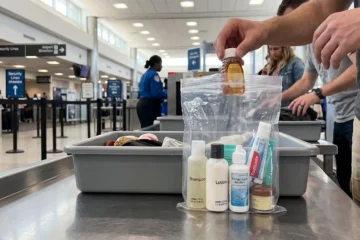
TSA's liquids rule is written against the container, not against what is left inside it. The rule page states the limit as "3.4 ounces (100 milliliters) or less per item", read on 7 September 2026, and nothing on TSA's liquids pages refers to fill level, remaining volume, or how much you can see through the plastic. A 6 ounce bottle with a splash of conditioner in the bottom is still a 6 ounce bottle. That is the whole mechanism, and it is why this is the single most expensive misreading of the 3-1-1 rule.
Last checked: 7 September 2026. These are Transportation Security Administration rules and they apply to airports in the United States. Other countries' screening authorities set their own limits. Rules change without notice, so open tsa.gov before you fly.
What TSA's Wording Actually Constrains
Read the three published statements side by side and notice what none of them mentions.
| TSA page, read 7 September 2026 | The limit as written |
|---|---|
| Liquids, Aerosols, and Gels Rule | "3.4 ounces (100 milliliters) or less per item" |
| FAQ, What is the 3-1-1 liquids rule? | "travel-size containers that are 3.4 ounces or 100 milliliters" |
| Travel Checklist | "3.4 ounces or less per container" |
Per item. Travel-size containers. Per container. Three phrasings, one object, and in none of them is the quantity of product a variable. There is no clause about a bottle being mostly used up, because the thing being measured is the vessel.
That cuts both ways, which is the part worth holding on to. A completely full 3 ounce bottle is inside the limit. A nearly empty 8 ounce one is not. Our fuller read of the 3-1-1 rule and what each number limits covers the other two digits, the bag and the one-per-passenger allowance.
Why the Rule Is Built That Way
TSA does not publish a rationale on the liquids pages we read, so this is mechanism rather than agency reasoning, and we will label it as such.
A printed capacity is a fact an officer can establish in under a second, from across a bin, on a bottle that is upside down in a bag. A remaining volume is not. It would have to be estimated through tinted plastic, on a container of unknown shape, with the liquid moving, at the pace a checkpoint runs. A rule that depended on that judgment would be slower and less consistent than one that depended on a number molded into the plastic.
So the marked capacity is doing a job that fill level cannot do, and that is true whether or not you find it fair.
The 3.4 Is a Rounding, and the Margin Is Not Yours to Split
The international baseline is 100 milliliters. In US customary units that is about 3.38 fluid ounces, which TSA rounds up and publishes as 3.4 ounces.
Two consequences follow. A container marked 3.4 oz and one marked 100 ml are the same container in two units, and both are inside the limit as TSA publishes it. And a container marked 4 oz is over by roughly 18 percent, which is not a rounding question and is not going to be treated as one.
Our size-by-size breakdown of what 1 oz, 2 oz, 3 oz and 3.4 oz containers actually hold sets out how much product each one carries for a trip of a given length, which is the calculation people are usually trying to avoid making when they hope the half-empty bottle will do.
The Unmarked Bottle Is the Underrated Problem
Here is the case nobody writes about, and it is more common than the oversized bottle.
If the rule is read off the container, a container with no readable capacity gives the officer nothing to read. Plenty of refillable travel bottles ship with no molded figure at all, or with a number printed in ink on a label that comes off in a wash bag after two trips, or in milliliters so small it is not legible under checkpoint lighting.
At that point the size of the bottle becomes a judgment rather than a fact, and judgments are slower and less predictable than facts. The fix is unglamorous and free: keep containers that carry their own capacity marking, and treat legibility as a feature rather than a detail. Our notes on filling travel bottles without losing half the product cover the decanting side of the same trip, including why thick products behave badly in narrow-necked containers.
We are not going to tell you to write a number on an unmarked bottle yourself. A figure you wrote is not evidence of anything, and putting it there does not make it true.
What Happens After the Bag Is Pulled
This is the second-order question, and the honest answer is that most of it is not published.
What TSA does publish: its liquids rule page directs items over 3.4 ounces or 100 milliliters to checked baggage, and states that "any liquid, aerosol, gel, cream or paste that alarms during screening will require additional screening." Being under the size limit and being cleared are two different things, and both pages say so.
What TSA also publishes, as a standing sentence on its item pages: "The final decision rests with the TSA officer on whether an item is allowed through the checkpoint." We read that line on the liquid medications page, the pills page and the breast milk page on 7 September 2026.
So this page will not tell you that a bottle will be allowed, and it will not tell you one will be taken. It tells you what the published rule addresses. The person at the belt applies it.
The Story You Will Hear, and Why We Will Not Build on It
Somebody will tell you they flew with a full-size bottle last month and nothing happened. That may well be true. Checkpoints differ in equipment and in traffic, and an outcome is not a rule.
What it is not is something you can plan around, because the cost is asymmetric. If the story holds, you saved yourself a two minute decant. If it does not, you lose the product, and if it happens at the front of a queue at 6 a.m., you lose time you did not budget. There is no version of this where relying on the exception pays for the risk.
This site does not write checkpoint workarounds. Not because we are cautious about the topic, but because the genre is written by people with nothing at stake and read by people with a flight to catch.
When the Container Limit Does Not Apply
Two groups of liquids sit outside the container rule on TSA's own pages, and both come with a procedure rather than a free pass.
Medically necessary liquids. TSA's liquid medications page states that it "allows larger amounts of medically necessary liquids, gels, and aerosols in reasonable quantities for your trip, but you must declare them to TSA officers at the checkpoint for inspection." It publishes no ounce figure for reasonable. What you carry and how much of it is a question for your prescriber or pharmacist, not for a packing site.
Formula, breast milk, toddler drinks and baby food. TSA states these are allowed in quantities greater than 3.4 ounces and do not need to fit within a quart-sized bag, with the items removed from the carry-on for separate screening.
Neither exemption turns on fill level either. They turn on what the liquid is and on telling the officer about it.
Which Products the Rule Even Catches
The container limit only bites if the contents are inside TSA's category, and that category is wider than the word liquid suggests: liquids, aerosols, gels, creams and pastes. Toothpaste is the one that surprises people, because nobody thinks of a tube as a liquid and TSA's own 3-1-1 FAQ names it directly.
Switching format is the only legitimate way to shrink the problem, and our read of what TSA counts as a liquid works through the items where the format decides the answer. A bar and a stick do not compete for space in the quart bag. Their liquid equivalents do.
Outside the United States
3-1-1 is TSA's rule for US airports. Your return leg is screened by that country's authority, under its own limit, in its own units.
The container-not-contents principle is common internationally, but the container limit, the bag specification and the exemptions are set separately in each jurisdiction. Read the hand baggage page published by each departure airport's own authority, for every leg including connections, and pack to the strictest rule on the trip.
How We Checked This
We have not flown with any of this, tested anything or run anything through a checkpoint. This page is desk research from TSA's own pages, read on 7 September 2026, and the quoted sentences are TSA's wording.
What we left out: any figure for what "reasonable quantities" means, because TSA publishes none, and any statement about how often an oversized bottle is refused, because TSA does not publish that and nobody else is in a position to know it.
FAQ
Will TSA take a half empty bottle that is over 3.4 oz?
The published rule addresses the container, not what is left in it, so a half empty 6 ounce bottle is treated as a 6 ounce bottle. We will not tell you what will happen at your checkpoint, because TSA states that the final decision rests with the officer. What we can say is that the rule as written does not help you here.
Does TSA measure how much liquid is in the bottle?
Nothing on TSA's liquids rule page, its 3-1-1 FAQ or its Travel Checklist refers to fill level. All three state the limit per item or per container, read 7 September 2026.
Is a 4 oz bottle close enough to 3.4 oz?
No. 3.4 ounces is TSA's rounding of 100 milliliters, which is about 3.38 fluid ounces. A 4 ounce container is meaningfully over that, not within a rounding margin.
What if my travel bottle has no size printed on it?
Then the size cannot be read off it, and what happens next is a judgment rather than a fact. Containers that carry a legible molded or printed capacity make the check quicker. Writing a number on the bottle yourself is not evidence of its capacity.
Can I pour the rest into a smaller bottle at the airport?
That is a decanting question rather than a rules question, and TSA does not address it. What TSA does state is that oversized liquids belong in checked baggage. Doing this at home, unhurried, with a funnel, is a different experience from doing it in a queue.