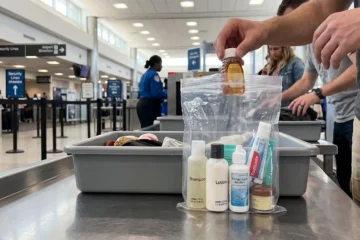
TSA's liquid medications page states that it "allows larger amounts of medically necessary liquids, gels, and aerosols in reasonable quantities for your trip, but you must declare them to TSA officers at the checkpoint for inspection", read on 7 September 2026. So a liquid medication over 3.4 ounces is not automatically a problem, and it is not automatically fine either: the exemption comes attached to a procedure, and the procedure is that you tell an officer before screening starts and present the items separately. TSA publishes no ounce figure for "reasonable quantities."
This page describes a screening procedure. It is not medical advice. What medication you need, how much of it, and how it should be stored and carried are questions for your prescribing clinician and your pharmacist. Nothing here is a reason to change anything about a medicine.
Last checked: 7 September 2026. These are Transportation Security Administration rules for airports in the United States. Other countries' screening authorities, and the customs and import rules of your destination, are separate and are not covered here. Rules change without notice, so open tsa.gov before you fly.
What TSA Publishes, Page by Page
TSA states this in more than one place, and the wording is not identical everywhere. Here is what we read.
| TSA page, read 7 September 2026 | Carry-on ruling | Instruction given |
|---|---|---|
| Medications (Liquid), What Can I Bring | "Yes (Special Instructions)" | Larger amounts of medically necessary liquids allowed in reasonable quantities; must be declared to officers at the checkpoint for inspection |
| Liquid Medications, What Can I Bring | "Yes (Less than or equal to 3.4oz/100 ml allowed)" | The same special instruction about larger medically necessary amounts |
| TSA Cares, Disabilities and Medical Conditions | Not stated as a ruling | "Before the screening begins, inform the TSA officer that you have medically necessary liquids and/or medications. Place them in a bin or bowl separate from other property." |
The two item pages are worth noticing. They carry different summary labels for the same category, and both carry the same special instruction underneath. The label that says 3.4 ounces or less is the ordinary liquids rule; the special instruction is the exemption sitting on top of it. Both pages also carry TSA's standing sentence: "The final decision rests with the TSA officer on whether an item is allowed through the checkpoint."
If you want the ordinary rule that these liquids are being excused from, our read of the 3-1-1 rule and what each number limits sets it out.
What "Declare" Means in Practice
Declaring is not a form and not a queue. Per TSA's guidance for travelers with disabilities and medical conditions, read 7 September 2026, it is two actions, both taken before anything goes into the X-ray tunnel.
- Tell the officer at the start of screening that you have medically necessary liquids or medications.
- Separate them from your other property, into a bin or bowl of their own.
The order matters. TSA's traveling with children page, which covers the equivalent procedure for infant liquids, notes that if you do not want items X-rayed or opened you should notify the officer, and that additional steps follow. A request made after your bag is on the belt is a request made too late.
TSA also states that officers may test liquids, gels or aerosols for explosives or concealed prohibited items, and that where a container cannot be cleared by the screening technology you may be asked to open it. Those are published expectations, not worst cases.
"Reasonable Quantities" Has No Published Number
This is the question every reader arrives with, and TSA does not answer it.
The phrase TSA uses is "reasonable quantities for your trip." We looked across the liquid medication item pages and the TSA Cares medical guidance on 7 September 2026 and found no ounce limit, no milliliter limit, no per-day figure and no formula. Every article that gives you one has supplied it themselves.
We are not going to supply one either, and the reason is not caution. A number invented here would be quoted back at a checkpoint by somebody whose medication depends on it. How much of a medicine you travel with is a clinical question for your prescriber or pharmacist, and the amount that is right for your trip is the amount they arrive at, not a figure a packing site rounded off.
Labeling, Prescription Bottles and the Question We Will Not Answer
TSA's guidance recommends rather than requires. Its medical screening guidance states that it is recommended that medication be clearly labeled to facilitate the screening process. Its own travel tip page on packing medicine puts the boundary plainly: "TSA does not require passengers to pack medicine in prescription bottles; however certain state laws are in place regarding the labeling of prescription medicine, which require passengers to comply."
Read that sentence carefully, because it contains two different authorities. TSA is not requiring the original container. Individual states may be, under their own law, and TSA is pointing you at them rather than overriding them.
There is a related question this site is not going to answer at all: whether to move a liquid medicine out of its dispensed container into a smaller travel bottle. That is not a packing decision. It touches the label, the expiry, the storage conditions the product was dispensed under, and in some jurisdictions the legal status of the medicine in your hand. Ask the pharmacist who dispensed it, and ask the clinician who prescribed it. They can answer it for your specific medicine. We cannot, and we would be guessing on the only part that matters.
Cooling, Ice Packs and Things That Keep Medicine Cold
TSA's gel ice packs page, read 7 September 2026, gives frozen items a general rule and medical items an exception.
The general rule is that frozen items are allowed through the checkpoint if they are frozen solid when presented for screening, and that a partially melted or slushy item falls back under the 3-1-1 liquids rule. The exception is stated directly: "medically necessary gel ice packs in reasonable quantities are allowed regardless of their physical state of matter (e.g., melted or slushy) with or without the presence of breast milk." The page also says to notify officers so the medical ice packs can be inspected.
The same declaration procedure applies. The cooling accessory is part of what you are telling the officer about, not a separate thing you hope nobody notices.
Three Authorities, and TSA Is Only One of Them
This is the gap that costs people the most, because clearing the checkpoint is not the same as being allowed to use, carry or import something.
| Who decides | What they decide |
|---|---|
| TSA | Whether an item passes the security checkpoint at a US airport |
| Your airline | What may be used, stored or powered in the cabin during the flight, under its own conditions of carriage |
| The destination country | Whether a medicine may lawfully be brought in, and under what documentation |
TSA's pages describe screening. They do not speak for an airline's cabin rules and they do not speak for another country's border. If any of those three is in doubt for your medicine, ask that body directly rather than reading across from this one.
The Officer Decides, and No Page Can Promise You Otherwise
TSA prints the same sentence on the liquid medications page, the pills page and the breast milk page: "The final decision rests with the TSA officer on whether an item is allowed through the checkpoint."
That is not a disclaimer TSA added to protect itself. It is the operative rule. The published guidance tells you what to expect and what is expected of you. It does not tell you the outcome, and neither does this article.
What the published material does support is that the declaration is the part under your control. Items announced at the start of screening and presented separately are being handled the way TSA's own guidance describes. That is the whole of the advice this site is willing to give.
If You Want Help Before You Travel
TSA runs TSA Cares, which its page describes as providing information on security procedures to help passengers with disabilities, medical conditions and individuals needing additional assistance prepare for screening. The published contact number is (866) 289-9673, with hours listed as weekdays 8 a.m. to 11 p.m. ET and weekends and holidays 9 a.m. to 8 p.m. ET, read 7 September 2026. TSA also offers a request form for TSA Cares assistance on the same page.
That is the right channel for a question about a specific device, a specific medicine or a specific need at the checkpoint. It is a better use of ten minutes than any packing article, this one included.
What Still Goes in the Quart Bag
The exemption is narrow. It covers medically necessary liquids, gels and aerosols. It does not turn your whole wash bag into a medical exemption, so the shampoo, the toothpaste and the moisturizer are still ordinary liquids under the 3.4 ounce container rule.
Two things are worth checking on that side. Which of your products count as liquids at all is wider than the word suggests, and our read of what TSA counts as a liquid works through the gels, creams and pastes that catch people. And contact lens solution is a case people assume is medical and TSA lists as an ordinary liquid, which we cover in the piece on carrying contact lens solution. If you are sizing the rest of the bag around a bulky medical item, what each travel bottle size actually holds is the calculation to run at home.
How We Checked This
We have not flown with any of this, tested anything or run anything through a checkpoint. This page is desk research from TSA's own pages, read on 7 September 2026, and the quoted sentences are TSA's wording rather than ours.
What we deliberately left out: any figure for reasonable quantities, because TSA publishes none; any statement about whether a specific medicine may be repackaged, because that is a clinical and legal question for a pharmacist; and any list of which states require original prescription labeling, because TSA points at state law without enumerating it and we have not verified any state's statute ourselves.
FAQ
Can I bring liquid medication over 3.4 oz in my carry-on?
TSA's liquid medications page states that larger amounts of medically necessary liquids, gels and aerosols are allowed in reasonable quantities for your trip, and that you must declare them to officers at the checkpoint for inspection. It publishes no ounce figure. The final decision rests with the TSA officer.
How do I declare medication at a TSA checkpoint?
TSA's guidance for travelers with disabilities and medical conditions says to inform the officer before screening begins and to place the items in a bin or bowl separate from other property. Read 7 September 2026.
Does medication have to be in the original prescription bottle?
TSA's own travel tip page states that TSA does not require passengers to pack medicine in prescription bottles, and that certain state laws are in place regarding the labeling of prescription medicine which passengers must comply with. Whether a particular medicine should stay in its dispensed container is a question for your pharmacist.
Will my medication be X-rayed?
TSA states that its X-ray machines are not harmful to food or medicines, and that if you do not want items X-rayed or opened you should notify the officer, after which additional screening steps are taken. Officers may also test liquids for explosives or concealed prohibited items.
Do TSA's rules cover my flight home from another country?
No. TSA screens airports in the United States. Other countries set their own screening rules, and separately their own rules on importing medicines. Check the authority for each departure airport on your itinerary and the entry requirements for your destination.