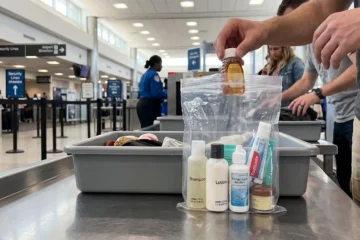
TSA's What Can I Bring entry for medications in pill form lists them as "Yes" for carry-on and "Yes" for checked bags, read on 7 September 2026, and TSA's own travel tip page on packing medicine states that "TSA does not require passengers to pack medicine in prescription bottles; however certain state laws are in place regarding the labeling of prescription medicine, which require passengers to comply." So a weekly pill organizer is not against a TSA rule. What TSA does require is that the medication be screened. What TSA recommends, separately, is that it be clearly labeled. Those three things get run together everywhere, and they are not the same.
This page describes a screening procedure. It is not medical or legal advice. What you carry, in what form, and whether a particular medicine should leave its dispensed container are questions for your pharmacist and your prescribing clinician. Nothing here is a reason to change anything about a medicine.
Last checked: 7 September 2026. These are Transportation Security Administration rules for airports in the United States. Other countries' screening authorities and border agencies set their own rules on carrying and importing medicines. Rules change without notice, so open tsa.gov before you fly.
Required, Advised, and Not TSA's Rule at All
Most of the confusion in this topic is a category error. Four different things are being treated as one, and separating them answers almost the whole question.
| Statement | Whose it is, per the pages we read on 7 September 2026 |
|---|---|
| All medication must undergo security screening | Required by TSA. Its medical screening guidance states that medications in pill or other solid forms must undergo security screening |
| Medication should be clearly labeled | Recommended by TSA, to facilitate the screening process. Recommended, not required |
| Medication should be in your carry-on rather than checked | Recommended by TSA, so you have immediate access if you need it |
| Prescription medicine must carry its original label | Not a TSA requirement. TSA points at individual state laws on labeling prescription medicine, which travelers must comply with |
| A pill organizer is not allowed through security | Not a rule we could find anywhere on tsa.gov |
The last row is the one people arrive with, and it appears to be folklore. TSA's pill item page carries no special instruction restricting the container.
What TSA Requires: Screening, and Only Screening
The requirement is unglamorous. Everything you bring gets screened, and medication is not carved out of that. TSA's guidance for travelers with disabilities and medical conditions states that medications in pill or other solid forms must undergo security screening, and that officers may conduct visual or X-ray screening and test items for traces of explosives.
TSA's material also states that medication in pill or solid form may be carried in unlimited amounts as long as it is screened. That is a different treatment from liquids, which are capped per container and gathered into one quart bag under the 3-1-1 rule unless a specific exemption applies. Pills are not measured against the quart bag at all.
TSA also prints a standing sentence on the pills item page and on the liquid medications page: "The final decision rests with the TSA officer on whether an item is allowed through the checkpoint." That sentence is on every item page we read, and it applies here too. No article can tell you an outcome.
What TSA Advises: Labeling, and Why It Is Only Advice
TSA's wording is that it is recommended that medication be clearly labeled to facilitate the screening process. Read that as a speed argument rather than a permission argument. A labeled item is quicker to resolve at a checkpoint than an unlabeled one, and that is the benefit on offer.
It is worth being precise about what "labeled" is doing here, because the internet turns a recommendation into a requirement within about two clicks. TSA is not conditioning entry on the label. It is telling you that the screening goes faster when an officer can see what something is.
That is genuinely useful, and it is also not a reason to relabel anything yourself. A label you printed is not evidence of what is inside a compartment, and it is not what the recommendation is pointing at.
Where the Original-Bottle Rule Actually Comes From
Here is the finding that makes this topic worth a page.
TSA's travel tip on packing medicine says plainly that it does not require medicine to be packed in prescription bottles, and in the same breath points at state law: certain state laws are in place regarding the labeling of prescription medicine, and passengers are required to comply with them. Two authorities, one sentence.
So "the pills have to be in the original bottles" is not wrong so much as misattributed. Whatever requirement exists in a given place is a state law about prescription labeling, not a TSA screening rule, and TSA is explicitly telling you it does not speak for it.
We are not going to list which states require what. We have not read any state's statute directly, and this site does not publish a legal figure it has not verified at the source. A pharmacist, or the state pharmacy board where you live and where you are traveling, can answer it for your medicine. That is a five minute question for someone qualified to answer it.
The Question This Site Will Not Answer
Whether to move a prescription out of its dispensed container and into a weekly organizer, a travel case or a small bottle is a decision with clinical and legal consequences, and it is not a packing decision.
It touches the label, the expiry date, the storage conditions the medicine was dispensed under, whether the tablets are stable outside their original packaging, and in some places the legal status of the medicine in your possession. Ask the pharmacist who dispensed it. Ask the clinician who prescribed it. They can answer for your specific medicine, and we cannot answer it for anyone.
What we can say is what the pages state: TSA is not the body imposing the original-container requirement, and TSA's own recommendation is about labeling for screening speed, not about which box the tablets sit in.
What Screening Actually Looks Like
Two published details are worth knowing before you are standing at the belt.
X-ray, and the option to decline it. TSA states that its X-ray machines are not harmful to food or medicines, and that a traveler who does not want items X-rayed or opened should notify the officer, after which additional screening steps are taken to clear the items. The request has to come before anything goes into the tunnel, not after.
The notification card, and what it does not do. TSA provides a notification card that lets a traveler describe a disability or medical condition discreetly rather than explaining it out loud in a queue. TSA's own material is clear that the card does not exempt the holder from screening. TSA also offers a Passenger Support Specialist, an officer with additional training, who can assist through the screening process.
Both are worth knowing about precisely because neither is a shortcut. They change how the conversation happens, not whether the screening happens.
Getting an Answer Before You Fly
TSA runs TSA Cares, which its page describes as providing information on security procedures to help passengers with disabilities, medical conditions and individuals needing additional assistance prepare for screening. The published number is (866) 289-9673, listed with hours of weekdays 8 a.m. to 11 p.m. ET and weekends and holidays 9 a.m. to 8 p.m. ET, read 7 September 2026. There is also a request form for TSA Cares assistance on the same page.
For a question about a specific device, a specific medicine or a specific need, that channel beats any article, including this one. TSA is the body that will be standing at the checkpoint.
Packing the Rest of the Kit Around It
Once the medication question is settled, an organizer is just an object with a footprint, and the ordinary rules resume around it.
Pills do not count against the quart bag, but anything liquid in your kit does, including things people assume are medical. Our read of what TSA counts as a liquid covers the gels, creams and pastes the category catches, and carrying contact lens solution covers the one that surprises people most often, because it is a liquid with no special status. If you are assembling a kit from nothing, what belongs in a travel bottle set starts from the same constraint the quart bag imposes.
The one physical failure worth designing against is an organizer whose lid pops in a bag that gets thrown around. That is a hardware problem, not a TSA problem, and it is solved before you leave rather than at the airport.
How We Checked This
We have not flown with any of this, tested any organizer or run anything through a checkpoint. This page is desk research from TSA's own pages, read on 7 September 2026, and the quoted sentences are TSA's wording rather than ours.
What we deliberately left out: which US states require original prescription labeling and what each one says, because TSA points at state law without enumerating it and we have not read any statute at the source; any statement about whether a specific medicine may be repackaged, because that is a clinical and legal question; and any figure for how many tablets is reasonable, because TSA publishes none for solid medication and the amount is a matter for your prescriber.
FAQ
Can you bring a pill organizer on a plane?
TSA lists medications in pill form as permitted in both carry-on and checked bags, and its own travel tip page states that TSA does not require medicine to be packed in prescription bottles. We found no TSA page restricting the container. The final decision rests with the TSA officer on whether an item is allowed through the checkpoint.
Do prescription pills have to stay in the original bottle for TSA?
Not for TSA. TSA states it does not require medicine to be packed in prescription bottles, and points travelers at individual state laws on the labeling of prescription medicine, which they are required to comply with. Ask a pharmacist about your medicine and the states involved.
Is there a limit on how many pills I can carry?
TSA's material describes medication in pill or solid form as permitted in unlimited amounts as long as it is screened. How much of a medicine you travel with is a question for your prescribing clinician, not a packing question.
Should medication go in the carry-on or the checked bag?
TSA lists pills as permitted in both, and recommends the carry-on so you have immediate access if you need it. That is a recommendation on its pages, not a rule.
Do I have to declare pills at the checkpoint?
TSA's published declaration procedure is written for medically necessary liquids, gels and aerosols, which must be declared to officers for inspection. Solid medication is subject to ordinary screening. If you want a ruling for your own situation, TSA Cares is the channel.