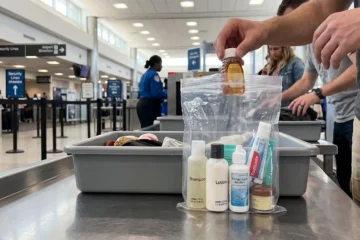
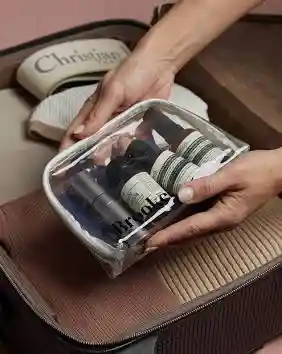
Toiletry aerosols are allowed in a carry-on, and TSA treats them exactly like liquids: 3.4 ounces or 100 milliliters or less per container, inside the one quart-size bag. TSA's liquids rule names aerosols in the same breath as liquids, gels, creams and pastes, so an aerosol deodorant, a dry shampoo and a spray sunscreen all compete for the same quart of space. Two things make aerosols different from everything else in that bag. Not every aerosol is a toiletry, and some are barred from the cabin outright. And the moment the can goes into a checked bag instead, a different authority takes over with different numbers.
Last checked: 7 September 2026. These are Transportation Security Administration rules and they apply to airports in the United States. Other countries' security services set their own container limits and their own rules on pressurized containers. Rules change without notice, so open tsa.gov before you fly.
Regime One: TSA, the Checkpoint, and the Quart Bag
TSA's Liquids, Aerosols, and Gels Rule page, read on 7 September 2026, states: "You are allowed to bring a quart-sized bag of liquids, aerosols, gels, creams and pastes in your carry-on bag and through the checkpoint," in "travel-sized containers that are 3.4 ounces (100 milliliters) or less per item."
Aerosols are named in the rule, not squeezed into it by interpretation. TSA's own item entries, read the same day, apply the cap consistently:
| TSA item entry, read 7 September 2026 | Carry-on ruling |
|---|---|
| Deodorant (Aerosol) | "Yes (Less than or equal to 3.4oz/100 ml allowed)" |
| Dry Shampoo (Aerosol) | "Yes (Less than or equal to 3.4oz/100 ml allowed)" |
| Hair Spray | "Yes (Less than or equal to 3.4oz/100 ml allowed)" |
| Sunscreen | "Yes (Less than or equal to 3.4oz/100 ml allowed)" |
| Shaving Cream | "Yes (Less than or equal to 3.4oz/100 ml allowed)" |
| Aerosol Insecticide | Not permitted |
That last row is the one to notice, and we come back to it below. Our fuller read of the 3-1-1 rule covers what each of its three numbers constrains.
The Thing About an Aerosol You Cannot Design Around
Every other item in the quart bag can be decanted. Shampoo, lotion, mouthwash and liquid foundation all move into a smaller container, which is the standard way to bring a full-size product under the limit. An aerosol cannot.
A pressurized can is a sealed system: propellant, product and valve, assembled under pressure at the factory. There is no domestic way to transfer its contents into a 3 oz bottle, and attempting to open or decant a pressurized container is a genuinely bad idea rather than a merely futile one. The propellants used in personal-care aerosols are commonly flammable hydrocarbons, which is also why aerosol cans carry the warnings they do about heat and puncture.
The practical consequence is that for aerosols, the 3.4 oz limit is a buying decision made in a shop, not a packing decision made the night before. Either you buy a travel-size can, or the aerosol does not fly in the cabin. That is different from every liquid in the bag, where refilling a travel-size bottle is a real option, and it is the single most useful thing to know before you start packing.
The other way out is form. A stick deodorant is a solid and is outside the liquids rule entirely, and TSA lists Deodorant (Solid) as "Yes" with no volume attached. Whether an item is a liquid, an aerosol or a solid is the question our read of what TSA counts as a liquid exists to answer.
Not Every Aerosol Is a Toiletry Aerosol
The line that circulates online is that aerosols are fine in a carry-on as long as they are under 3.4 oz. That is true of toiletry aerosols and it is not a general rule about spray cans.
TSA's own entry for aerosol insecticide, read on 7 September 2026, states: "Aerosol insecticides are not allowed in carry-on; however they are allowed in checked bags as long as they are not labeled as hazardous material (HAZMAT)." Not permitted in the cabin at any size, and permitted below the deck only on a labeling condition.
That is the shape of the real rule. Personal-care aerosols are one recognized category. Household, automotive, industrial and pest-control aerosols are not in it, and cans labeled as hazardous material are handled differently again. If the can is not something you would put on your body, check its specific entry on TSA's What Can I Bring list rather than assuming the toiletry answer covers it.
Every one of those item pages also carries TSA's standing sentence: "The final decision rests with the TSA officer on whether an item is allowed through the checkpoint."
Regime Two: The FAA, the Checked Bag, and a Limit Almost Nobody Reads
Move the same can from your carry-on to your checked bag and you leave TSA's liquids rule behind. You do not arrive somewhere with no rules. The Federal Aviation Administration limits the quantity of medicinal and toiletry articles, aerosols included, that a person may carry in baggage, and TSA reproduces that limit on its own item pages.
On the TSA entries for dry shampoo, sunscreen and shaving cream, read on 7 September 2026, the note states that the total aggregate quantity per person cannot exceed 2 kg (70 ounces) or 2 L (68 fluid ounces), and that the capacity of each container must not exceed 0.5 kg (18 ounces) or 500 ml (17 fluid ounces). The same pages add: "Permitted aerosol release devices (button/nozzle) must be protected by caps or other suitable means to prevent accidental release."
Three things follow that people routinely get wrong. The 70 oz figure is an aggregate across everything in the category, not an allowance per can. It covers medicinal and toiletry articles together, so sunscreen, insect repellent, shaving foam and dry shampoo all draw on one budget. And the nozzle cap is a stated condition, not a courtesy: a cap that came off in the bathroom cabinet at home should be replaced before the can is packed.
We read those figures on TSA's pages rather than on the FAA's own site, which did not return content to our research tool on the day we checked. The authority behind the numbers is the FAA, and faa.gov is where to confirm them.
Why the Two Regimes Are Not One Sentence
It is tempting to write "3.4 oz in your carry-on, 70 oz in your checked bag" and move on. That merges two separate systems that answer different questions.
TSA's liquids rule is a security screening rule about what may pass through a passenger checkpoint. It is about detection, and about what an officer can resolve at the belt with a line behind you. Its unit is the container and its instrument is the quart bag.
The FAA's limit is a hazardous materials rule about what may be carried aboard an aircraft at all. It exists because a pressurized can of flammable product in a cargo hold is a fire risk, and it is written in the units hazardous materials rules use, mass and volume in aggregate. It applies whether or not anything ever went through a checkpoint.
They are enforced by different people at different points and they can bind at the same time. The reason to keep them apart is practical as well as pedantic: if you are told there is one aerosol rule, you will assume that clearing the checkpoint means your checked bag is fine, and the checked bag was never the checkpoint's business.
Outside the United States
Neither regime follows you abroad. Other countries' security authorities set their own carry-on container limits, and the carriage of pressurized and flammable articles in baggage is governed internationally in ways that individual airlines also apply through their own conditions of carriage.
Two consequences for a return leg. The airline you fly home on may publish its own aerosol allowance, and airline rules can be stricter than the regulator's. And your outbound checkpoint tells you nothing about your return one. Read the security or hand baggage page published by each departure airport's own authority and your airline's dangerous goods page, for every leg including connections, and pack to the strictest rule on the trip.
How We Checked This, and What We Left Out
We have not flown with any of this, tested any product, or run anything through a checkpoint. This page is desk research from TSA's own pages, read on 7 September 2026: the Liquids, Aerosols, and Gels Rule page, the 3-1-1 FAQ, and the What Can I Bring entries for aerosol deodorant, solid deodorant, dry shampoo, hair spray, sunscreen, shaving cream and aerosol insecticide.
Deliberately left out: any figure from faa.gov itself, which did not return content to our research tool on the day we checked, so the FAA numbers above are quoted as TSA reproduces them and are attributed to the FAA as their author. Also left out is any per-airline aerosol allowance, any list of which propellants a given brand uses, and any prediction of how an officer will treat a specific can. TSA runs a public help channel, AskTSA, for the last of those.
FAQ
Can you bring aerosol deodorant in a carry-on?
Yes, if the container is 3.4 ounces or 100 milliliters or less and it fits in your one quart-size bag. TSA's Deodorant (Aerosol) entry, read on 7 September 2026, states "Yes (Less than or equal to 3.4oz/100 ml allowed)". A solid stick deodorant is not covered by the liquids rule at all and needs no bag space.
Is dry shampoo allowed through TSA?
Aerosol dry shampoo is treated as an aerosol: 3.4 oz or 100 ml or less, inside the quart bag. TSA's Dry Shampoo (Aerosol) entry states the same wording, read 7 September 2026. In checked baggage it counts toward the FAA's aggregate limit on medicinal and toiletry articles.
How many aerosol cans can I put in my checked bag?
TSA's item pages state the FAA limit as a total aggregate per person of 2 kg (70 ounces) or 2 L (68 fluid ounces), with no single container over 0.5 kg (18 ounces) or 500 ml (17 fluid ounces). It is an aggregate across medicinal and toiletry articles together, not a per-can allowance, so there is no fixed number of cans. Confirm on faa.gov.
Do aerosol nozzles need caps in checked baggage?
TSA's pages state that permitted aerosol release devices, meaning the button or nozzle, must be protected by caps or other suitable means to prevent accidental release. A can whose cap is missing should not be packed on the assumption that the wording is advisory.
Can I bring bug spray or any household aerosol in my carry-on?
Not on the toiletry answer. TSA's aerosol insecticide entry, read 7 September 2026, states that aerosol insecticides are not allowed in carry-on, and are allowed in checked bags only as long as they are not labeled as hazardous material. Check the specific item on TSA's What Can I Bring list rather than generalizing from deodorant.