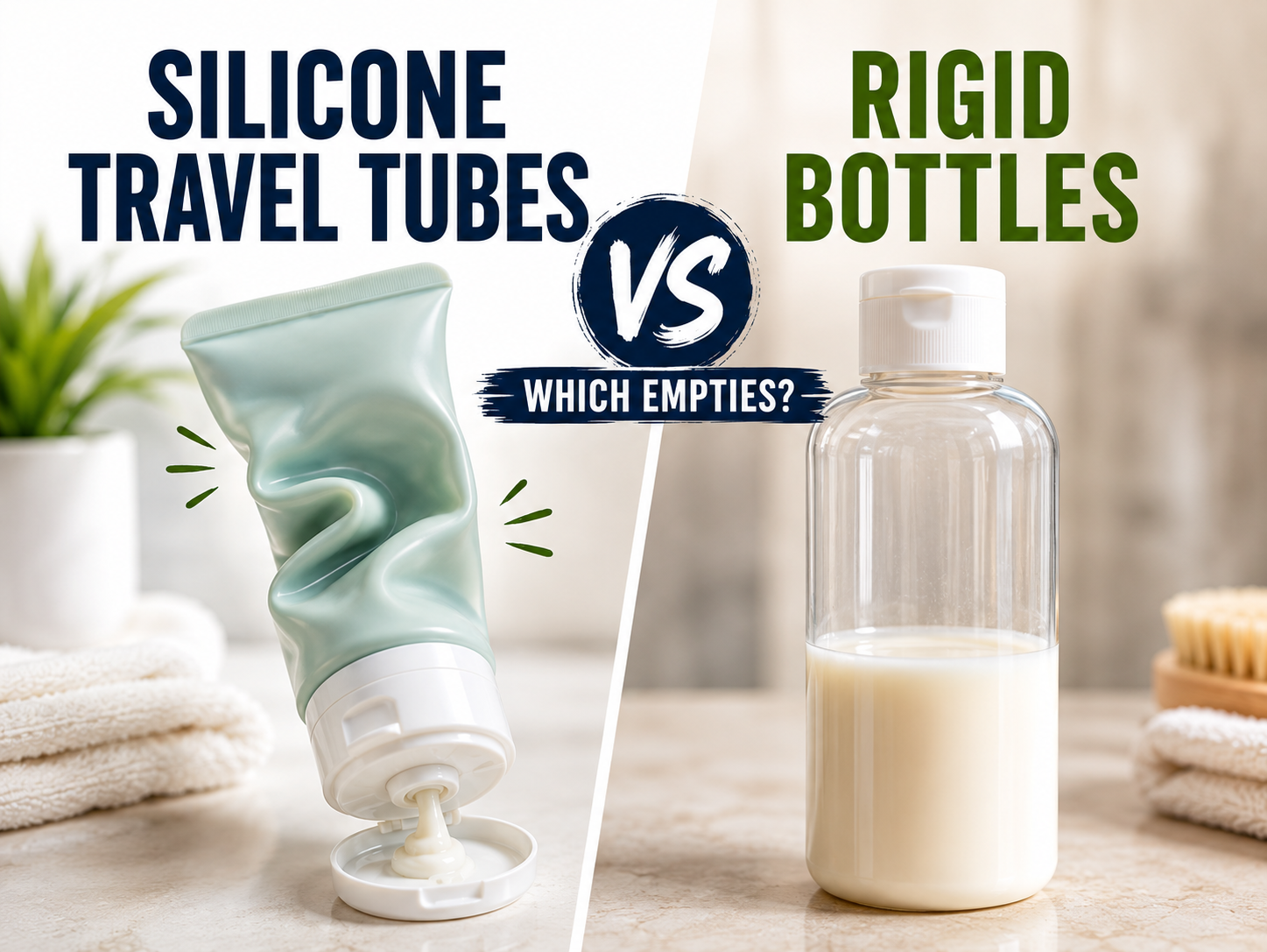
A silicone travel tube empties completely because it flexes as you squeeze, collapsing behind the product and pushing it out the opening. A rigid bottle can’t do that: once you’ve pressed past a certain point, the walls stop moving and the last third of the product sits trapped under a pocket of air until you either dig it out with a finger or give up and toss it. That single mechanical difference, flexible wall versus fixed wall, is the whole answer to which container wastes less product. It doesn’t decide everything else, though. Silicone tolerates some products and degrades under others, and it needs different cleaning care than a hard bottle does.
What a Silicone Tube Actually Is
A silicone travel tube is a squeezable container, usually food-grade or medical-grade silicone, with a flip-top, screw, or disc closure at one end. It’s built to be pressed flat as it empties, the way a toothpaste tube works, rather than poured from a fixed opening. That’s the design trade: a rigid bottle holds its shape and stands up on a shelf; a silicone tube only holds its shape when it’s full and collapses as you use it. PackRefills covers this kind of container decision from research rather than a lab test we haven’t run; see our about page for that approach.
Why Rigid Bottles Waste the Last Third
The mechanism is simple once you see it. As you press a rigid plastic or aluminum bottle, the liquid moves toward the opening, but the walls don’t move with it. Past a certain fill level, there’s more air behind the liquid than liquid itself, and squeezing just compresses that air pocket instead of pushing product out. You end up tipping the bottle, tapping it, or fishing with a finger to reach what’s left. A flexible tube doesn’t have that problem because the wall collapses inward as the product leaves, so there’s no growing air pocket to work around. This is the main reason a genuinely flexible tube outperforms a rigid bottle on waste, independent of price or brand.
Cabin Pressure and How Each Container Leaks
Cabin pressure in the hold and in the cabin itself is lower than pressure at sea level, which means trapped air inside any sealed container expands during ascent. In a rigid bottle, that expanding headspace air pushes on the liquid and on the cap seal, and a bottle filled close to the top with less headspace to expand into is generally less likely to weep through a worn gasket. A silicone tube behaves differently: because the wall itself can flex outward slightly to absorb some of that pressure change, a tube that’s mostly full has some give that a rigid bottle doesn’t. The trade-off is the closure. A flip-top or disc cap on a tube is doing the same sealing job as a cap on a bottle, and if that seal is worn or the tube was overfilled and can’t flex, pressure still finds the weak point. Neither shape is leak-proof by itself; fill level and closure condition matter more than material.
What Silicone Tolerates and What It Doesn’t
Silicone handles most water-based lotions, shampoo, conditioner, and body wash without issue. It’s less suited to concentrated essential oils and some oil-heavy serums used undiluted and left sitting for weeks, since repeated contact with certain oils can cause silicone to swell or soften over time. If a product’s own packaging is glass or a specific plastic rather than a generic bottle, that’s often a hint the manufacturer picked that material for a compatibility reason, not just cost. When in doubt with a strong-smelling essential oil blend or a solvent-heavy product, a short test fill for a day or two, checked before a real trip, costs nothing and avoids a surprise.
Cleaning and Drying Without Residue or Mold
Silicone’s flexible wall folds on itself as the tube empties, and product residue collects in those folds and under the cap threads where a rinse doesn’t reach. Turn the tube inside out if the design allows it, or work a bottle brush into the folded sections, using warm water and a small amount of mild soap. The part that actually grows mold is almost never the tube body; it’s the cap seal and the threaded neck, where a thin film of shampoo or conditioner stays damp between trips. Rinse the cap and gasket separately, and leave both open to air-dry completely, ideally overnight, before you cap it and put it away. A tube sealed while still damp inside is how residue turns into a smell, and eventually into visible growth.
Refilling a Tube Without Contaminating the Product
Open the tube fully at the cap end rather than trying to pour into a small flip-top opening, since a wide opening is faster to fill and easier to wipe clean afterward. Fill from a full-size bottle that’s clean at its own opening, not one that’s been dipped into with fingers, and leave a small amount of headspace rather than filling to the very top so the tube still has room to flex under cabin pressure. If the last refill held a different product, a quick rinse and full dry between uses avoids mixing scents or textures into the next fill. For a routine that covers funnels, labeling, and timing before a trip, see how to refill travel size bottles, which applies to tubes as well as rigid bottles.
Do Silicone Tubes Still Have to Follow the Container Size Rule?
Yes. The checkpoint liquids rule that limits carry-on containers applies to the size of the container, not the material it’s made from and not how much product is actually inside it. A silicone tube rated at a larger capacity is treated the same as a rigid bottle of the same size, even if you’ve only filled it halfway. For what that size limit actually is where you’re flying from, and why it isn’t the same number everywhere, see travel bottle sizes explained.
The Squeeze Test: A Way to Judge a Tube Before You Buy It
Most reviews of silicone tubes talk about capacity and price and skip the one thing that predicts whether a specific tube will actually empty for a specific product: the ratio between the opening width and the product’s thickness. A tube with a narrow flip-top opening will struggle to release a thick conditioner or a dense sunscreen no matter how flexible the walls are, because the bottleneck isn’t the wall, it’s the exit. A wide disc-top opening empties thick products more easily but is harder to control for thin, runny liquids like toner or micellar water. Before relying on a tube for a specific product, do a two-part check: squeeze the empty tube and confirm the walls fold rather than crack or resist, then look at the opening against the product’s own thickness. A tube built for shampoo isn’t automatically right for a thick styling cream, even if both are “silicone travel tubes” on the same listing.
Tube or Bottle: A Quick Decision Guide
| Situation | Better fit |
|---|---|
| Thin liquids: toner, micellar water, mouthwash | Rigid bottle with a flip-top or disc cap |
| Thick products: conditioner, lotion, sunscreen | Silicone tube with a wide opening |
| You want to use every last drop | Silicone tube |
| The product is oil-concentrate or solvent-heavy | Rigid bottle, or test the tube first |
| You’re building a kit that includes several product types | A mix of both, chosen per product |
For a fuller breakdown of what a complete kit should actually contain instead of a 21-piece assortment you’ll never use, see what belongs in a refillable travel bottle kit.
FAQ
Are silicone travel tubes reusable?
Yes, a silicone tube is designed to be refilled repeatedly. Its useful life ends when the walls stiffen, crack, or the cap seal no longer closes flush, not after a fixed number of uses.
Do silicone tubes smell after a few trips?
They can, and it’s almost always residue trapped at the cap threads or in the folded body rather than the silicone itself breaking down. Full drying between fills largely prevents it.
Can I put essential oils in a silicone tube?
Diluted, water-based products are generally fine. Concentrated essential oils used undiluted and left sitting for extended periods can soften some silicones over time, so a short test fill before committing a favorite product is worth the extra minute.
Is a silicone tube more likely to leak than a rigid bottle?
Neither material is inherently more leak-prone. Fill level, cap seal condition, and how full the container is when cabin pressure drops matter more than whether the wall is flexible or rigid.
Do TSA size rules treat tubes differently from bottles?
No. The container-size limit applies to the container itself, regardless of shape or material, and regardless of how much is inside it.