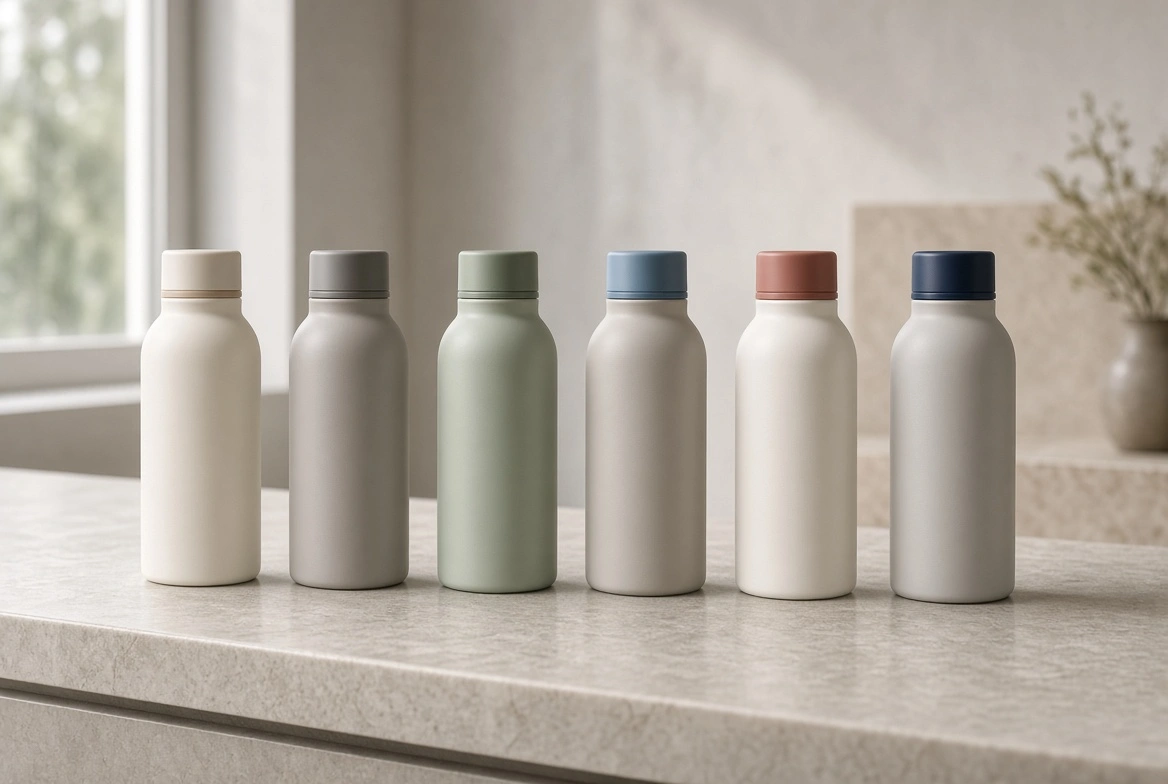
Six bottles, all the same size, all the same color, none of them see-through. You filled them a week ago and you were certain you would remember.
The problem is genuinely worse with a good travel kit than with a bad one, because a matching set is matching. It is also worse with silicone and other opaque materials, and worse again in a shower.
Almost every labeling method fails, and they all fail for the same three reasons, which is the useful thing to know before you pick one.
Why labels come off
Water. Not just water, hot water, steam, soap and shampoo residue. A label lives its life in the wettest place in the house.
Oil. This is the one people miss. Product on your fingers, product on the bottle, and oil defeats adhesives that water alone would not.
Flex. A squeeze bottle changes shape every time you use it. A rigid label on a flexible surface peels from the edges, and the more you squeeze, the faster.
Any method that survives all three is a method worth using. Most survive one or two.
The four that work
1. Write on the bottle itself, with an oil-based paint marker. No adhesive to fail, no edge to peel. It survives water well, and it comes off with alcohol when you want it to, which is a feature rather than a flaw.
The caveat is that it will eventually wear at the points you grip, so a label on the side rather than the base lasts longer. And write it small: you are labeling for yourself, not producing packaging.
2. Write on the cap. The cap is rigid, it is the part you look at when the bottle is upright in a wash bag, and it does not flex. It is also the part most likely to get put back on the wrong bottle, which is the failure mode to be aware of.
Best used together with method one, so that the bottle and the cap agree.
3. A wrap of tape, written on. A band of waterproof tape all the way round the bottle, written on before it goes on. A continuous wrap has no edge to lift, which is what defeats reason three above.
4. Color, not words. The most underrated approach and the one that survives everything, because there is nothing to come off. Bottles in different colors, or a band of colored tape, or different caps. You are not reading in the shower anyway; you are recognizing.
A different shape works even better than a different color, because you can identify it by feel with your eyes shut, which is the actual situation in a shower.
What tends not to work
Paper labels, including printed ones. They survive a dry cupboard and not a wash bag.
Standard sticker labels, which lift at the edges once oil gets under them.
Permanent marker directly on plastic, which sounds right and rubs off with handling and product.
Embossed or clear-on-clear labels, which look excellent and are unreadable in low light with wet hands.
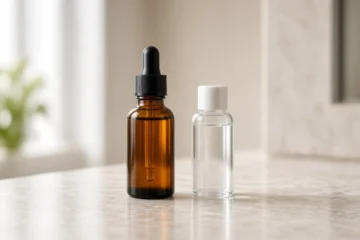
Relying on transparency. Two clear liquids look the same, and so do two white creams. The idea that you can see what is in it is the assumption that produces the problem in the first place.
What the label should actually say
Shorter than you think, and one field people always leave off.
What it is, in the fewest characters that work. “SH” and “CO” beat “shampoo” and “conditioner” on a small bottle.
The date you filled it. This is the field almost nobody includes and it is the most useful one. A decanted product with no packaging has no printed information on it at all, and in six months you will not know whether the contents are from this year. It matters most for anything you decanted from a product that had its own storage guidance, and it is part of why when a refillable bottle is finished is a question with an answer rather than a guess.
Anything the label of the original product told you, if it matters. A product with storage instructions has those instructions on packaging you left behind.
Nothing else. A travel bottle is not a product and it does not need branding.
Doing it as part of filling
The reason labeling fails is almost never the method. It is that it happens later, or not at all.
Make it a step in the refill routine rather than a separate task: fill, wipe the rim, close, label. Ten seconds, at the sink, while you still know exactly what went in. Refilling from full-size bottles covers the routine, and adding the label to it is the change that makes it stick.
The wiping step is not incidental either. A rim wiped clean labels better, closes better and leaks less, and why travel bottles leak on a plane covers why the sealing surface matters more than anything else about a bottle.
Between trips
Two habits that decide whether you have to relabel every time.
Empty and wash between trips, which means the label is now describing an empty bottle. That is fine if you use the same bottle for the same thing every time, and it is the argument for one bottle, one job.
Store them dry and open, which also stops the labels from sitting in a damp drawer for months. Storing refillables between trips covers the rest of it.
If a bottle changes job, the old label has to come off completely. A half-removed label plus a new one is how the original problem returns.
Shared and family kits
Where labeling stops being convenience and starts being necessary.
A shared kit needs both what it is and whose it is, and colored bands per person is the method that survives, because nobody reads in a shower. Refillable containers for kids and shared family kits covers the wider set of decisions there.
Anything that must not be confused gets a different shape, not a different label. If two products should never be swapped, make them impossible to mistake by feel.
The one thing that does not go in a travel bottle
Anything prescribed or medicated stays in its own packaging.
That packaging carries the name, the strength, the instructions and the batch information, and a hand-written label replaces none of it. This is a different situation from decanting shampoo and it is not a labeling problem to be solved.
If you are unsure whether something falls into that category, the pharmacist who supplied it will tell you in a minute.
The short version
- Labels fail because of water, oil and flex. Pick a method that survives all three.
- An oil-based paint marker on the bottle, writing on the cap, a continuous tape wrap, or color and shape instead of words.
- Paper, ordinary stickers and permanent marker do not survive a wash bag.
- Write what it is and the date you filled it. The date is the field everyone leaves off.
- Label at the sink as part of filling, not later.
- Different shapes beat different colors, because you identify by feel in a shower.
- Prescribed and medicated products stay in their own packaging. That is not a labeling problem.