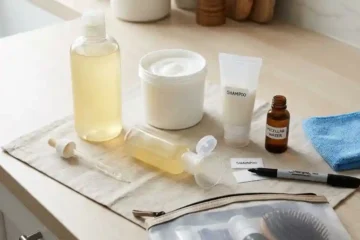
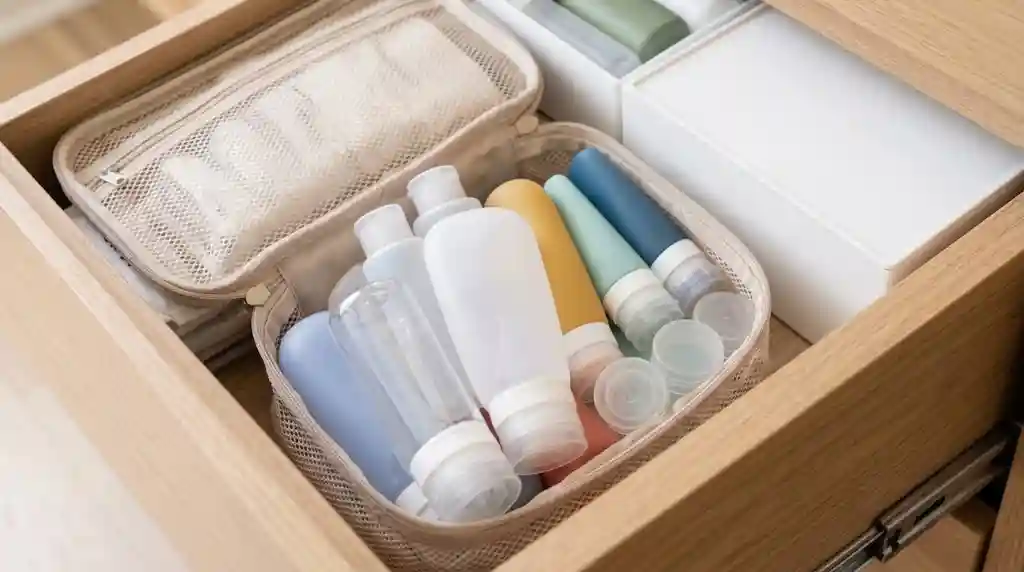
Store travel bottles empty, washed, fully dry, and with the caps off or resting loose, in a cool, dark, dry place that is not the bathroom, keeping every cap and gasket with the bottle it belongs to. That one state solves almost everything that goes wrong between trips: a bottle put away damp and sealed is the one that grows mold, a bottle put away full is the one whose contents degrade and whose pump leaks on the next flight, and a bottle whose cap wandered off is the one you are hunting for at 11pm the night before you fly. Everything below is the reasoning behind that sentence, plus a two-minute check to run before the bottles go back in the bag.
Nearly Every Storage Guide Skips the Part That Causes the Problem
Search this question and you get packing advice: use a toiletry bag, keep it in a clear pouch, tighten the lids. That is all fine, and it is all about the trip. The failures readers actually describe happen in the months when nobody is traveling, in a drawer. Sticky threads, a smell that will not rinse out, black specks under a cap, a cap that no longer seals, a half inch of unidentifiable conditioner that has separated. None of that happened in transit. It happened in storage, and it was decided by the state the bottle was in when it went in there.
The State a Travel Bottle Should Be In When It Goes Away
Five conditions, ordered by how much damage skipping them does.
| Condition | What it is protecting against | What you find next time if you skip it |
|---|---|---|
| Empty | A product sitting for months in a container it was not packaged for | Separated, smelly or spoiled product, and a bottle primed to leak in flight |
| Washed | Residue on the threads and under the cap liner | The sticky bottle, and a closure sealing against film instead of against plastic |
| Fully dry | Moisture sealed inside a dark container | Mold, black specks under the seal, a smell that will not rinse out |
| Open or loosely capped | Trapped humidity condensing inside | The same as above, discovered months later |
| Kept with its own cap and gasket | Parts scattering across a drawer, a washbag and a shelf | Six bottles, five caps, and no seal the night before a trip |
Manufacturer and retailer guidance for silicone travel bottles broadly says the same thing about emptying and drying, which is worth noting because those pages are written by people selling bottles and they still tell you not to leave product in them. The reasoning below comes from public health and consumer-safety sources rather than from any testing on our side, because we have not run any.
Why a Full Bottle Is Not a Head Start
Leaving shampoo or lotion in a travel bottle so it is "ready to go" feels efficient and is the most expensive habit on this list.
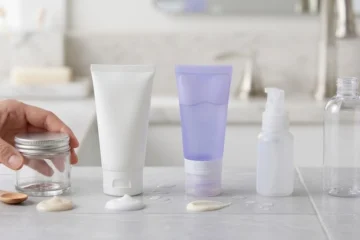
The US Food and Drug Administration's page on shelf life and expiration dating of cosmetics states that there are no US laws or regulations requiring cosmetics to carry expiration dates at all, and that how long a product stays good depends on the type of product, how it is used, and how it is stored. It also states that heat can make preservatives break down and let bacteria and fungi grow faster, that expiration dates are "rules of thumb," and that a product's safety can expire before the printed date if it has been stored badly. Decanting adds to that. FDA notes that introducing anything into a product, such as dipping fingers into it, adds microorganisms that the preservative system then has to control, and pouring a product into a home container is the same category of event. The travel bottle is not sterile, the preservative system was formulated for the original packaging, and nothing about a refill restarts the clock.
Sunscreen is the clearest case, because it is regulated as a drug rather than as a cosmetic. FDA's sunscreen guidance states that sunscreens are required to carry an expiration date unless the manufacturer's stability testing shows the product will remain stable for at least three years, that expired sunscreen should be discarded, and that sunscreen labels must carry the instruction to protect the product from excessive heat and direct sun. A decanted travel bottle carries none of that. No lot number, no expiration date, no warning, and it usually gets stored somewhere warmer than the original tube was.
Then there is the mechanical problem. A bottle stored full is a bottle stored under load. Pump closures are the worst offenders, because a pump is not a seal in the way a screw cap is: the dip tube and the pump chamber stay charged with product, and the outlet path stays open unless the head locks down. Put that bottle in a bag that flies and the air in the headspace expands as cabin pressure drops, pushing product out through the easiest exit. That is the same mechanism set out in our guide to why travel bottles leak on a plane, and storing a bottle full simply preloads it.
If you want something stored ready, store the full-size product in its own original packaging and refill the travel bottle before you go. That is the entire point of a refillable.
Dry Matters More Than Clean
A bottle can be spotless and still ruin itself in a drawer, because what mold needs is not dirt. The US Environmental Protection Agency's brief guide to mold, moisture and your home states plainly that there are many types of mold and none of them will grow without water or moisture, and that mold begins growing when spores land on wet surfaces. Its practical instruction is to dry wet or damp materials within 24 to 48 hours, because in most cases mold will not grow if they are dried inside that window.
That guidance is written about buildings and water damage, not about toiletry bottles, so treat the window as EPA's figure for damp materials rather than as a tested figure for a travel bottle. The principle transfers cleanly anyway: a rinsed bottle capped while still wet is a wet surface sealed in the dark, which is exactly the situation the guidance tells you not to create.
Drying properly takes a little more than shaking it out.
- Stand the bottle upside down at an angle, mouth clear, so water runs out instead of pooling on the shoulder.
- Take the gasket or cap liner out of the cap and dry it separately. Water hides under the liner, which is also where black specks tend to appear first. Our article on mold in a travel bottle covers what happens under that seal and what to do about it.
- Leave flexible silicone bottles open and squeezed slightly flat, so the inner walls are not resting wet against wet.
- Give it longer than you think it needs. A narrow neck exchanges air slowly, and a bottle that feels dry at the opening can still be damp at the base.
Keep the Set Together, Because Caps Do Not Find Their Way Back
The second failure mode is not chemical, it is inventory. Caps, gaskets, liners, pump heads, disc tops and flip lids come off for washing and then get put away somewhere other than with their bottles. Come the next trip you have six bottles, five caps, and no idea which gasket belongs to which lid.
This matters more than tidiness, because a closure only seals against the neck it was made for. A cap that threads on is not automatically a cap that seats, and a cap missing its liner will thread on perfectly and still leak. Three habits fix it.
- Wash, dry and reassemble as one operation. A bottle does not go away until its own cap is back on it, loosely.
- Store the whole kit in one container instead of spreading it across a drawer, a washbag and a cupboard shelf. An open box, a mesh pouch left unzipped, or the liquids bag stored unsealed all work, and unsealed is the operative word.
- If a bottle has lost its gasket, deal with it now rather than at the airport. Knowing which parts of a set are actually load-bearing helps here, and what belongs in a refillable travel bottle kit goes through which pieces of a multipack earn their space.
Label the bottles too, if you have not already. A labeled bottle is easier to reunite with its own cap and much harder to refill with the wrong thing.
Where to Store Travel Bottles, and Why Not the Bathroom
The bathroom is the obvious place and the worst one. It is the most humid room in the house, and humidity is the input the drying step just spent an evening removing. A cupboard in a bedroom or hallway beats it on every count.
Three conditions to aim for.
- Cool. FDA's cosmetics guidance is specific that heat makes preservatives break down, and its sunscreen labeling requirement names excessive heat directly. That rules out the car, the trunk, a garage in summer, and the shelf above a radiator.
- Dark. Direct sun is named in that same sunscreen labeling instruction. Sun on a windowsill also drives a container well above room temperature.
- Dry and ventilated. A sealed plastic tub in a damp basement is not dry storage. An open container in a dry cupboard is.
Store bottles upright if anything is still in them, and any way you like if they are empty. Keep the toiletry bag itself open or unzipped in storage for the same reason the bottles are open: a zipped bag holds whatever moisture is inside it.
The Two-Minute Check Before the Next Trip
Storage is only half the job. Run this before you refill, not at the gate.
- Smell it. A bottle that still smells of old conditioner after washing is telling you residue is in there.
- Look under the gasket. Lift the liner out of the cap and check its underside and the groove it sits in. That is where growth starts and where it hides.
- Run a finger around the threads. Grit or tackiness there means the closure is sealing against residue rather than against the neck.
- Do a water test. Fill with plain water, close it, stand it on a paper towel for an hour, then invert it for another hour. A bottle that weeps with water will empty itself into your clothes with shampoo.
- Check the pump or valve. Prime a pump with water and see whether it draws and then stops cleanly. A pump that keeps dribbling after you release it has product dried in the chamber.
- Check what you are refilling from, not just what you are refilling into. If the full-size product carries an open jar symbol with a number and the letter M, that is its period-after-opening figure, required in the European Union under Regulation (EC) No 1223/2009 for products with a long minimum durability. FDA does not require that symbol on US labels, so plenty of products will not carry one.
Only then refill. Doing it the night before rather than on the day gives a marginal bottle time to reveal itself, and our walkthrough of refilling from full-size bottles covers the order of operations that keeps the outside of the bottle clean while you work.
When Storage Is Not the Fix
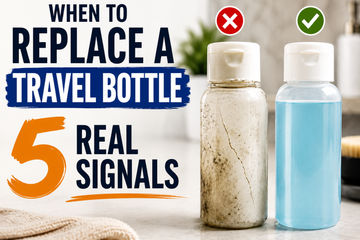
Some bottles are finished, and good storage will not bring them back. Cloudiness that does not rinse out, a smell that survives a proper clean, a gasket gone hard or slack, threads that no longer bite, staining under the seal: those are replacement signals, not cleaning problems. The honest answer is sometimes to stop maintaining a container that costs less than the shirt it is going to ruin, and when a refillable bottle is finished sets out the signals worth acting on.
What We Can and Cannot Tell You Here
We have not stored bottles under controlled conditions, run humidity tests, or measured how long a decanted product lasts in a travel container, and no independent published work on that appears to exist. What is above is mechanism plus guidance from named public sources, applied to a container. Where a number would be useful and no source supports one, this article says so instead of inventing it. That standard is described on our about page.
FAQ
Should travel bottles be stored empty or full?
Empty. Product left in a travel bottle for months sits in a container its preservative system was not formulated for, and FDA's cosmetics guidance notes that heat degrades preservatives and that poor storage can shorten a product's usable life regardless of any printed date. A full bottle is also the one most likely to leak on the next flight.
Should I store travel bottles with the caps on or off?
Off, or resting on loosely. A tightened cap traps whatever moisture is still inside. Keep each cap with its own bottle so the set does not scatter.
How long should a travel bottle dry before I put it away?
Longer than it looks like it needs. EPA's mold guidance advises drying damp materials within 24 to 48 hours, because in most cases mold will not grow if they are dried inside that window, so dry the bottle fully and promptly rather than to a stopwatch. A narrow-necked bottle can be damp at the base while the opening feels dry.
Is it safe to keep travel bottles in the bathroom?
It is the worst room for it. Humidity is precisely what the drying step is meant to remove, and a bathroom cupboard puts damp air back around the bottle for months. A dry bedroom or hallway cupboard is better.
Can I store a filled travel bottle of sunscreen for next summer?
Not sensibly. FDA requires sunscreens to carry an expiration date unless stability testing shows at least three years of stability, and requires labels to say the product must be protected from excessive heat and direct sun. A decanted bottle carries no expiration date, no lot number and no warning, so you lose the information you would need to judge it. Keep the original bottle and decant before you travel.
My bottles came out of storage sticky. What did I do wrong?
Almost always residue left on the threads and under the cap liner, sealed in while still damp. Wash the cap and the liner separately, dry both fully, and put the bottle away open.