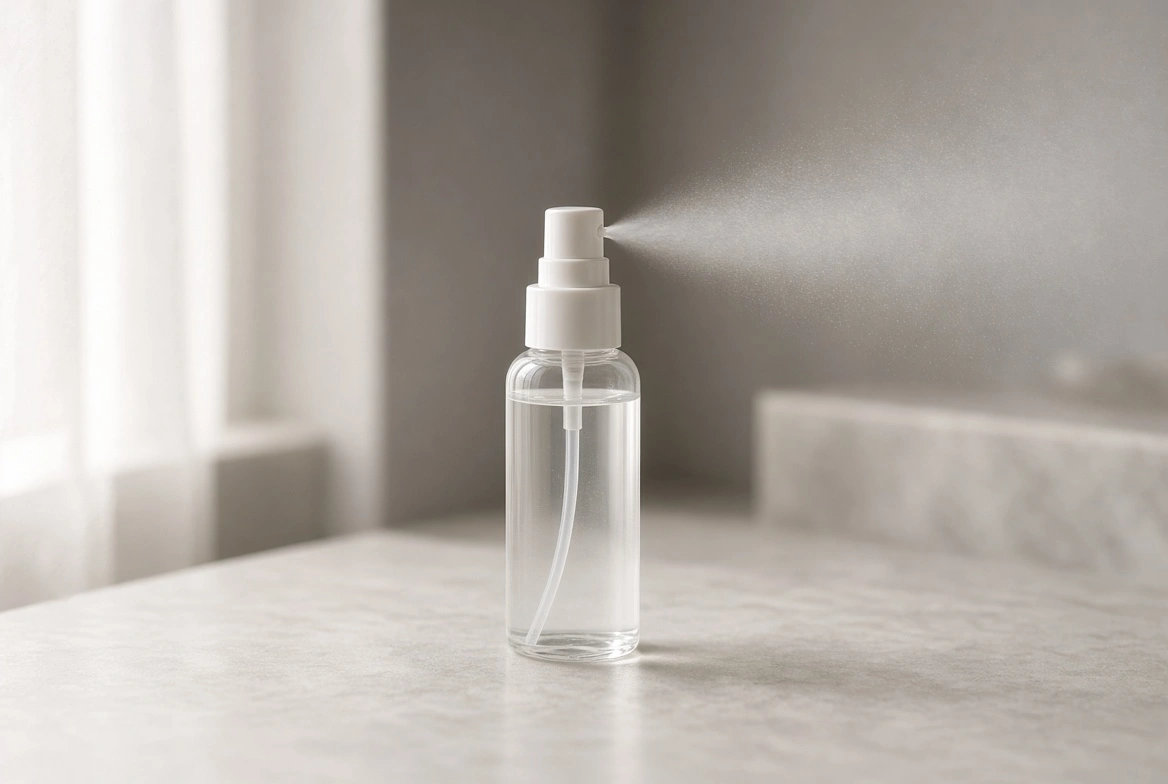
A continuous mist sprayer is the one that keeps spraying after you stop pressing. You pump the top a number of times, the bottle builds up pressure inside, and then a single press releases a steady fine mist for a few seconds rather than one burst.
It is genuinely better than a trigger sprayer for anything you want distributed evenly, which is why people buy them for hair products, facial sprays and anything applied to a surface rather than a spot.
And it is fussier than a trigger sprayer, in a way the packaging does not mention. The mechanism that produces a fine, even mist is the same mechanism that blocks.
How it actually works
Two chambers rather than one, in effect.
The pump at the top pushes air into the bottle, above the liquid. That raised pressure is what pushes the liquid up a dip tube and out through the nozzle when you press the button, and it keeps pushing until the pressure equalizes.
The nozzle is the part that turns a stream into a mist, and it does that by forcing the liquid through a very small opening. Small enough that anything solid in the liquid, or anything that dries in the opening, stops it.
Three consequences follow, and they explain every complaint people have about these bottles.
It has to hold pressure. If the seal at the pump, the cap or the nozzle leaks, the bottle stops building pressure and the spray gets weak or stops. That is not a clog, it is the opposite problem, and the fixes are different.
It has a dip tube. A tube reaching down into the liquid, which is why the bottle sprays badly when it is nearly empty and why it does not work well tilted or upside down.
It has a very small opening. Which is the clog.
Why it clogs
Almost always one of four things.
Product with solids in it. Anything with particles, anything that separates, anything with undissolved ingredients. This is the most common cause and it is a choice made at filling time rather than a fault.
Product that dries in the nozzle. Anything with a film-former, a polymer, a gel component or a lot of dissolved solids leaves a residue as the water evaporates from whatever is sitting in the opening after the last spray.
Product that is too thick. These sprayers are built for water-thin liquids. Anything with body will move slowly through the nozzle and will not atomize properly.
Time. A bottle left full and unused between trips dries out at the nozzle, which is why the thing that worked in June does not work in September.
Note what is not on that list: the bottle being cheap. A well-made sprayer with the wrong thing in it clogs, and a cheap one with water in it works.
What to put in one
The general shape of the answer: thin, dissolved, and filtered.
Water-thin liquids work. Anything you would describe as watery.
Anything with visible particles does not, and if you can see it separate when it stands, that is the same information.
Anything you mix yourself gets strained before it goes in, through a fine mesh or a coffee filter. This one step prevents most clogs and almost nobody does it.
Dilute if you can. Many products that clog at full strength are fine diluted, and for a fine mist you were not applying much anyway.
Check the product’s own instructions, because some products state what kind of container or applicator they are intended for, and where they do, that is the source rather than a general article.
The specific case of hair products is common enough to have its own treatment, and it involves a different set of ingredients: hair misters for travel covers filling and clearing one of those.
Clearing a blocked one
In order, least invasive first.
1. Confirm it is a clog and not a pressure loss. Pump it and listen. If it will not build pressure, or if you hear air escaping, the seal is the problem rather than the nozzle. If it builds pressure and then spits, sputters or produces a stream instead of a mist, that is a clog.
2. Remove the nozzle if it comes off and soak it in warm water. Most nozzles are a separate part and this is the whole repair for most blockages.
3. Flush the whole bottle. Empty it, fill it with warm water, pump it up, and spray it out until it runs clear. Repeat.
4. Do not push anything into the nozzle. A pin will get the blockage out and will also change the shape of the opening, which is what produced the mist in the first place. A nozzle you have widened does not go back.
5. Take the dip tube out if you can and check it, because a blockage can be at the bottom rather than the top.
6. Let it dry fully, in pieces, before reassembly. A part put back damp is the start of a different problem.
7. If it will not clear, it is finished. These are inexpensive and a nozzle that has had product dried in it repeatedly does not recover. When a refillable bottle is finished covers the wider set of signals.
Preventing it, which is easier
Strain anything you mix.
Spray water through it after each use, or at least at the end of a trip. Two seconds, and it is the single most effective habit here.
Empty it between trips. Do not store it full. This is the same rule that governs everything else in a travel kit, and storing refillables between trips covers the rest of it.
Store it dry and open.
Keep the nozzle clean of dried product on the outside as well as in.
Do not fill it completely. These bottles need air above the liquid to hold pressure, so a full one does not work as designed. That is a different reason from the usual headspace argument but it points the same way, and how to fill and close a travel bottle so it survives the flight covers the general fill-level question.
The air travel question, which this page does not answer
A pressurized sprayer raises an obvious question and this page is not going to answer it.
No claim is made here about whether a continuous mist sprayer may be carried, in a cabin bag or otherwise. That is a security and aviation authority question, the answer can differ by authority, and our own attempts to read the relevant primary sources returned an access error to our fetcher on 2026-08-28, repeating the same result recorded on 2026-08-24.
That is our retrieval failing rather than the authority withholding anything. Check the authority’s own current page for your departure airport before you pack, and remember that a connecting airport may apply something different.
What this site can say without a source is a mechanical point: a bottle pressurised at ground level is carrying air that will expand as cabin pressure drops. For a sprayer that is designed to hold pressure, releasing it before packing is a sensible precaution, and this is one of the reasons leaks happen at all: why travel bottles leak on a plane covers the mechanism.
The short version
- Pump the top, the bottle holds pressure, the small nozzle turns it into mist. The small nozzle is also the clog.
- Four causes: solids, drying residue, product that is too thick, and time sitting unused.
- Put thin, dissolved, strained liquids in it. Dilute where you can.
- Clear it by soaking the nozzle and flushing with warm water. Never push a pin through it.
- Rinse it after use, empty it between trips, store it dry and open, and never fill it completely.
- No air travel rule appears here. Our fetcher could not reach the authority’s page; read it yourself before you pack.