A hair mister that keeps blocking is almost never blocked by the bottle. It is blocked by what is dissolved in what you put in it, and the blockage is happening in a passage narrower than a pin: the pump orifice at the tip of the nozzle. The reason a travel mister blocks more than the one on your bathroom shelf is not that it is smaller or cheaper. It is that you refill it more often, from whatever water is available, with a mixture you re-make by eye every couple of days, and every one of those things changes what arrives at that orifice.
Fix the mixture and the refill routine and most travel misters stop clogging. This page covers the mixture, the routine, the unblocking, and the one question about misters that a checkpoint actually cares about.
The Object That Is Clogging Is the Orifice, Not the Bottle
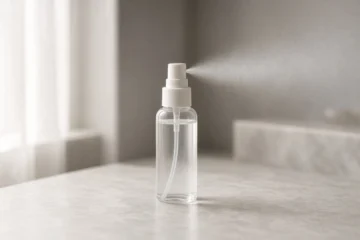
Worth being precise about, because it changes every decision below. A spray head pulls liquid up a dip tube, through a small chamber, past a check valve, and out through a hole at the tip that is deliberately tiny, because a fine mist is produced by forcing liquid through a small aperture at speed. That final hole is the narrowest point in the whole system and the only place a fine mist can be made. Anything in your liquid that is larger than that hole, or that can become larger than that hole by drying, stops the mister working.
Three things do that.
Undissolved solids. Anything that has not fully dissolved, or has fallen back out of solution while the bottle sat. Gel, thick leave-in conditioner and cream mixed into water rarely dissolve. They disperse, and dispersions separate.
Oil. Oil and water do not mix, so an oil-and-water mister is a suspension that separates in the bottle within minutes and arrives at the pump as slugs of oil rather than as a uniform liquid. Oil also coats the internals, and coated internals hold everything else that comes past.
Dried residue at the tip. The one nobody expects. Between uses, the small amount of liquid left in the orifice dries and leaves behind whatever was dissolved in it. Do that a hundred times, at an aperture that size, and the deposit is the blockage. This is why a mister that worked yesterday spits today with nothing having changed.
Mineral content in water contributes to the third of these directly. Hard water leaves mineral deposit as it dries, and a travel mister is filled from a different tap in every city. If your mister has always worked at home and started spitting on a trip, that is the most likely single change, and it is a good argument for filling from bottled or filtered water on the road even though the water is perfectly fine to drink.
What to Put in a Travel Mister
The mixtures that survive travel are the ones that are genuinely in solution, and thinner than you think.
Water alone works, will not clog, and for refreshing curls between wash days it is doing most of the work anyway.
Water plus a small amount of a liquid leave-in conditioner is the common working mixture. Thin, water-based leave-ins disperse well enough to spray. Creams and gels do not, whatever the ratio. If the product does not pour freely on its own, it will not spray after dilution, it will only clog more slowly.
Water plus a very small amount of oil is possible and needs shaking before every use, not before every session. Accept that this mixture demands more cleaning, and know that this is the mixture that ruins misters.
Anything with a suspended particle in it does not belong in a spray head. If the product is opaque because something is suspended in it rather than dissolved, that something is heading for the orifice.
One habit removes a surprising number of clogs on its own: mix less and mix fresher. A mister filled to the top with a week’s worth of diluted conditioner is a container of dilute product sitting warm in a bag, separating and growing whatever it is going to grow. Fill it two-thirds, use it up in a few days, rinse and refill.
The Refill Routine on the Road
The bottle you use for four days without touching a sink is the bottle that fails on day five. A short routine avoids it.
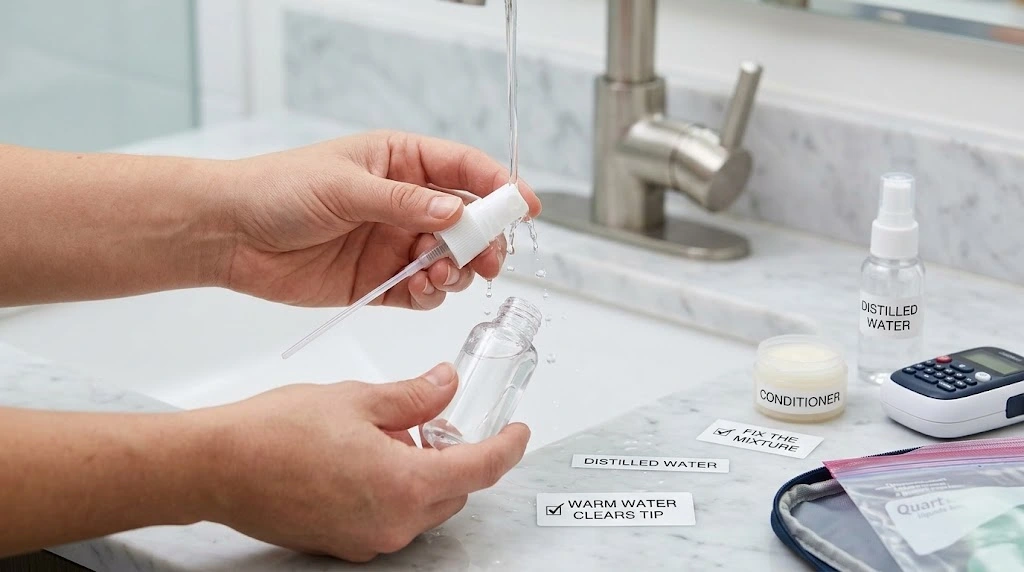
- Rinse before every refill, not every third one. Ten seconds of warm water through a working pump clears the tip while it is still clear. Most people only clean a mister once it has already stopped working, which is the hardest moment to fix it.
- Flush the pump, not just the bottle. Fill with plain warm water, refit the head, and spray until the water runs through cleanly. Water sitting in the bottle does nothing for a passage that runs through the head.
- Make the mixture in the bottle, not in the cap. Water first, product second, then close and shake. Product first means undiluted product sitting against the dip tube inlet.
- Do not store it warm and full. A bag in a car or on a windowsill is the worst place for a diluted, water-based mixture with no preservative system designed for it. Dilution is exactly what a preservative system is not designed for.
- Travel with it upright and with the nozzle locked or capped. Most spray heads twist to a closed position; use it. A mister that has leaked into your bag is a worse problem than a mister that has clogged.
Unblocking One That Has Already Stopped
In order, cheapest first.
Warm water, from the outside. Hold the nozzle tip under warm running water and work the trigger. Much of the time the deposit is right at the tip and dissolves.
Soak the head, off the bottle. Unscrew the spray head and stand it in a cup of warm water so the dip tube and nozzle are submerged. Half an hour is not too long. If you suspect mineral deposit, warm water with a splash of white vinegar is the standard approach, because vinegar is acidic and mineral scale is not. Rinse the head thoroughly afterwards, by pumping clean water through it until the vinegar smell has gone.
Pump warm water through it while it soaks. Working the trigger with the head submerged pulls solvent through the blocked passage rather than around it, which is the entire point and the step most often skipped.
Do not push anything into the orifice. A pin, a needle or a paperclip deforms the aperture, and the aperture’s exact size and shape is what produces a fine mist rather than a jet. A mister you have “cleared” with a pin frequently sprays worse afterwards, permanently.
Replace the head rather than the bottle if it will not clear. Spray heads and bottles are separate components, and a head that has been through months of diluted conditioner is a consumable.
The Checkpoint Question, Briefly
A hair mister is a liquid container and gets treated as one. The figure that governs it in the United States is the standard carry-on liquids limit, which TSA’s own pages stated as 3.4 ounces (100 ml) per container when we last read them in August 2026, with every container fitting in one quart-size bag. What people miss is that this is a rule about the container, not about what is inside it: a 6 ounce mister with an inch of water in it is a 6 ounce container and is over the limit. Buy the mister at or under the size limit rather than planning to travel with it half full. Rules change without notice and differ by country, so check tsa.gov, or the authority for the airport you are actually departing from, before you pack rather than trusting a figure on any blog including this one.
Note also that a mister large enough to be worth carrying for a week is usually a mister too large for a carry-on. That trade is real, and the usual resolution is a small mister carried on and a larger bottle of the concentrate in checked baggage, decanted as you go.
A Note on What We Did Not Test
We have not run a hair mister through a clog test, we have not measured orifice diameters, and we are not going to publish a number we have not read on a manufacturer’s own documentation. Everything above is the mechanism plus what makers publish about their own products, and where a figure would be useful and nobody publishes one, we have said so instead of estimating. That is how the pages here are built, and it is set out in more detail on our about page.