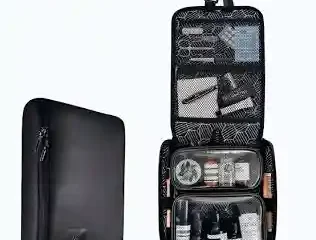
A dopp kit packs small and unpacks large: it takes up almost no room in a suitcase, and it needs a counter to be usable. A hanging toiletry bag is the reverse: it costs you real space and weight in the bag, and in exchange it needs no counter at all, because it becomes the shelf. That is the entire trade, and it is decided by the bathrooms you actually stay in rather than by how much you like to be organized. Everything else in this comparison, pockets, panels, materials, is downstream of that one exchange.
Two Names That Describe Different Kinds of Thing
Before comparing them it is worth noticing that these two terms are not the same class of word, which is part of why the comparison gets muddled.
"Dopp kit" is a genericized brand name. According to the etymology reference World Wide Words, the term traces to Charles Doppelt, a leather goods maker in Chicago in the early twentieth century, with accounts differing on whether he or his nephew Jerome Harris designed the kit, and Dopp was registered as a trademark for a men's toiletry case. The word spread widely through Second World War military issue. What it does not carry is a specification. No standards body defines a dopp kit, so in practice it means a compact, roughly rectangular zip case with one main cavity.
"Hanging toiletry bag" is a functional description: a bag with a hook, built to be opened and suspended. It tells you what the object does. So you are comparing a shape convention against a feature, and the honest version of the question is: do I need the hook, and what does it cost me.
Packed Footprint Against Unpacked Footprint
This is the framing the seller comparisons skip, and it is the one that predicts regret.
A dopp kit is a solid rectangle. It tessellates: it drops into a corner of a suitcase, sits under a stack of clothes, and wastes very little of the space it occupies. Opened, it wants a flat surface roughly the size of the bag plus whatever you take out of it, because a single-cavity case has to be emptied onto something to be used.
A hanging bag is the opposite on both counts. Folded it is thick and stiff, with internal panels and a stiffened back that resist compression, so it takes a fixed block of your case and does not squash to fit. Hung, its footprint on the counter is zero. Everything stays in its own pocket, visible, off the wet surface.
So the question is not which is better organized. It is which scarce resource you have more of: room in your luggage, or room in the bathroom.
Access: Digging Versus Seeing
The second real difference is how you get at things, and it follows directly from the geometry.
A dopp kit is a bucket. Small items migrate to the bottom, and finding one means moving several others, which is fine with eight items and irritating with twenty. Some kits fit a wide opening or a flat base to reduce this, and it helps. It does not change the fact that the contents are in one pile.
A hanging bag is a set of shallow, vertical compartments. Nothing is on top of anything else, so retrieval is a glance rather than a search, and putting things back has an obvious place. The cost is that those compartments are fixed: a bag whose pockets were sized for small bottles will not take a tall pump bottle or an electric toothbrush, and the fixed layout that helps you find things is the same layout that refuses to hold them.
That is the practical test to run in a shop. Take the two or three most awkwardly shaped things you actually carry, and see whether the bag has a place for them.
What Fails, on Each
Both shapes have a characteristic failure and it is not the fabric on either.
A hanging bag fails at the hook and its anchor. The full weight of the loaded bag hangs from one small attachment point and the seam behind it, and it swings each time you take something out. If the hook anchors into a single layer of lining rather than a reinforced panel, that is where the stitching goes, and it goes on the trip the bag was bought for. It also has more zips than a dopp kit, and each one is another thing that can jam.
A dopp kit fails at its single zip and at the base. One zip carries the whole job, it meets grit and dried product, and a coil zip that has been forced past contamination either separates behind the slider or loses teeth. The base takes the abrasion, because the kit is the thing that gets set down on wet counters and dragged out from under a stack.
Neither is more durable as a category. What varies is which single component you are depending on.
The Weight and Volume You Are Actually Buying
A hanging bag carries structure a dopp kit does not: a stiffened back panel, internal dividers, a hook and its hardware, and often a bi-fold or tri-fold spine. That is weight and it is bulk, and you carry it on every trip, including the ones with a perfectly good counter.
We do not publish weights or capacities here, because we have not measured any bag and we do not repeat a figure we have not read on the maker's own specification. What you can do is compare two candidates empty, in your hands, in the shop. The difference between an empty hanging bag and an empty dopp kit is the price of the hook, and it is worth knowing what that price is before you decide the hook is free.
Which Suits Which Trip
| Trip | Which shape | Why |
|---|---|---|
| Weekend, hotel with a vanity | Dopp kit | Counter available, luggage space is the scarce thing |
| Carry-on only, frequent short trips | Dopp kit plus a separate quart bag | Small packed footprint, liquids stay reachable at the checkpoint |
| Cruise cabin, camper van, older city hotel | Hanging bag | Sink rim only, nowhere dry to put anything down |
| Two weeks, checked bag, one base | Hanging bag | Bathroom is home for two weeks and packed bulk is paid once |
| Multi-stop trip, new room every second night | Dopp kit | It gets repacked constantly, and a bucket repacks faster than panels |
| Hostel or shared shower block | Neither, usually | An open caddy that drains and carries down a corridor does this better |
The row that should decide it is the trip you take most often, not the most demanding trip you can imagine. A hanging bag bought for a once-a-year two-week trip is carried on eleven other trips that did not need it.
The Thing Both Shapes Fail At
Neither shape prevents a leak. A hanging bag's compartments contain a spill within one pocket, which is genuinely useful, and a wipeable lining limits the damage in either. Neither stops product escaping the bottle in the first place, and the mechanism is almost always the closure rather than the bag: pressure change in the hold, a worn gasket, a cap cross-threaded in a hurry. Our read of why travel bottles leak covers what actually causes it.
The corollary is that the containers do more for your trip than the bag does. Getting the set of bottles right and sized right changes outcomes in a way that switching between these two shapes does not.
Where the Quart Bag Sits in Both
If you fly carry-on only from a United States airport, your liquids, aerosols and gels come out at the checkpoint in a clear quart-size bag, and TSA's travel checklist suggests keeping that bag in the front pocket of your carry-on for accessibility. That requirement belongs to the quart bag, not to your toiletry bag, and the details are in our read of the 3-1-1 rule.
It matters for this comparison in one way. A hanging bag's fixed pockets tend to hold the small bottles you would otherwise put in the quart bag, so you either duplicate containers or you empty three pockets at the belt. A dopp kit that simply has the quart bag lying inside it is faster to deal with. Outside the United States, the rules are set by each country's own security service and differ, including whether a bag is required at all.
FAQ
What is the actual difference between a dopp kit and a toiletry bag?
A dopp kit is a compact, roughly rectangular zip case with one main cavity, named after Charles Doppelt and originally a trademark rather than a specification. "Toiletry bag" is the general category, and a hanging toiletry bag is the version built with a hook, internal panels and a stiffened back so it can be suspended and used without a counter.
Is a hanging toiletry bag worth the extra bulk?
It is worth it if the bathrooms you use have no dry counter space, which is common on cruise ships, in hostels, in camper vans and in older hotels. If you mostly stay in rooms with a vanity, you are carrying a stiffened panel and hardware on every trip for a hook you do not use.
Which one is better for carry-on only travel?
Usually the dopp kit, because packed volume is the binding constraint and it packs as a solid rectangle with almost no wasted space. Keep the clear quart bag separate and reachable rather than buried inside it.
Do hanging toiletry bags break?
The characteristic failure is the hook and the seam anchoring it, because the loaded weight of the bag hangs from one small point and swings in use. Before buying, check whether the hook anchors into a reinforced panel or into a single layer of lining fabric.
Can I use a dopp kit as my TSA liquids bag?
No, if you are flying carry-on only from a United States airport. TSA's checklist describes the liquids bag as clear, plastic and zip top, with all liquids fitting inside it. A fabric or leather dopp kit is a different object, and it is the container that carries everything the quart bag does not.