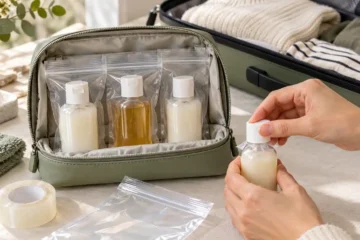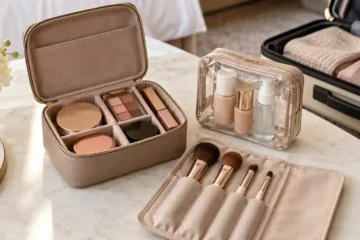
To pack jewelry for travel, give every piece its own space: thread each necklace through a straw and close the clasp, put rings and earrings in separate compartments of a pill organizer or a small hard case, and keep the whole kit in your carry-on, which is what TSA itself advises for valuables. Keep nail scissors, tweezers and razors in a different pouch. Scissors can go in a carry-on only if the blades are less than 4 inches from the pivot point, per TSA as read on 2026-09-23.
The rest of this page explains why each of those steps works, what TSA's own pages say word for word, and what we could not confirm.
Last verified: 2026-09-23. Every TSA rule quoted here was read on TSA's own "What Can I Bring?" pages on that date. Rules change without notice, so check tsa.gov before you pack.
How this page was made. This is desk research. We have no test rig and no product access, and we did not pack, fly with or damage anyone's jewelry to write it. Where a step rests on a mechanism (why chains knot, why stones scratch), we explain the mechanism so you can judge it yourself.
How to pack jewelry for travel: what goes wrong and why
Most jewelry damage on a trip comes from three things: chains knotting, hard pieces scratching soft ones, and small items going missing. Each has a different cause, so each needs a different fix.
| What goes wrong | The mechanism | The fix that addresses it |
|---|---|---|
| Necklaces arrive knotted | A loose, flexible strand tumbling in a confined space forms knots on its own | Shorten the free length and stiffen it: straw, closed clasp, one chain per sleeve |
| Stones and metal get scratched | A harder material scratches a softer one when they rub | Separate pieces so nothing touches anything else |
| Earring backs and small studs vanish | Small parts shake loose and fall through seams and pouch openings | Closed compartments, backs reattached before packing |
| Silver comes home darker | Silver reacts with sulfur compounds in the air and forms tarnish (silver sulfide) | Less air exchange: a sealed bag around silver pieces |
| A prong bends or a stone loosens | Pressure from a squeezed or compressed bag | A rigid container, kept out of compression bags |
Padding helps, but it is not the main defense. Separation is. Two rings wrapped together in a sock can still grind against each other for a whole flight.
Why necklaces tangle, and the fixes that work
Tangling is not bad luck. In 2007, physicists Dorian Raymer and Douglas Smith published a study in the Proceedings of the National Academy of Sciences in which they tumbled lengths of string in a rotating box. Knots formed spontaneously, and longer, more flexible strings were more likely to knot. A fine chain in a pouch in a moving bag is that experiment on a small scale.
That points straight at the fixes:
- Reduce free length. Close the clasp. An open chain has two free ends, and free ends are what thread through loops to make knots.
- Stiffen the strand. Threading a chain through a drinking straw (a reusable one is sturdier than paper) and clasping it around the outside turns a flexible strand into a rigid rod. Rods do not knot.
- Confine each chain alone. One chain per small zip bag, with the clasp end left poking out of the seal, keeps two chains from knotting into each other.
- Lay it flat. For a delicate chain, lay it straight on a strip of plastic wrap and fold the wrap over it. The chain cannot move enough to loop.
Pendants add weight at one point, which gives the chain something to swing around. Wrap the pendant itself in a small square of cloth so it cannot flip through its own chain.
Rings, earrings and bracelets: separation beats padding
Diamond is the hardest natural material, so a diamond ring loose in a pouch can scratch gold, silver and softer gemstones. Softer organic gems such as pearls and opal are easy to scratch too. The fix is a wall between pieces, not more fabric around them.
The container most people already own is a weekly pill organizer. Its compartments are small, closed and separate, which is exactly what rings and stud earrings need. One piece per compartment. If the lids are held shut only by friction, put the organizer in a zip bag so one lid popping open does not empty the others.
For earrings, push the posts through a scrap of stiff card or foam and put the backs on behind it. The pair stays together and the backs cannot fall off.
Bracelets hold their shape best around something rigid. A cardboard tube or a rolled pair of socks works; slide it into a zip bag so nothing slips off the ends.
A dedicated jewelry case with molded compartments does the same job with less improvising. It is a convenience, not a requirement. If you already own a pill organizer and a few zip bags, you have what you need.
Carry-on or checked bag? What TSA says about jewelry
TSA answers this directly. Its TSA "What Can I Bring?" entry for jewelry, read on 2026-09-23, lists jewelry as allowed in both carry-on and checked bags, then adds: "If you are travelling with valuable items such as jewelry, please keep those items with you at all times (do not put them in checked baggage). You can ask the TSA officer to screen you and your valuables in private to maintain your security."
So the rule is permissive and the advice is not. Jewelry is allowed in a checked bag, but TSA tells you not to put valuable pieces there. A checked bag leaves your control at the counter and you do not see it again until the carousel.
What an airline will pay if a checked bag loses your jewelry depends on that airline's contract of carriage. We have not surveyed airline terms for this article, so read your own airline's before you decide what goes in the hold.
Inside the carry-on, keep the jewelry kit in an interior pocket or in the middle of the bag, packed between soft items. Outer pockets take the knocks and are the easiest to open.
If you use packing cubes, the jewelry kit is one more category. A system with one cube per category rather than one per day keeps every piece in one place instead of scattered across four cubes. Keep the kit out of any roll-up compression bag, though. Those bags work by squeezing the contents flat, and that pressure lands on prongs, clasps and settings.
Getting through the checkpoint while wearing it
TSA's travel checklist, read on 2026-09-23, tells travelers to "remove bulky jewelry (valuable items can be placed in carry-on)." Small everyday pieces are not singled out, but anything bulky should come off before you reach the scanner.
A practical order that follows from that wording:
- Before the line, take off bulky pieces and put them straight into the jewelry kit in your carry-on. Do not drop them loose in a bin, where a ring can slide into the bin's corner or roll out.
- Close the kit so nothing can spill if the bag is opened for inspection.
- If you want privacy, TSA's jewelry entry says you can ask the officer to screen you and your valuables in private.
Every TSA item page carries the same caveat: "The final decision rests with the TSA officer on whether an item is allowed through the checkpoint."
Nail scissors, clippers, tweezers and razors: the TSA rules as read on 2026-09-23
These are the small sharp things that usually travel with jewelry and grooming kits. Here is what each TSA "What Can I Bring?" entry said on 2026-09-23, quoted rather than summarized:
| Item | Carry-on | Checked | TSA's wording |
|---|---|---|---|
| Scissors | Yes (special instructions) | Yes | "If packed in carry-on, they must be less than 4 inches from the pivot point." |
| Nail clippers | Yes | Yes | No special instructions beyond the sharp-objects note |
| Tweezers | Yes | Yes | No special instructions beyond the sharp-objects note |
| Disposable razor | Yes | Yes | No special instructions beyond the sharp-objects note |
| Safety razor with blade | No | Yes | "A Safety Razor is allowed through the screening checkpoint without the blade. The blade must be removed prior to entering the screening checkpoint. TSA officers are not authorized to remove the blades from the holder." |
| Razor-type blades | No | Yes | "Box cutters, razor blades not in a cartridge are prohibited in carry-on." |
Every one of those entries also carries this line: "Any sharp objects in checked bags should be sheathed or securely wrapped to prevent injury to baggage handlers and inspectors." TSA's Sharp Objects list, read the same day, also shows knives as not allowed in carry-on and allowed in checked bags, which matters if your grooming kit includes a small folding blade.
If a tool is not in that table (cuticle nippers, a metal nail file, a multitool), search for it by name in TSA's "What Can I Bring?" tool before you fly rather than guessing from a similar item.
How to read "less than 4 inches from the pivot point"
The TSA scissors entry measures from the pivot point, the screw or rivet where the two blades cross. Read plainly, that is the length of the blade from the screw to the tip, not the overall length including the handles. Most small nail scissors are well under that. Longer grooming or craft scissors may not be, so measure the blade from the screw before you pack them in a carry-on. If they are 4 inches or more from the pivot, they go in the checked bag, sheathed or wrapped.
Where the small sharp things go in the bag
Keep sharp tools and jewelry in separate pouches. A tweezer tip or scissor point in the same pouch as a chain will snag it, and a loose blade can scratch a stone the same way a diamond can.
- Carry-on: nail scissors under the 4-inch line, clippers and tweezers go in the toiletry bag with the points covered. A cap, a folded piece of card with tape, or the case they came in all work. Your toiletry bag does not need to be see-through for these; our page on whether a toiletry bag has to be clear covers what TSA does and does not require of the bag itself.
- Checked bag: safety razor blades, loose blades and any scissors 4 inches or more from the pivot. Follow TSA's own instruction and sheath or wrap them securely.
- Near the top: put the grooming pouch where an officer can reach it without unpacking everything. If a bag is pulled for inspection, the item they want to see should be easy to find.
What we could not confirm, and what no case solves
We are not going to overstate this.
- We did not compare jewelry cases, anti-tarnish strips or organizers. Anti-tarnish strips are sold to absorb the sulfur compounds that darken silver. We have no test data on how well any of them work over a week of travel, so we are not recommending one.
- Wear is the biggest risk and packing cannot fix it. A clasp that is already weak or a loose stone setting will fail wherever it is. If a setting moves when you press it, have a jeweler look at it before the trip, not after.
- Airline and insurance cover vary. We have not reviewed airline liability terms or jewelry insurance for this article. Both are worth checking for anything you could not bear to lose.
- Leaving it at home is an option. The piece that cannot be lost on a trip is the one that did not go.
Do you need to buy anything?
Usually not. A pill organizer, a few zip bags, some straws and a small zipped pouch cover almost every piece most people travel with. A dedicated case is tidier and quicker to repack, and that is the honest case for it. Whether packing cubes are worth adding at all is a separate question: see whether packing cubes actually save space, because for a small jewelry kit, they mostly add organization, not room.
FAQ
Can I pack jewelry in my checked bag?
TSA lists jewelry as allowed in checked bags, but its own "What Can I Bring?" entry, read on 2026-09-23, says to keep valuable items such as jewelry with you at all times and not put them in checked baggage. Carry it on.
Do I have to take off my jewelry at airport security?
TSA's travel checklist, read on 2026-09-23, tells travelers to remove bulky jewelry and notes that valuable items can be placed in carry-on. Put bulky pieces in a closed pouch in your carry-on before the line, not loose in a bin.
Are nail scissors allowed in a carry-on?
Yes, if they are small enough. TSA's scissors entry, read on 2026-09-23, says that if packed in a carry-on, scissors "must be less than 4 inches from the pivot point." Measure the blade from the screw to the tip. Longer scissors go in a checked bag, sheathed or wrapped.
What is the best way to keep necklaces from tangling in a suitcase?
Close the clasp, thread the chain through a straw so it cannot bend into loops, and give each chain its own small bag. Tangling comes from free, flexible length moving in a confined space, so shortening and stiffening the chain removes the cause.
Can I bring tweezers and nail clippers on a plane?
Yes. TSA's entries for both, read on 2026-09-23, list them as allowed in carry-on and checked bags. In a checked bag, TSA asks that sharp objects be sheathed or securely wrapped. The officer at the checkpoint still has the final say.