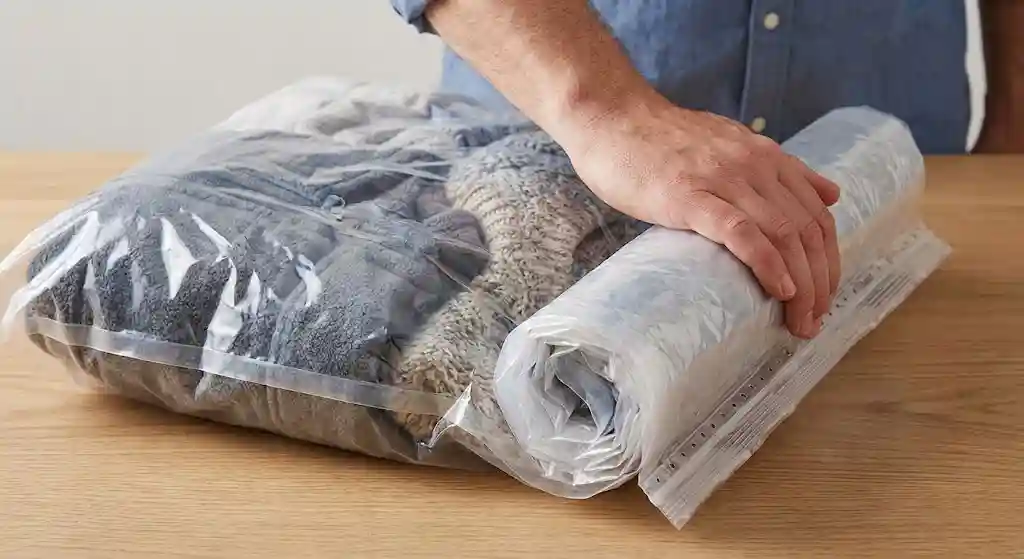
A roll-up compression bag is a sealed plastic bag with a one-way valve or a set of vents along one edge. Clothes go in, the bag is closed, and you roll it from the sealed end toward the valve. The air is pushed out ahead of the roll and cannot come back in.
The question people arrive with is whether squeezing air out actually makes clothes smaller. It makes the package smaller. It does not make the clothes smaller, and the difference between those two statements explains everything about when these work and when they disappoint.
What is actually being removed
Three kinds of air are in a bag of clothes.
Air between garments. The gaps where one folded item sits on another. This is the bulk of what a roll-up bag removes, and it is real.
Air inside garments. The loft in a fleece, a puffer, a wool sweater, a towel. Fabrics with structure hold a great deal of air inside their own fibers, and a compression bag squeezes most of it out.
Air the fabric cannot give up. The volume of the material itself. Nothing removes this, which is why a compressed bag of jeans is still a substantial object.
So the effect scales entirely with how lofty your clothes are. A bag of bulky knitwear compresses dramatically. A bag of t-shirts and jeans barely changes.
That single observation resolves most of the disagreement about these products. People with different wardrobes get genuinely different results and both are reporting accurately.
Roll-up versus vacuum
Two products that do the same job by different means.
Roll-up bags use your own effort. No pump, nothing to plug in, and they work anywhere. They are lighter, they pack flat when empty, and they remove less air than a vacuum, because rolling is a less complete method than suction.
Vacuum bags need a pump or a vacuum cleaner. They remove more air, which is why they are the choice for storage at home. They are frequently impractical on a trip, because you will not have a vacuum cleaner in a hotel, so the bag that compressed beautifully on the way out cannot be recompressed on the way back.
For travel, the roll-up is the one that works in both directions, and that is its main advantage over the more effective product.
What the compression costs you
Four things, and they are not usually stated.
Creasing. Compression is sustained pressure, which is the actual cause of wrinkles in a bag. Anything you compress comes out creased, and the crisper the fabric the worse it looks.
Weight is unchanged. This is the most important sentence for anyone flying with a weight limit. Compression removes volume, not mass. A bag that now fits may still be over the limit, and it will feel deceptively small while being exactly as heavy as before.
Density in one place. A tightly compressed brick is heavy, rigid and awkward, and it does not conform to the shape of a bag the way loose clothes do. A very hard block can actually be harder to fit than the loose equivalent.
The bag itself. Plastic, seams and a valve, all of which can fail. A split bag mid-trip means you now have loose clothes and a useless bag.
The return journey
This is where the disappointment happens and it is entirely predictable.
On the way out you had time, a flat surface and clean, folded, uncompressed clothes.
On the way back you have dirty clothes that are no longer folded, souvenirs that do not compress at all, and less time. Dirty clothes occupy more space than clean ones because they have lost the arrangement you put them in, and nothing about a compression bag recovers that.
Two practical responses:
Do not fill your bag to capacity on the way out. Whatever you gained in compression, leave some of it as space rather than as more clothes. The gain is only useful if you do not immediately spend it.
Refold before recompressing. The bag will compress what you put in it, and a bag of loose clothes compresses less well than a bag of folded ones. The rolling still works; you just get less from it.
What to compress and what not to
Compress: bulky knitwear, fleece, jackets, towels, sleepwear, anything soft that you do not mind creasing, and everything you have already worn.
Do not compress: anything crisp or tailored, anything with structure, anything you want to look presentable on arrival, and anything with a shape that matters.
Never compress: anything rigid, anything electronic, and anything that could be damaged by pressure. A compression bag applies real force and it does not distinguish.
The general rule that emerges: compress the things whose appearance does not matter, and use ordinary containers for the things whose appearance does. That is the same split that governs whether to roll or fold something in the first place.
Why the percentages online are unusable
Search this question and you will be given compression figures. This site’s own review of that SERP found published claims ranging from around five to ten percent, through fifteen to thirty percent, up to twenty to fifty percent.
Not one of those pages states a method.
A compression figure without a stated method is unreadable, because the result depends entirely on what was compressed, how the uncompressed baseline was packed, and how the measurement was taken. A lofty sweater packed loosely as a baseline will produce a spectacular number. The same sweater packed carefully first will not.
So no percentage appears here, and this site has measured nothing. What is stable and true regardless of whose number is right is the mechanism above: the gain scales with the loft of the fabric, and it removes no weight at all.
If you want a figure for your own trip, produce one. Pack the clothes as well as you can without the bags and note how the case looks. Repack the same clothes in the bags. Compare. That takes an hour and it tells you about your wardrobe rather than about somebody’s claim.
Liquids, and why they never go in one
Worth stating plainly, because a sealed bag looks like the obvious place for anything that might leak.
A compression bag is squeezed, deliberately and hard. Putting a bottle in one applies exactly the force that opens a closure, and the failure would be inside a sealed bag with your clothes.
Liquids go in their own sealed bag, uncompressed, and the reasons a closure fails in a packed bag are covered in why travel bottles leak on a plane. The fill level matters too, and how to fill and close a travel bottle so it survives the flight covers the headspace question, which compression makes considerably worse.
The short version
- A roll-up bag removes air between and inside garments. It does not make the clothes smaller.
- The gain scales with loft. Bulky knitwear compresses dramatically; t-shirts and jeans barely.
- Roll-up beats vacuum for travel because you can recompress on the way back without a pump.
- Compression removes volume and not weight. A weight limit is unaffected.
- It causes creasing, because sustained pressure is what creases clothes.
- Do not fill the space you gained, and refold before recompressing on the way home.
- No percentage appears here, because the published ones state no method. Test your own wardrobe.
- Never put a liquid container in one.