A silicone travel bottle that still smells after washing is not dirty. Washing removes what is sitting on the surface, and the smell you are chasing is not on the surface: it is dissolved into the silicone itself. That is why the internet gives you two sets of instructions that appear to contradict each other, hot soapy water and a long soak, and why people who try the first one and fail assume they did it wrong. They did not. They used the method for the other problem.
This article separates the two problems, because almost nothing written about cleaning silicone travel bottles does, and the order you tackle them in decides whether you get the bottle back or throw it away.
The Two Problems Are Not the Same Problem
Open the bottle and ask which of these you have.
Residue. Something visible or tactile. A film on the inside wall, a ring at the shoulder, dried conditioner in the cap threads, grit around the valve. It has physical presence. It comes off with mechanical force plus a surfactant, which is to say hot water, dish soap and a brush that actually reaches.
Absorbed odor. Nothing visible. The bottle is clean, dry and empty and still smells of what was in it three months ago. Nothing is sitting on the wall to remove, so scrubbing harder does nothing at all, and this is the point at which most people scrub harder.
Silicone is the reason for the second one. The elastomer used in travel bottles is soft, flexible and slightly permeable, and it is chemically friendly to oils. Fragrance compounds and the oil carriers they ride in are small, oily molecules, so they do not merely coat the wall. They migrate a short distance into it and sit there. The bottle is not holding a layer of conditioner. It is holding the smell of conditioner in solution, which is a different object entirely, and a scrubbing brush cannot reach an object that is inside the wall.
Once that is clear, the contradictory advice resolves. Soap and a brush is the correct method for residue and useless against absorbed odor. A long soak is the correct method for absorbed odor and mostly a waste of an afternoon against residue. They are both right. They answer different questions.
Method One: Getting the Residue Out
Do this every time, and do it at the end of a trip rather than the start of the next one.
- Empty and rinse warm, immediately. Product that has not dried is product that has not bonded. Most of the difficulty in cleaning a travel bottle is created in the week it spent full and shut in a bag.
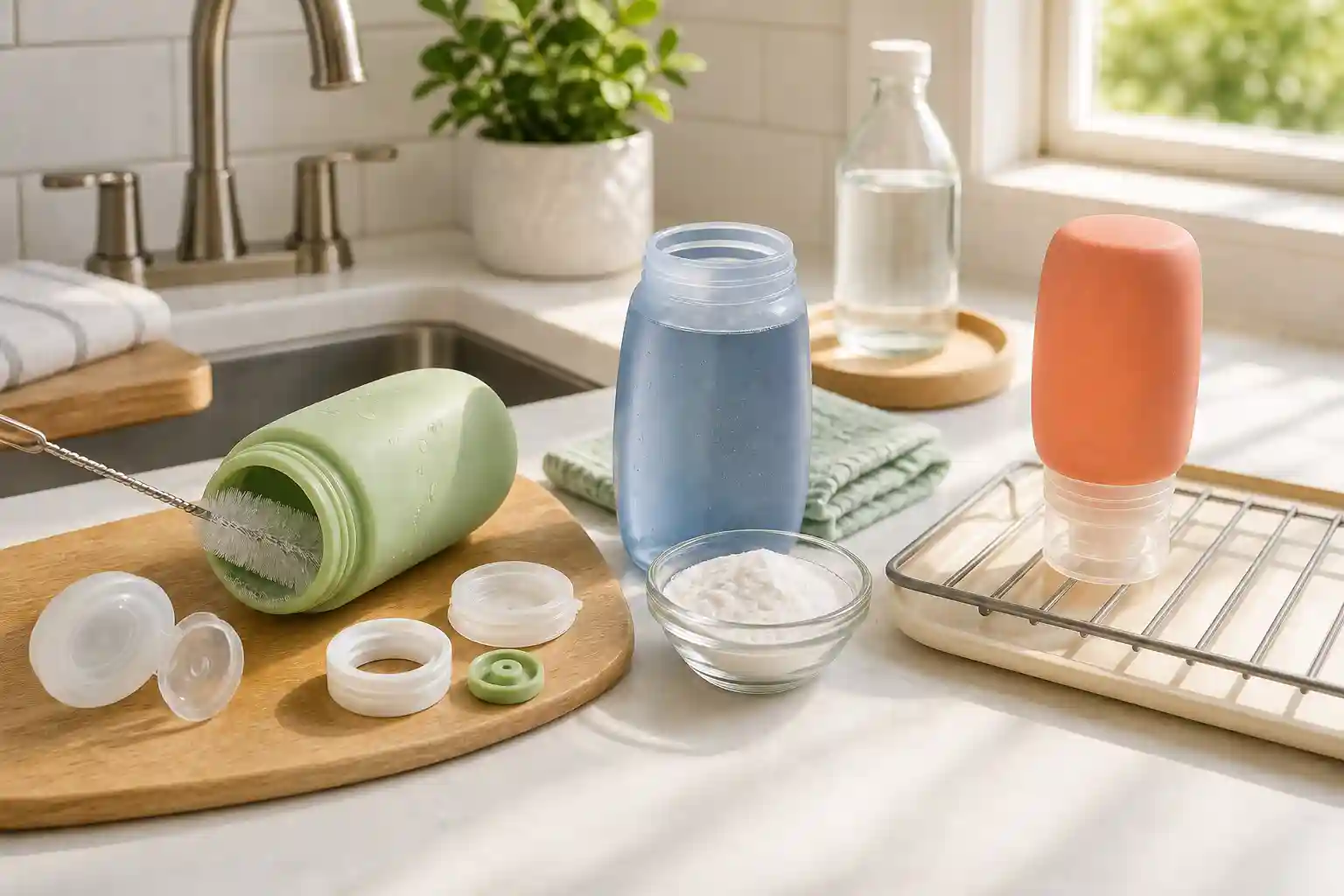
- Take it apart. The cap comes off, and on most designs so does the gasket, the disc insert or the pump collar. Whatever separates, separate it. The single most common failure in cleaning a travel bottle is washing the bottle and not the parts, and the parts are where the trapped product lives.
- Hot water and dish soap. Dish soap is a degreaser, which is exactly the job. A thick, oily product needs surfactant, not pressure.
- Reach the geometry. A narrow bottle brush for the body, and something thin, a soft interdental brush or a cotton swab, for the cap threads and the underside of the disc. On a squeezable bottle you can fill it a third full with hot soapy water, close it and shake, and the wall flexing does a fair amount of the scrubbing for you.
- Rinse until the water runs clear and stops feeling slippery. Slipperiness after rinsing is unrinsed surfactant, and left in the bottle it will contribute its own smell.
- Dry fully, open, upside down, with the cap off. This is the step people skip and the one that decides whether you are cleaning a bottle next month or fighting mold in it.
If the bottle smells fine after this, you are done. The rest of this page is for the bottle that does not.
Method Two: Getting the Smell Out
There is no scrubbing solution to absorbed odor. What works is time and a medium that the odor compounds would rather be in than the silicone.
Baking soda in warm water, and leave it. Make a slurry, fill the bottle, cap it, and leave it overnight or longer. Bicarbonate is mildly alkaline and works on the acidic end of the odor range, and the long contact time is doing more work than the chemistry is. A short soak is not a small version of this method. It is a failed version of it.
White vinegar, and leave it. Dilute in warm water, same overnight treatment. Vinegar works on a different range of compounds than bicarbonate does, which is why one bottle responds to the first and another to the second, and why the advice you found online worked for the person who wrote it and not for you. Rinse thoroughly afterwards or you have traded one smell for another. Do not mix the two. Combining an acid and a base gives you fizzing, salt and water, and neither reagent left to do its job.
Heat, if the manufacturer’s own listing allows it. Boiling water or a dishwasher’s top rack shifts absorbed odor faster than a cold soak, because you are increasing the rate at which those molecules leave the material. The condition matters: check the maker’s own stated instructions for that specific bottle, because a pump mechanism, a printed label or a plastic collar may not tolerate what the silicone body does. Do not assume dishwasher-safe from the fact that it is silicone.
Sunlight and open air, for days. Unglamorous, free, and the most reliable of the four. An empty, clean, dry, uncapped bottle left somewhere airy loses smell continuously because the compounds are volatile and nothing is stopping them from leaving. Several days is not unusual. It is the method that most often works after the soaks did not.
Expect a partial result on some bottles, and know when to stop. Strongly pigmented or heavily fragranced products, and essential oils in particular, can leave a bottle permanently marked, and no soak fixes permanent. At that point the honest options are to retire the bottle or to accept it as a dedicated container for that one product, which is a real solution and not a defeat.
What Bleach Does, and Why We Do Not Recommend It
Household bleach appears in a great many cleaning guides for silicone travel bottles, usually as a one-line instruction with no discussion of consequences. It deserves the discussion.
Sodium hypochlorite is an oxidiser. It is effective against the organic material you are trying to destroy, and it is not selective about which organic material it meets. The part of a travel bottle you least want to degrade is the seal: the gasket or moulded lip that is doing the entire job of keeping shampoo out of your clothes. That component is thin, it is under compression every time you close the cap, and it is the part with the least material to spare. A cap that no longer seals is a worse outcome than a bottle that smells faintly of conditioner, because one is an inconvenience and the other empties into your bag at altitude.
There is a second problem with bleach specifically on silicone. The odor you are trying to remove is absorbed into the wall, and so is bleach if you leave it there long enough. Bleach smell in a bottle you are about to fill with face cream is not a fix.
We are not aware of a published, independent test of what a bleach soak does to travel-bottle gaskets over repeated cycles. If one exists we have not found it, and we are not going to invent a number to fill the gap. What we can say is that the manufacturers who sell these bottles publish cleaning instructions for them, those instructions are the closest thing to an authority that exists here, and where they say soap and water they are not being cautious for the sake of it. We build pages like this one from reasoning and primary documentation rather than from testing we have not done, and we say which is which; that approach is set out on our about page.
Preventing the Problem Instead of Solving It
The bottle that never smells is the bottle that was never left full and sealed in a warm bag for a month. Almost all of this is avoidable.
- Empty it at the end of the trip, not the start of the next one. Product that sits is product that soaks in.
- Dry it uncapped. A sealed damp bottle is the standard origin story for both smell and mold.
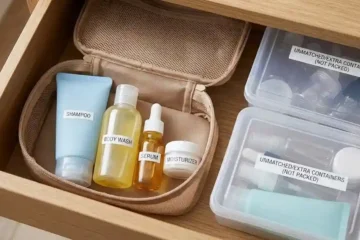
- Dedicate bottles to product types. Keep one for oils and one for water-based products and label them. Oil is the thing that soaks in, so the bottle that only ever meets shampoo will outlast the one that meets everything.
- Do not decant essential oils, solvent-based products or strong fragrance into silicone. This is the single most common way a silicone bottle is ruined permanently, and it is a compatibility question rather than a cleaning one.
- Keep the cap with its bottle. Caps and gaskets are not interchangeable across designs, and a mismatched cap is a leak.
When the Bottle Is Finished
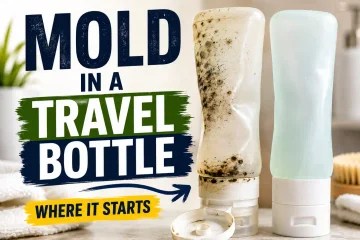
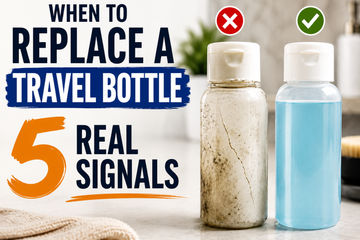
Cleaning has a limit and it is worth naming. Retire a silicone travel bottle when the smell survives a proper soak and several days of open air; when the surface has gone tacky, which is degradation of the material rather than dirt; when the gasket is deformed, split, hardened or missing; when a stain is inside the wall rather than on it; or when you have found dark specks under the cap and cannot get behind the seal to be certain they are gone. A container that holds something you put on your skin is not the place to be optimistic. These are cheap objects, and a bottle you have stopped trusting is not doing its job even if it still holds liquid.