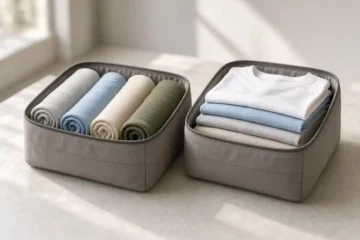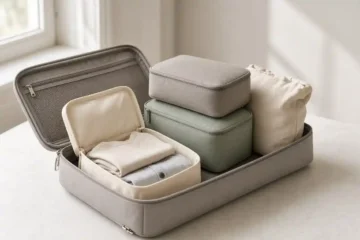
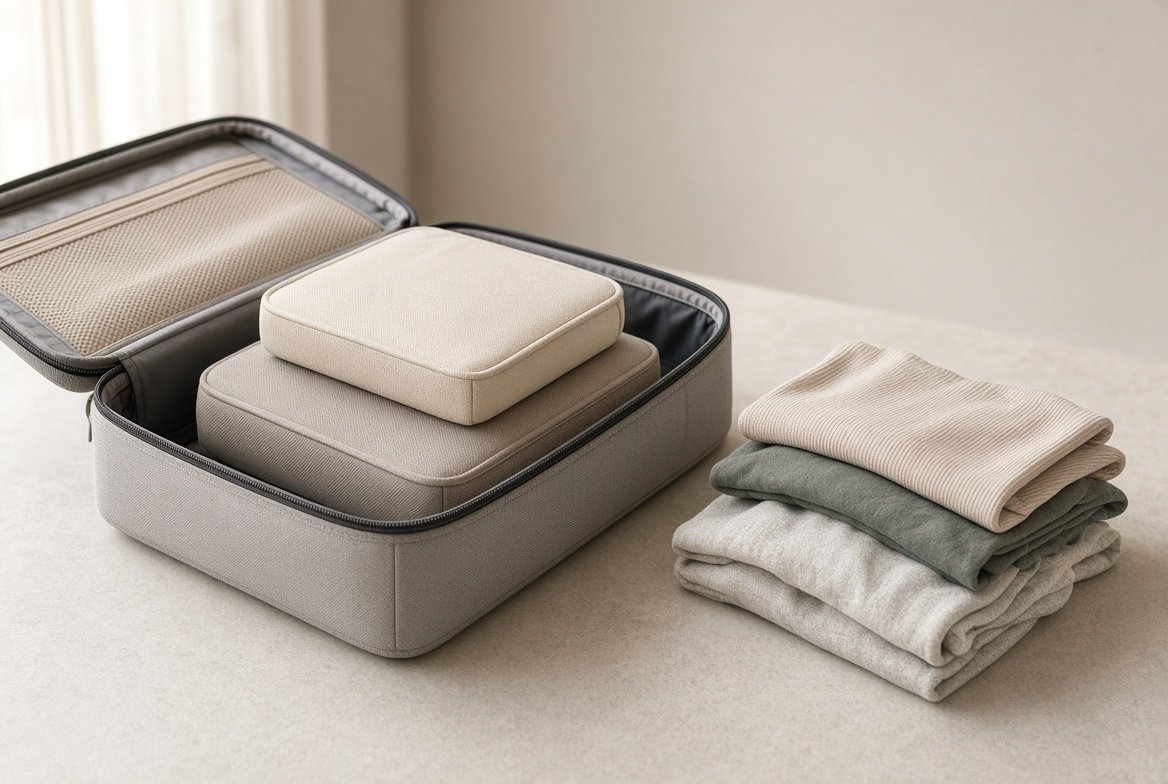
Everyone who sells packing cubes says they save space. They would.
The honest answer needs the question split in two, because “packing cubes” covers products that do different things, and because the space question and the organizing question have different answers.
A plain packing cube does not remove volume from your clothes. It arranges the volume. A compression cube is a different product and it does something else. Conflating the two is why the internet cannot agree on this.
What a plain cube physically does
A rectangular fabric container with a zip. Clothes go in, the zip closes, the cube goes in the bag.
What it does not do: reduce the volume of the clothes. Nothing about putting a shirt in a bag makes the shirt smaller. If you close a plain cube on the same clothes, you have the same clothes in a container.
What it does do, and this is real:
It makes the volume regular. Loose clothes in a suitcase form an irregular pile with air gaps around the edges. A cube is a rectangle, and rectangles stack against each other and against the sides of a rectangular bag without gaps. The space you gain is the space that was wasted around an irregular shape, not space taken out of your clothes.
It stops things migrating. A packed bag settles in transit, and what was neat becomes loose. Cubes hold their contents in the shape you put them in.
It makes a bag unpackable and repackable. Which is a real benefit on a multi-stop trip and is not a space benefit.
It adds weight and a small amount of volume of its own. The fabric is not free. On a weight-limited trip that matters, and on a volume-limited one the cube walls take some space.
Net effect: usually a modest gain, entirely from the packing geometry, and it depends heavily on how badly you were packing before. Somebody who packed loosely gains more than somebody who already packed tightly, which is a large part of why people’s experiences differ so much.
What a compression product does
Different mechanism, and there are two kinds.
A compression cube has a second zip that pulls the top down, physically squeezing the contents. It does reduce volume, by forcing air out of and between the garments.
A vacuum or roll-up compression bag removes air more aggressively, either with a pump or by rolling the air out through a valve.
Both of these genuinely reduce the space clothes occupy. Both have costs: more creasing, more weight in some cases, and the compressed volume comes back when you open it, which is the reason things fit going out and not coming home.
These are a different product from a plain cube and they answer a different question. If your problem is that your clothes do not fit, that is a compression question. If your problem is that your bag is chaotic, that is a cube question.
Why every number you find is unverifiable
Search this question and you will be given percentages. This site’s own review of that SERP found published claims ranging from around five to ten percent, through fifteen to thirty percent, up to twenty to fifty percent.
Not one of those pages states a method.
That is the entire finding, and it is worth sitting with. A compression percentage is meaningless without knowing what was compressed, how it was measured, what it was compared against, and how the “before” state was packed. Ten identical trousers packed carelessly and then compressed will produce a spectacular figure. The same trousers packed carefully first will produce a small one.
So this page publishes no percentage of its own, and it has not run a test. Any figure here would join the pile above, and this site has bought, packed and measured nothing.
What it can tell you is the shape of the answer: a plain cube’s benefit comes from geometry and depends on how you packed before; a compression product’s benefit comes from removing air and depends on what the clothes are. Those two statements are true regardless of whose percentage is right.
The test that answers it for you
An hour, and it produces a number about your bag, your clothes and your packing style, which is the only number that matters.
- Pack your bag the way you normally do, with the clothes for a real trip.
- Note how full it is, by whatever means you have: does it close easily, how much room is left, what did not fit.
- Take everything out and repack it in cubes, the same clothes, same bag.
- Compare.
Then, if you want to isolate the compression question:
- Repack the same clothes in compression cubes or bags, and compare again.
The step people skip is step one done honestly. If you pack loosely as a baseline and tightly with cubes, you have measured your own effort rather than the product. Pack the baseline as well as you can, and the result will be smaller and true.
What actually decides whether they help you
Four things, and none is the brand.
How you packed before. The single biggest variable, and the reason recommendations conflict.
What you pack. Bulky soft items compress. Structured items, shoes and anything rigid do not, and no cube changes that.
Whether your bag is soft or hard. A soft bag with an irregular pile in it can be squashed into shape by the zip; a hard case cannot, so regular rectangles matter more.
Whether your problem is space or chaos. Be honest about this before buying. If you can close your bag and simply cannot find anything, cubes solve your problem and the space question is irrelevant. If your bag will not close, you need compression or fewer clothes.
The argument against
Made properly, because every page selling these skips it.
They add weight. Small per cube and it accumulates, and on a weight-limited flight that is a real cost against a modest gain.
They add their own bulk. Fabric and zips occupy space.
They can make packing worse. A set of six cubes encourages filling six cubes. A container invites contents, and this is the same effect that produces an over-stocked kit in any category: the reason what actually belongs in a refillable travel bottle kit is a shorter list than the sets sold is exactly the same principle.
They do not reduce what you brought. The most effective volume reduction available to anyone is packing less, and it is free.
A compressed bag is harder to close on the way home. Whatever you compressed expands, and souvenirs do not compress at all.
Where they genuinely earn their place
Multi-stop trips, where you unpack and repack repeatedly.
Shared bags, where two people’s things need to stay separate.
Hard-sided cases, where regular shapes matter most.
Keeping wet, dirty or leaking things away from everything else. This is an underrated one, and it overlaps with the reason every liquid container in a bag goes in its own sealed bag: why travel bottles leak on a plane covers what fails, and the containment principle is the same.
The short version
- A plain cube does not shrink your clothes. It makes the volume regular, which recovers the space wasted around an irregular pile.
- A compression cube or bag does reduce volume, by removing air. Different product, different question.
- The percentages online range widely and not one of the pages states a method. No figure appears here.
- Your gain depends mostly on how well you packed before, which is why recommendations conflict.
- Run the test with your own bag and clothes, and pack the baseline honestly.
- Cubes add weight and bulk and encourage filling them. Packing less is still the most effective method.