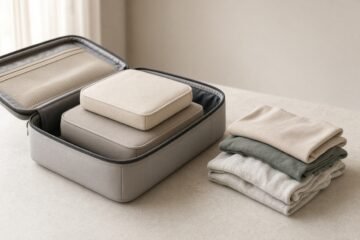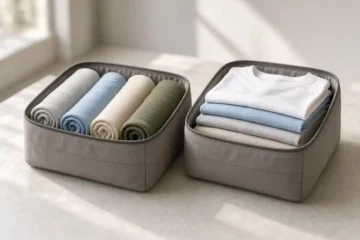
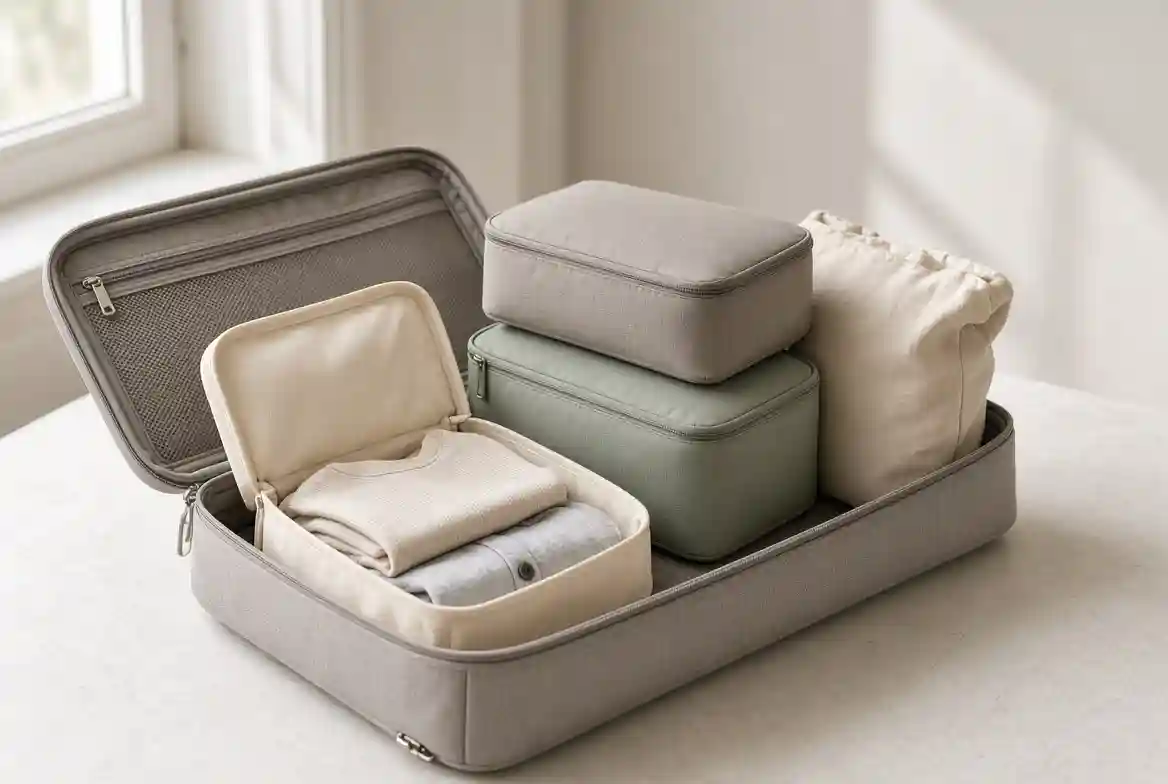
You bought the cubes. Everything is now in a cube. And on day three of the trip you are still taking three cubes out of the bag to find one shirt.
The cubes were not the answer on their own, because a cube is a container and a container without a system is a smaller version of the same problem.
There are two systems that work, they suit different trips, and most people have never explicitly chosen between them.
System one: one cube per category
All the shirts together, all the trousers together, underwear and socks together, and so on.
It suits: a trip with one base. A hotel for a week, a house, anywhere you unpack on arrival.
Why it works there: you unpack once. Each cube becomes a drawer, either literally in a drawer or left open in the bag, and after that the system is invisible because you are living out of an unpacked room.
Where it fails: a trip where you never unpack. Every morning you are opening three or four cubes to assemble one outfit, then putting three or four back.
The refinement that makes it much better: categories by frequency rather than by garment type. The things you need daily in one cube, the things you need occasionally in another, and the things you may not need at all in a third. That way one cube comes out most days and the rest stay packed.
System two: one cube per day, or per segment
Each cube holds a complete outfit, or everything for one segment of the trip.
It suits: multi-stop travel, one night in each place, a trip where the bag is never fully unpacked, and any trip with distinct phases such as work days and then a weekend.
Why it works there: you take out one cube, you use its contents, and the used items go somewhere else. The bag never gets opened up and never gets disordered.
Where it fails: longer stays, where a full unpack makes daily categories more useful. And it fails when plans change, because a cube containing a whole outfit assumes you know what you will wear.
The refinement: per segment rather than per day. One cube for the first three days, one for the next three, one for the different climate or the different dress code. That keeps the benefit without pretending you can predict a Tuesday.
The version most people end up with
A hybrid, and it is not a failure of discipline.
One cube per day for the short structured part of the trip, plus category cubes for everything that is the same every day: underwear, socks, sleepwear, workout things.
Plus two fixed cubes that are always the same regardless of the trip, which is the part that matters most:
A dirty cube. The single most useful container in any bag and the one people improvise. Dirty things go in it and never come out until you are home, which is what stops the used and unused mixing.
A wet or leaking cube. Anything damp, anything that might leak, swimwear, and anything you would not want next to your clothes.
That second one deserves emphasis, because containment is the whole reason bags get ruined. Every liquid container in a bag goes in a sealed bag of its own regardless of what cube it is in, because the cost of a leak is your clothes rather than the bottle. Why travel bottles leak on a plane covers what actually fails, and it is almost never the container.
The failure mode that makes people give up
It is the same one every time, and it happens on day two.
The system exists for packing and not for unpacking. You pack beautifully. You wear things. And now the used things have nowhere to live, so they go back into whichever cube has room, and by day three every cube contains a mixture of clean and dirty.
A system that does not have a designated place for used items is not a system. It is a packing arrangement that survives until you use it.
Two things fix it and both are trivial:
A dirty cube that is only ever dirty. Never the source of anything, only a destination.
Nothing goes back into a clean cube. Ever. If you took something out and did not wear it, it can go back. If you wore it, it cannot.
The same principle applies to anything you refilled during a trip: things you have used and things you have not need to be distinguishable, which is one of the reasons a travel kit wants labeling more than it looks like it does. What actually belongs in a refillable travel bottle kit makes the same argument about carrying less in the first place.
Which cube goes where in the bag
Independent of the system and worth getting right.
Heavy things low and close to your back in a backpack, or over the wheels in a wheeled bag. This is a stability question and it changes how a bag carries more than its total weight does.
The cube you need first at the top, or nearest the opening. On a wheeled case that opens flat, that is a side; on a top-loading backpack, it is literally the top.
Anything you need at security or on the plane in an outer pocket, not in a cube. Whatever your departure airport requires you to present separately, plus anything you want during the flight. This site states no security rule and Cluster 2 remains gated because our fetcher could not obtain the primary sources, so check the authority’s own current page for your departure airport before you pack.
Shoes at the bottom, in their own bag, filled with socks.
Nothing hard against anything fragile.
Getting home
The system that worked outbound frequently collapses on the return leg, and it has a known cause.
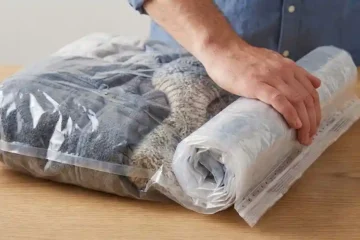
Dirty clothes take more space than clean ones, because they were folded or rolled and now they are not. Compressed items do not go back into their compressed volume by themselves either, which is why things fit going out and not coming home.
Plan for it rather than discovering it. Leave one cube empty on the way out, or accept that the return pack will be less tidy and pack the return in categories rather than by day.
And whatever you refilled or used on the trip, empty it before it goes back in the bag rather than after it has spent a fortnight in a drawer: storing refillables between trips covers why the state you pack things away in decides how they come out.
The short version
- A cube without a system is a smaller version of the same problem.
- One cube per category suits a single base you unpack into. One per day or segment suits multi-stop travel.
- Most people want a hybrid: per segment for the variable things, per category for the daily ones.
- Two fixed cubes regardless of trip: a dirty cube and a wet cube. The dirty cube is only ever a destination.
- Nothing worn goes back into a clean cube.
- Heavy low and close to your back, first-needed nearest the opening, shoes at the bottom.
- Leave room for the return. Dirty clothes take more space than clean ones.