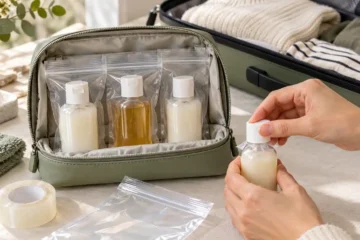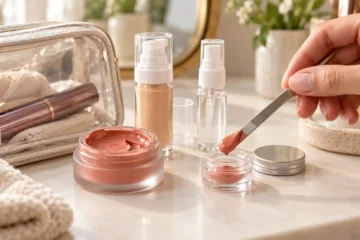
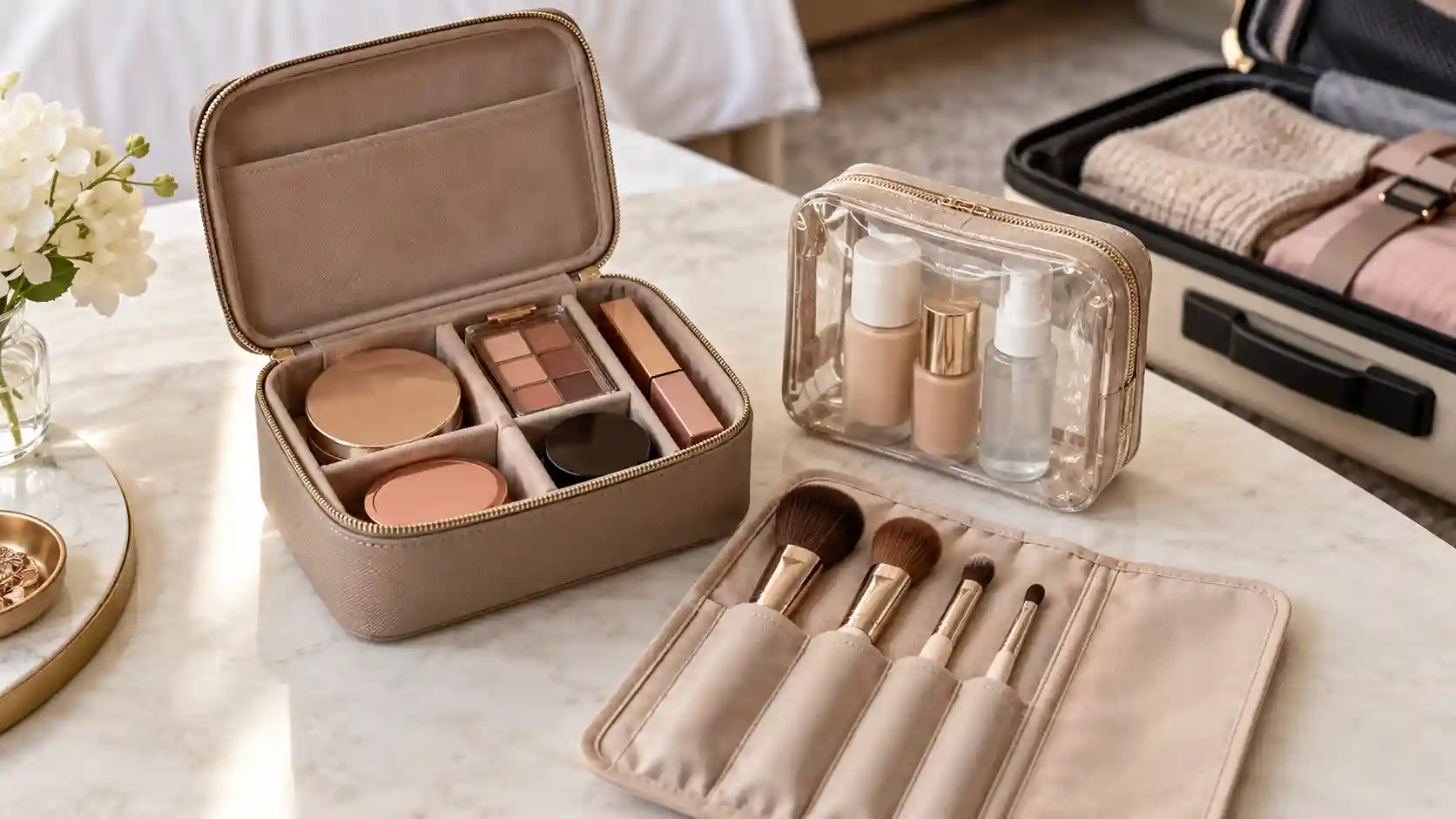
The right travel makeup case depends on what in your kit breaks, not on how the case looks. A hard or structured case protects pressed powders and glass from crushing. A soft pouch with a wipeable lining contains spills. A brush roll or a capped brush tube keeps bristles in shape. Very few cases do all three well, so decide which failure you are protecting against first. For many kits, the answer is two small containers, not one big one.
Last checked: 11 September 2026. The screening rules below come from TSA’s pages for airports in the United States. Other countries and airlines set their own rules. Check tsa.gov and your airline before you fly.
Start With What Breaks, Not With the Case
Most pages that rank for this term are product listings: retailer grids, brand pouches and brush sets. They answer “which case can I buy” and skip the question that decides whether it will work: what is it protecting against?
A makeup kit fails in three distinct ways, and each asks something different of a case:
- Crushing and impact. Pressed powders, eyeshadow palettes, glass foundation bottles and compact mirrors. These need rigid walls or thick padding, and they need to be held still.
- Leaking. Liquid foundation, concealer, nail polish, setting spray. These need a lining you can wipe clean and seams that do not wick.
- Bending and contamination. Brushes and sponges. These need their heads held in shape and kept apart from product residue and anything damp.
Look at your own kit and ask which of the three would ruin a trip. That decides the case.
The Main Case Shapes, Compared
These are types of case, not brands or models. We have not tested any of them, and we give no ranking. Each has a real weakness, listed in the last column.
| Case type | Protects best against | Typical construction | Where it falls short |
|---|---|---|---|
| Hard-shell or structured box | Crushing, impact | Rigid or semi-rigid walls, often with a zip around the frame | Bulky even when half empty; a leak inside pools in the corners |
| Train case | Crushing; keeping many items upright | Box with a hinged lid, sometimes with trays | Heavy and large for a carry-on; mostly suits professionals and long trips |
| Soft pouch, wipeable lining | Spills | Coated or laminated fabric, zip closure | Little crush protection; powders need padding of their own |
| Pouch with padded dividers | Impact and sorting | Soft shell, removable padded inserts | The dividers take space; a zip closure does not contain a spill |
| Flat-lay pouch (drawstring or zip opening flat) | Speed of use | Opens into a flat mat | Fragile items knock together when it is gathered up |
| Brush roll | Brush shape, separation | Fabric sleeve with individual slots, rolled and tied | Fabric can hold moisture; loose slots let brushes slide |
| Brush tube or cup with lid | Brush shape | Rigid tube or cup with a cap | Brushes rub together inside; hard to dry if packed damp |
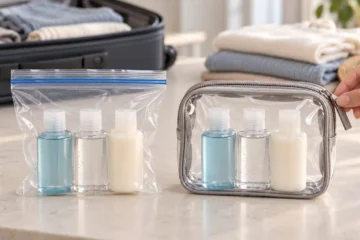
| Clear liquids pouch | The carry-on checkpoint | Clear, closable, quart-size or similar | Holds liquids only; offers no padding |
Two points apply across the table. First, a case’s outer fabric matters less than its lining and its seams, because an internal spill escapes through the seams and the zip. Second, a case that is too big lets items slide around inside, and movement is what breaks powders.
The Checkpoint Problem Most Cases Ignore
A travel makeup case is almost never the same thing as your carry-on liquids bag, and that affects the design more than any other factor.
At the time of writing, TSA’s liquids rule page allows liquids, gels, aerosols, creams and pastes in containers of 3.4 ounces (100 milliliters) or less per item, and TSA’s 3-1-1 FAQ states that each passenger is limited to one quart-size bag. TSA’s item pages for powder makeup and solid makeup, read 11 September 2026, both say “Yes” for carry-on and checked bags. The item pages also note that the final decision rests with the TSA officer.
The practical result is a split. Powders, sticks, pencils and brushes can live in the makeup case. Liquid foundation, liquid liner, nail polish and setting spray have to go in the liquids bag with your other toiletries if you fly carry-on. A case built with slots for liquid bottles looks convenient, but in a carry-on you will be emptying those slots at the checkpoint. If you are unsure which items count as liquids, the dividing lines are in what TSA considers a liquid.
For many carry-on travelers, the tidiest setup is:
- A small structured or padded case for powders, sticks and tools.
- The quart liquids bag holding the liquid makeup alongside the other toiletries.
- A separate brush roll or tube, so brushes are kept away from both.
Fragile Compacts: What the Case Can and Cannot Do
A case keeps the outside world off a compact. It does not stop the compact moving inside the case, and inside movement is what cracks pressed powder. Whatever case you choose:
- Fill the empty space so nothing can slide. A folded cloth or a second, smaller pouch works.
- Keep glass and metal apart from powders, in a separate section or on the other side of a divider.
- Pad the inside of each compact with a cotton pad or tissue before closing it, which keeps the pressed cake from bouncing against the lid.
A good hard case with loose compacts rattling inside can do worse than a soft pouch packed tight.
Brushes: The Part of the Case That Fails Slowly
Brushes rarely break outright. They bend, splay and pick up residue from the powders around them. A brush roll with separate slots or a tube with a cap keeps heads in shape. The main concern is moisture. A brush packed damp into a closed case stays damp. The American Academy of Dermatology, on its page on cleaning makeup brushes read 11 September 2026, advises drying brushes lying flat with the tips hanging off the edge of the counter, not upright in a container. For travel, that means brushes go into their case dry, not straight after washing.
Closures, Linings and Cleaning
Some features are worth checking in any case type:
- The zip. A standard coil zip is not a barrier to liquid. It does not matter much for powders. It matters a lot if liquids ride in the case. How closures behave in a bag under pressure is compared in pump, flip cap or disc top, and the same logic applies to the bottles inside your case.
- The lining. Smooth, coated linings wipe clean. Bare woven fabric absorbs spilled foundation and keeps it.
- Can it dry? A case that seals well also traps moisture. It needs to be left open to dry after a spill or a damp brush. We cover the same issue for bottles in how to store travel bottles between trips.
- Can it be emptied fully? Corners and fixed pockets gather powder dust and residue that is hard to clean out.
You May Already Own the Right Case
Before buying anything, check what you have. A padded pencil case or glasses case holds brushes well. A small hard-sided box from another kit holds compacts. A clear zip pouch covers the liquids. Our guide to what actually belongs in a travel bottle set makes the same point about bottles: most kits are built from things people already own, arranged better.
How We Wrote This
This page is desk research. We have not tested any makeup case, and we do not rank, price or recommend products. The case types are described by construction, the TSA rules are quoted from tsa.gov as read on 11 September 2026, and the brush-drying guidance is quoted from the American Academy of Dermatology. If a maker publishes specifications for a particular case, read them on the maker’s own page.
FAQ
What kind of travel makeup case protects powders best?
A structured or padded case, packed so nothing can slide inside it. Rigid walls stop crushing, but pressed powder cracks from movement, so filling empty space and padding the inside of each compact matters as much as the case itself.
Can my makeup case go through airport security as it is?
Powder and solid makeup can, per TSA’s item pages read on 11 September 2026. Liquid makeup has to go in your quart-size liquids bag in containers of 3.4 ounces (100 milliliters) or less when you fly carry-on. Check tsa.gov and your airline before you fly.
Is a brush roll better than a brush case?
They solve slightly different problems. A roll with individual slots keeps brushes apart and in shape. A capped tube protects better against crushing but lets brushes rub together. Either way, pack brushes dry.
Do I need a separate makeup bag and toiletry bag?
Not necessarily, but their jobs differ. Liquids need spill containment and a place in the quart bag at the checkpoint, while powders need crush protection. Keeping them apart stops a leak from reaching your powders.