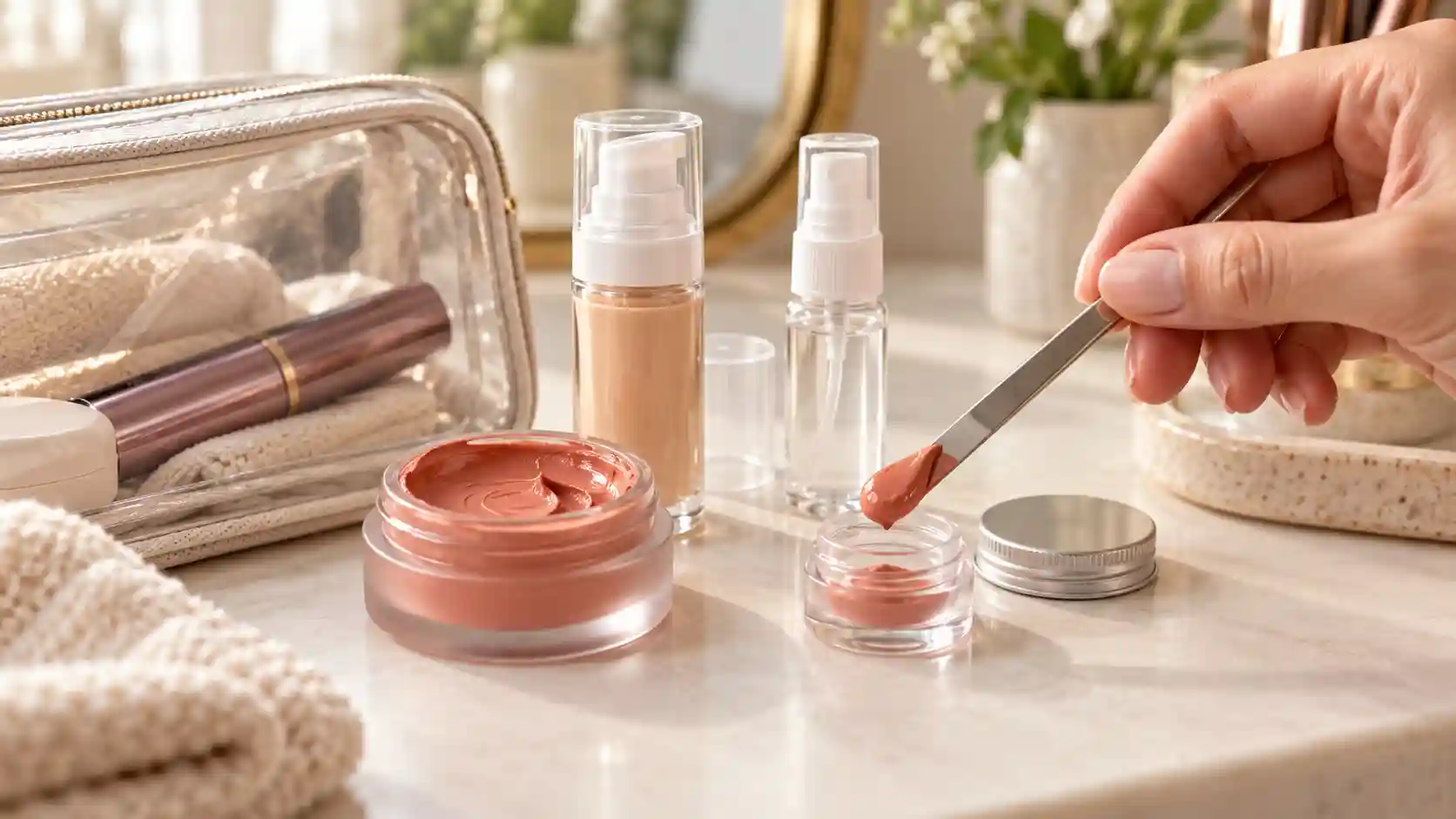
To decant makeup for travel, move only what the trip needs into a container that is clean, dry and suited to the product’s texture, and transfer it with a clean tool, never with fingers or water. Liquid foundation and creams decant well enough for a short trip. Mascara and liquid eyeliner are the products to leave in their original tubes, because the FDA treats eye-area cosmetics as higher risk. The rest of this page covers which products survive decanting and why.
This page describes how cosmetic products are packed and stored. It is not medical advice. If a product irritates your skin or eyes, the FDA’s advice is to stop using it and talk to a healthcare provider. Questions about a specific product’s formula are for its manufacturer.
Why Decanting Is a Different Risk From Packing
Packing moves a product in its own container. Decanting moves the product itself, out of the packaging its maker chose and tested, into one you chose. Three things change when you do that.
Exposure. The product meets the air, a tool and a new container. The FDA, on its page on microbiological safety and cosmetics read 11 September 2026, lists consumer habits that introduce microorganisms. It advises washing hands before using cosmetic products, especially where fingers dip into the container, and keeping containers clean.
Dilution. The same FDA page advises against adding water or saliva to cosmetic products, because that can add harmful microorganisms and water down the preservatives meant to stop them growing. A travel container rinsed and not dried, then filled, is a small version of the same problem.
Storage. The FDA’s page on shelf life and expiration dating of cosmetics notes that there is no US law requiring cosmetics to carry specific shelf lives or expiration dates. Dipping fingers into a product adds microorganisms, moisture such as in a bathroom may make it easier for bacteria and fungi to grow, and heat can make preservatives break down. A decanted pot in a hot, damp bathroom bag is exposed to all of these.
None of this means decanting is off limits. It means the container, the tool and the timescale matter more than the tips on most pages admit.
Which Makeup Survives Decanting, by Type
| Product type | Decant it? | Suitable container | What goes wrong |
|---|---|---|---|
| Liquid foundation, tinted moisturizer | Yes, for a short trip | Small pump bottle or airless pump; a screw-top pot at a pinch | Separates or thickens; a wide-mouth pot invites fingers |
| Cream concealer, cream blush | Yes | Small screw-top pot, filled with a clean spatula | Fingers in the pot; dries at the surface if the lid is loose |
| Primer, serum-textured products | Yes | Dropper bottle or small pump | A dropper that touches skin carries residue back into the bottle |
| Loose powder, setting powder | Yes, with care | Small sifter jar, or a screw-top jar lined with tissue | Spills and clumps if damp; powder goes airborne as you transfer it |
| Pressed powder | Not really | Stays in its pan; move the whole pan to a magnetic palette if it is removable | Crushing a pressed cake turns it into loose powder |
| Lipstick | Scraping into a small pot works | Small screw-top pot | A spatula mark is fine; heat turns a pot of lipstick soft |
| Mascara | No | Keep the original tube | Eye-area product, FDA notes shorter shelf life |
| Liquid eyeliner | No | Keep the original | Eye-area product with its own applicator |
| Setting spray | Yes | Small fine-mist sprayer | Nozzle clogs; the new sprayer may not atomize like the original |
The pattern is simple. Products you pump or scoop onto a clean tool move well. Products that carry their own applicator into the eye area stay where they are.
Why Eye Products Stay in Their Tubes
The FDA’s shelf-life page states that eye-area cosmetics tend to have shorter shelf lives than other products and that they may cause eye infections that can be serious. It notes that manufacturers typically recommend discarding mascara two to four months after purchase, and it warns specifically against adding water or saliva to moisten it. The FDA’s eye cosmetic safety page adds that any instrument placed in the eye area should be clean and that containers should be kept clean.
A mascara tube is a closed system: the wand lives inside it, and the wiper at the neck removes excess product. Decanting mascara breaks that system for no real saving in space. For travel, the usual answers are a smaller tube bought for the trip or simply the tube you already own.
How to Decant, Step by Step
1. Choose the container by texture. A runny product needs a narrow opening and a secure closure. A thick one needs an opening wide enough to get it back out. The difference is explained in travel containers for thick products, and for serum-textured primers the dropper option is covered in precision droppers and serum bottles.
2. Clean the container, then dry it completely. Wash it, rinse it, and let it dry fully, ideally overnight and open. Water left in a container is exactly what the FDA’s guidance warns against adding to a product. If the container is silicone, the method for getting it clean without leaving residue is in how to clean silicone travel bottles.
3. Wash your hands and use a clean tool. A clean spatula, a small funnel or a pump pressed straight into the new container keeps fingers out of both the original and the travel pot. That also protects the full-size product you are leaving at home.
4. Move only what the trip needs. A small amount, used up within the trip, is sitting in its new container for the shortest time. Decanting a large amount into a pot you will keep refilling is a different practice, and a riskier one.
5. Close it, label it and note the date. A small label with the product name and the day you filled it takes the guesswork out later. The refilling routine we recommend for all travel containers is set out in how to refill travel size bottles without a mess.
6. Keep it cool. The FDA’s eye cosmetic safety page advises against storing cosmetics at temperatures above 85 degrees Fahrenheit. A decanted product is no hardier than the original, and in a thin container it may warm up faster.
When a Decanted Product Should Be Thrown Away
This is the section most decanting guides leave out. A decanted product has no printed date and sits in a container that was not designed for it. So judge it by what you can see.
- It has changed color, smell or texture. The FDA’s shelf-life page lists color and texture changes as effects of temperature, sunlight and air.
- It has separated and will not mix back together.
- Water or another product got into it.
- You cannot remember when you filled it.
When in doubt, throw it out. The container can be cleaned and reused; the decanted product should not be topped up with fresh product on top of old. Topping up mixes new product with whatever has grown in the old. If a container has started to show spots or smell, the reasons are covered in mold in a travel bottle.
At the Checkpoint
A decanted liquid foundation or cream counts as a liquid at a US airport. At the time of writing, TSA’s liquids rule page, read 11 September 2026, allows liquids, gels, aerosols, creams and pastes in containers of 3.4 ounces (100 milliliters) or less per item in a quart-size bag in your carry-on, with larger containers directed to checked baggage. Powder products are covered by TSA’s powder makeup page, which says “Yes” for carry-on and checked bags. Rules change and differ by country, so check tsa.gov and your airline before you fly.
What This Page Does Not Say
We have not tested how long any decanted product lasts, and we give no timescale, because the answer depends on the formula, its preservative system and how it was handled. Only the manufacturer can speak to its own formula. We make no claim that any container keeps a product “safe.” The FDA guidance quoted here describes how contamination happens. It is not a guarantee against it.
FAQ
Can I put foundation in a travel container?
Yes, for a short trip. A small pump bottle limits contact with fingers and air better than an open pot. The container should be clean and fully dry, and the product should be moved with a clean tool, in line with the FDA’s guidance on keeping containers clean and not adding water.
Should I decant mascara for travel?
Generally no. The FDA notes that eye-area cosmetics have shorter shelf lives and may cause eye infections that can be serious, and mascara’s tube and wand work as a closed system. A smaller tube is the simpler option.
How long does decanted makeup last?
There is no general answer, and no US law requires cosmetics to carry an expiration date, per the FDA. Decant only what the trip needs, date the label, and throw away anything that changes color, smell or texture.
Can I reuse old sample pots for decanting?
Only if they can be cleaned and dried thoroughly. A pot that still holds old product or rinse water brings exactly the contamination the FDA’s guidance describes. If it cannot be fully cleaned, replace it.