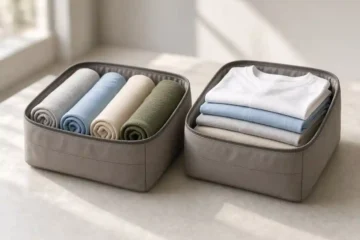
How to unpack in a hotel without losing things: unpack containers, not items. Move each packing cube, toiletry bag and pouch whole into the room, so every object still has a home it came out of. Give the few things that must come loose, such as your phone, charger, glasses and watch, one landing zone and nothing else. Avoid spreading small items across drawers, shelves and the shower. At checkout, the room is swept in a fixed order, and every container is checked against what it held. This is desk research; we have not tested any organizer or routine in a lab.
Why Things Get Left Behind
Almost nobody leaves a suitcase in a hotel room. They leave the small things that came out of it: a charger still in the wall, a razor in the shower, a bottle on the ledge, a shirt in the one drawer that was not opened again. The pattern is consistent across the pages that rank for this question, and most of them answer it with a checkout checklist.
A checklist helps, but it treats the symptom. The cause is at the start of the stay, not the end: every item that leaves its container becomes a separate thing to remember. Unpack fifty items onto shelves and you have fifty things to collect. Unpack five containers and you have five, plus a handful of loose objects that you know to look for.
That is the idea this article is built on. Unpacking is not about how much you take out. It is about how many places you create.
How to Unpack in a Hotel: Containers, Not Items
Move cubes whole
If you pack in cubes, the cube is the unpacking unit. Put each cube into a drawer, onto a closet shelf or on a luggage rack exactly as it is, and open it there. Take out what you are wearing that day; leave the rest inside. The drawer is now a holder for the cube, not a new home for a loose pile of clothing.
This works with either of the systems we describe in one cube per category or one cube per day. With category cubes, each drawer holds one category. With day cubes, the next day's cube sits on top.
If you did not pack in cubes, the same logic applies to the suitcase itself: live out of it, keep it zipped in sections, and resist spreading everything into drawers for a short stay.
Hang only what needs hanging
Items that need to lose their creases can go on hangers. Hanging is visible, which makes it lower risk than a drawer: an empty rail is easy to check. What goes in a drawer, especially a low or deep one, is what tends to stay there.
One landing zone for loose things
Some things will always come loose: phone, charger, watch, glasses, keys, earbuds, a wallet. Choose one surface for them for the whole stay, a corner of the desk or one bedside table, and put them only there. A small tray or an open pouch helps, because it gives the zone an edge.
The discipline is simple. When you take one of these off, it goes to the zone. When you look for it, you look there first. At checkout, the zone is where you start.
Chargers: follow the cable back to the wall
Cables are the classic item left behind, because the charger sits behind furniture or at a bedside outlet you do not normally look at. Two habits help:
- Charge at the landing zone when an outlet is close to it, so the charger is part of the zone.
- When you unplug, unplug from the wall first, and coil the cable into its pouch at once, rather than pulling the phone off and leaving the brick in the socket.
The Bathroom Is Where Containers Fall Apart
The bathroom deserves its own rule, because it is where a toiletry kit breaks into many small objects: bottles lined up on the counter, others on the shower ledge, a razor, a toothbrush in a glass. It is also where the most items are hidden behind a shower curtain or in a corner caddy.
Keep the kit as a kit
Hang the toiletry bag on a hook or a door, or stand it on the counter, and take bottles out only for the time you use them. A bottle that goes back into the bag after use cannot be forgotten on a ledge. If you use the shower, take in only what you need and bring it back in one trip.
Labeled bottles help here too. When every bottle in the kit looks alike, you cannot tell at a glance which one is missing. When each is labeled, a quick look at the bag tells you. We cover simple methods in how to label travel bottles.
Reclose bottles properly before they go back
Travel bottles opened and closed daily in a warm, humid bathroom are the ones that leak on the way home. Wipe the threads, make sure the cap or valve is clean and fully closed, and stand bottles upright in the kit. The reasons they leak, and the fixes, are in why travel bottles leak on a plane.
Rebuild the liquids bag before you leave
If you are flying home with a carry-on, the liquids bag has to come back together before you reach the airport. At the time of writing, TSA's liquids, aerosols and gels rule page (read September 27, 2026) says you may carry "travel-sized containers that are 3.4 ounces (100 milliliters) or less per item" in "a quart-sized bag of liquids, aerosols, gels, creams and pastes in your carry-on bag," and that "Placing these items in the small bag and separating from your carry-on baggage facilitates the screening process." Rules change without notice; check tsa.gov before you fly.
In practice, that means the bathroom is the one room where you reassemble a container rather than simply repack it: every liquid goes back into the one bag, and nothing new from the trip slips in over the size limit. We go through the whole rule in the TSA 3-1-1 rule, read carefully.
Scale the Unpack to the Stay
The ranking pages agree on one point worth keeping: how much you unpack should depend on how long you stay.
| Stay length | What to unpack |
|---|---|
| One night | Nothing but the landing zone and the toiletry kit. Live out of the bag. |
| Two to three nights | Hang what needs hanging, move one or two cubes to a shelf, keep everything else in the bag. |
| A week or more | Move all cubes into drawers and closet, but keep them as cubes. Empty bag goes in the closet. |
Whatever the length, the container principle holds. A longer stay means more containers out of the bag, not more loose items.
Where Dirty Laundry Goes
Laundry left in a hotel closet or on a chair is another common loss, and dirty clothes mixed back into clean cubes cause problems on the way home. Choose one bag for dirty laundry at the start of the stay, keep it in one place, and put worn clothes into it every night. At checkout, the laundry bag is one container, not a scattered pile.
A Checkout Sweep That Follows the Room
The final step is the sweep. It works best as a fixed route rather than a glance around, and done before the bag is closed:
- Landing zone first. Phone, charger, watch, glasses, keys, earbuds, wallet.
- Every outlet in the room, including behind the bed and the desk.
- Bathroom: counter, shower ledge, any caddy, the back of the door, the hook where the bag hung.
- Closet: rail, shelves, floor and any in-room safe. If you used the safe, it is part of the route every time.
- Every drawer, opened fully, including those you do not remember using.
- Bed and floor: under pillows, under the bed, beside the nightstand.
- Containers: every cube and pouch closed and in the bag, the liquids bag complete.
Keep the route in your phone notes so it is the same each time. When the route is fixed, you do not rely on remembering where you put things; you only need to follow the list.
FAQ
Should I unpack in a hotel or live out of my suitcase?
For one or two nights, living out of the bag with a landing zone for loose items is usually simplest. For longer stays, move packing cubes into drawers whole, rather than emptying them, so each item keeps its container.
How do I stop leaving chargers in hotel rooms?
Charge at one fixed spot if an outlet is nearby, unplug from the wall first rather than just pulling the phone off, and check every outlet in the room as part of your checkout sweep.
Are hotel drawers a bad idea?
They are where things are most often forgotten, because a closed drawer hides its contents. If you use them, put whole cubes in rather than loose items, and open every drawer fully before you leave.
What should I check before leaving a hotel room?
Follow a fixed route: landing zone, all outlets, bathroom counter and shower, closet and safe, every drawer, the bed and floor, and finally every container in your bag.
How do I avoid losing toiletries in the bathroom?
Keep the toiletry bag intact and take bottles out only while you use them. Labeled bottles make a missing one easier to spot, and the liquids bag should be complete before you pack for the flight home.