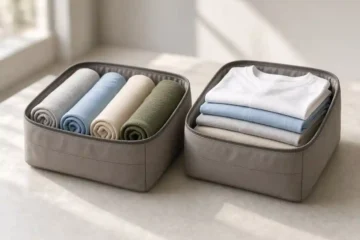
How to pack dirty clothes when traveling comes down to two separations. First, separate dirty from clean: give worn clothes their own container, a spare packing cube, a drawstring laundry bag or a plain bag, and keep the clean clothes closed in theirs. Second, separate dry from wet: dry worn clothes go in something breathable, and only damp items such as a swimsuit or a sink-washed shirt go in a sealed bag, and only until they can be hung up. Most advice gets the first part right and the second part backward. This is desk research; we have not tested any laundry bag or cube.
Why Dirty Laundry Becomes a Problem on Day Four
On day one, a bag of worn clothes is a small, dry bundle. By day four it has three problems that clean clothes do not have.
- Smell. Worn fabric carries sweat and skin oils. Odor comes from what grows on and breaks down that residue, and it spreads to anything the fabric touches or shares air with.
- Moisture. A worn shirt is rarely bone dry when you take it off, and a swimsuit, a rain-soaked layer or a sink-washed pair of socks is wet. Moisture is what turns a mildly stale bag into a musty one.
- Volume. Clothes that went in rolled or folded tight come out as loose, springy piles. The same garments take more room on the way home than they did on the way out.
Each of those needs a different answer, which is why "just throw it in a plastic bag" works for some travelers and ruins a suitcase for others.
How to Pack Dirty Clothes When Traveling: The Container Choice
The container has one job: keep worn clothes away from clean ones while letting the worn ones dry out. Here is how the common options do against those two jobs.
| Container | Keeps dirty from clean | Lets fabric breathe | Best for |
|---|---|---|---|
| Spare packing cube (mesh panel) | Yes | Partly | Dry worn clothes on a normal trip |
| Drawstring laundry bag (cotton or nylon) | Yes | Yes, if not coated | Dry worn clothes, hung up in the room |
| Plastic grocery or trash bag | Yes | No | Short trips, or a quick wet item |
| Zip-top or roll-top sealed bag | Yes, and holds smell in | No | Wet items only, short term |
| Roll-up compression bag | Yes | No | The trip home, once clothes are dry |
A spare packing cube
A cube you already own is the least effort. Pick one that looks different from the rest, a different color or size, so you never grab it by mistake when you want a clean shirt. A cube with a mesh panel lets some air through, which helps a bag of slightly damp clothes dry rather than stew. At home, the cube goes in the wash with its contents. If you are still choosing how to divide your cubes, one cube per category or one cube per day sets out both systems, and a laundry cube slots into either.
A drawstring laundry bag
A plain fabric bag does the same job and folds almost flat when empty. Travelers who favor it in packing forums tend to use it in the room rather than in the case: hang it on a hook or a door handle, drop clothes in each evening, and pack it on departure day. That habit matters more than the bag, because a bag hanging open in a room is drying its contents all week.
A plastic bag
A grocery bag or a small trash bag costs nothing and separates dirty from clean perfectly well. What it does not do is breathe. For a dry weekend's worth of worn clothes, that is fine. For a week of slightly damp clothes sealed in plastic, it is a small greenhouse.
A sealed bag, and why it is the wrong default
The instinct is to seal dirty laundry in so the smell cannot escape. Sealing does hold smell in. It also holds moisture in, and moisture is what makes the smell worse over time. Treat an airtight bag as a quarantine for wet items, not a home for all laundry. If you want smell containment, reverse the logic: keep the clean clothes in closed cubes or bags, and let the dirty ones breathe in something open-weave.
Wet Items: The One Case for a Sealed Bag
A swimsuit, a towel you have to take, or anything you washed in the sink and could not dry before checkout goes in a sealed bag, on its own, apart from the dry laundry. Then take it back out at the next stop and hang it up. A wet item sealed for a few hours of travel is fine. A wet item sealed for three days is how a bag starts to smell of mildew, and the smell can outlast the trip.
The same mechanism turns up on a smaller scale in our piece on mold in a travel bottle: water, warmth and no airflow, left alone, is the recipe for growth. A closed bag of damp fabric in a warm car or a hotel wardrobe offers all three.
A few practical rules for wet items:
- Wring them out, or roll them in a towel, to pull out as much water as you can before packing.
- Keep the wet bag near the top of the case so you remember to empty it.
- If you have a choice, carry the wet item in an outside pocket rather than in the middle of your clean clothes.
Where the Laundry Bag Sits in the Suitcase
Where you place the dirty bag matters for two reasons: smell transfer and weight.
Against the clean clothes, not mixed with them. Keep a layer of closed cubes between the laundry and anything you still plan to wear. If your clean clothes are in cubes and the laundry is in its own cube or bag, they can sit side by side.
At the wheel end or the back panel, if it is the heavy item. A week of laundry, especially with jeans or a damp towel in it, can become one of the denser things in the bag. In a wheeled case that belongs toward the wheels; in a backpack, toward your back.
Not in the front pocket. A front pocket is where a bag of laundry goes when the main compartment is full on the last morning. It is also the pocket that makes a roller fall on its face.
Socks can go inside shoes. Plenty of travelers stuff worn socks into the shoes they are already carrying. It uses dead space and keeps the smallest dirty items contained. It does not suit anyone planning to wear those shoes before the socks are washed.
The Space Problem on the Way Home
This is the part most packing advice skips, and it is the reason a case that closed easily on day one will not close on the last morning.
Clean clothes are packed once, carefully, at home. Dirty clothes are packed in a hurry, in a hotel room, as a heap. A heap of the same garments takes more space because nothing is folded, rolled or pressed flat, and air sits in every gap.
You have three ways to get that space back:
- Roll the dirty clothes as you add them. It takes seconds per item and keeps the laundry bag closer to its original volume.
- Squeeze the air out on departure day. A roll-up compression bag, or a cube with a compression zipper, pushes out the trapped air. This only works on dry clothes, and it does not make anything lighter; it only makes it smaller. We explain what squeezing actually does in compression without a pump. Do not compress anything still damp; you are sealing moisture in under pressure.
- Leave room on the way out. If your case is full to the zip on the outbound trip, it will not fit laundry on the return. A case packed only to the point where it closes without effort has somewhere for the loose pile to go.
The claims you will see that packing cubes "save" a large share of space deserve a skeptical read; the figures conflict and most come from people selling cubes, a point we lay out in do packing cubes actually save space. For laundry, the gain from compression is real but comes from pushing out air, not from shrinking fabric.
Washing Mid-Trip to Shrink the Laundry Pile
The smallest laundry bag is the one you empty halfway through. Sink washing socks, underwear and a light shirt in a hotel basin, then hanging them overnight, is a common tactic among long-trip travelers. Whether you do it is your call; if you do, the detergent you pack is subject to the checkpoint like any other item.
At the time of writing, TSA's page for liquid detergent (read September 27, 2026) lists it in carry-on as "Yes (Less than or equal to 3.4oz/100 ml allowed)," which puts a small bottle of liquid detergent under the same limit as your shampoo, in the same quart-size bag. TSA's page for powder or pellet detergent (read the same day) says: "Powder-like substances greater than 12 oz. / 350 mL must be placed in a separate bin for X-ray screening. They may require additional screening and containers may need to be opened." Both pages add that "the final decision rests with the TSA officer." Rules change without notice; check tsa.gov before you fly.
The TSA pages we read do not name laundry pods or detergent sheets specifically. If you want certainty about either, ask TSA directly rather than relying on a blog.
A Simple System That Works on Any Trip
Pulling the pieces together:
- Pack one extra container for laundry before you leave: a spare cube, a fabric drawstring bag, or at minimum a plastic bag. Make it visibly different from your clean-clothes cubes.
- Pack one sealable bag for wet items, separate from the laundry container.
- Start using the laundry container on day one, not on the last morning. Clothes added as you go get rolled; clothes added all at once get stuffed.
- In the room, leave the laundry bag open or hanging so the clothes dry out. Close it only to travel.
- Hang wet items the moment you arrive. The sealed bag is for transit, not storage.
- On departure day, squeeze the air out of the dry laundry if space is tight, then place it low and toward the wheels or your back.
- At home, wash the laundry container too. A cube or fabric bag that has carried a week of worn clothes holds some of that smell.
None of this needs a new purchase. Most travelers already own a spare cube or a bag that will do. If you find yourself buying something, buy it because the thing you own failed at one of the two jobs above, not because a product page said you needed it.
FAQ
Should I put dirty clothes in a plastic bag when traveling?
A plastic bag keeps dirty clothes away from clean ones, but it does not let them breathe. For a short trip with dry clothes it is fine. For a longer trip, a breathable fabric bag or a mesh cube lets worn clothes dry out. Save sealed plastic for wet items.
How do I stop dirty clothes from making my suitcase smell?
Keep the clean clothes closed in their own cubes or bags, keep the dirty clothes in a separate container that can breathe, and never leave anything wet sealed up for days. Hang the laundry bag open in your room between travel days.
Where do I put a wet swimsuit in my luggage?
In its own sealed bag, apart from both clean and dirty dry clothes, and only for the time you are actually traveling. Take it out and hang it at the next stop.
Can I compress dirty laundry?
Yes, once it is dry. Compression pushes out trapped air, which helps the loose pile of worn clothes fit on the trip home. Compressing damp clothes traps the moisture in.
Can I bring laundry detergent in my carry-on?
At the time of writing, TSA lists liquid detergent in carry-on at 3.4 oz (100 ml) or less, and says powders over 12 oz may need a separate bin and extra screening. Check TSA's own pages before you fly, because rules change.