How to distribute weight in luggage depends on what holds the bag up. In a wheeled bag, the wheels and the floor do, so the heaviest items go at the wheel end, low and centered, with the lightest on top; that keeps the bag standing when you let go and light on the handle when you pull. In a backpack, your body does, so the heaviest items go close to your back, around the middle of the pack, with light, soft things at the bottom and outside. The same items, packed the same way in both, will behave well in one bag and badly in the other. This is desk research; we have tested no bags.
One Principle, Two Bags
Every bag has a center of mass: the single point where its weight acts, on average. Where that point sits, relative to whatever is supporting the bag, decides whether the bag stays upright, tips over, or pulls on you.
- A wheeled bag standing upright rests on its wheels and a pair of feet, or on four wheels. It stays up as long as its center of mass sits above that footprint. Move the center of mass high or forward and it only takes a small nudge, or no nudge at all, to push it outside the footprint.
- A wheeled bag being pulled is tilted back on two wheels. The wheels carry most of the weight and your hand carries the rest. The farther the heavy items sit from the wheels, the more of the weight ends up in your hand.
- A backpack hangs from your shoulders and hips. Its support is you, and the farther the heavy items sit from your back, the more they lever the pack away from you.
That is why the advice differs. It is not two sets of rules; it is one rule applied to two different supports.
How to Distribute Weight in Luggage With Wheels
Heavy at the wheel end
Put the densest items at the end with the wheels: shoes, a heavy toiletry kit, chargers and adapters in a pouch, anything that weighs a lot for its size. When the bag stands up, that end is the bottom, which lowers the center of mass and widens the margin before it tips.
Luggage makers give the same instruction. Away's guide to packing a carry-on (dated November 14, 2024, read September 27, 2026) says: "Place heavy items (shoes, jeans, jackets) at the bottom near the wheels. This keeps the suitcase balanced when upright." Away sells suitcases, and this is general guidance rather than a measurement, but it matches the mechanism.
Heavy against the back panel, not the front
The back panel is the side with the handle. When a two-wheeled bag is pulled, it tips back onto that side, so weight packed against the back panel sits closer to the wheels and loads your hand less. When the bag stands, weight against the back panel keeps the center of mass away from the front edge.
The front pocket is where this usually goes wrong. A laptop, a book or a full water bottle in the outside front pocket moves the center of mass forward, toward the edge of the footprint, and a bag that stands fine when empty starts falling on its face. If something heavy must travel in the bag, put it inside, against the back.
Even from side to side
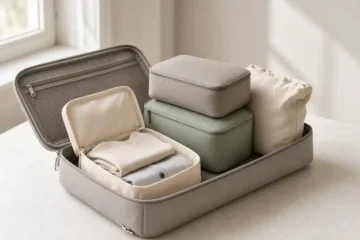
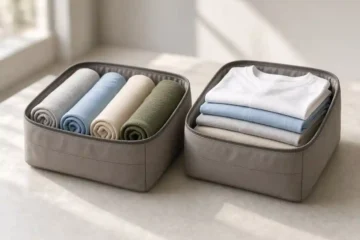
A bag with its heavy items all on one side leans when it stands and pulls to one side when it rolls on two wheels. Spread dense items across the wheel end rather than piling them in one corner. Packing cubes help here only in the sense that full, flat cubes of similar weight make it easier to see where the weight has gone. How you sort them is a separate choice; see one cube per category or one cube per day.
Light on top, and fill the gaps
The lightest, softest items go at the top end, away from the wheels. Fill gaps around the heavy items with small soft things so nothing shifts in transit. A load that slides when the bag is tilted will end up at one end or one side, and the balance you packed is gone by the time you reach the curb.
Things you hang on the handle
A tote or backpack hung on the extended handle adds weight high up and at the back. On a spinner standing upright, that can be enough to tip it backward. If you stack a second bag on a roller, make it the lighter of the two.
How to Distribute Weight in a Backpack
A backpack reverses the wheel-end logic, because the bottom of a backpack is not the part doing the supporting.
Heavy close to your back, around mid-height
Put the densest items in the zone against the back panel, roughly between your shoulder blades and the bottom of the pack. Weight close to your back sits near your own center of mass, so the pack moves with you. Weight far from your back acts on a longer lever and pulls the top of the pack away, which you feel as the pack dragging backward.
On a travel backpack with a laptop sleeve against the back panel, the laptop is already in a good place. Other dense items, such as a toiletry kit or shoes, can go next to it rather than out in the front pocket.
Light and soft at the bottom and outside
Soft, light items suit the bottom of a backpack and the part farthest from your back. They fill space without adding leverage. Heavy items at the very bottom tend to make a pack sag toward the hips; heavy items at the very top make it feel top-heavy and tippy when you lean or turn.
Tighten it into one unit
A loose load shifts with every step and moves the center of mass around. Compression straps, if your pack has them, pull the load in toward your back and stop it swinging. Filling gaps with soft items does the same job from the inside.
If carrying a loaded pack causes pain, that is a question for a clinician, not a packing guide. This article covers where weight sits in a bag, not what a body should carry.
Side by Side
| Wheeled bag | Backpack | |
|---|---|---|
| What supports it | Wheels and floor | Your shoulders and hips |
| Heaviest items | Wheel end, against the back panel | Against the back panel, mid-height |
| Lightest items | Top end, away from wheels | Bottom and outer layer |
| Front pocket | Flat and light only | Light items you need quickly |
| Most common mistake | Heavy front pocket, bag falls forward | Heavy items at the outside, pack drags backward |
| Quick test | Stand it up and let go | Put it on, lean forward and turn |
Compression Changes Weight, Not Just Volume
Compressing clothing lets you fit more into the same bag, and more clothing weighs more. That adds weight to wherever the compressed item sits. If you compress a bulky layer, place it where extra weight does the least harm: toward the wheel end of a roller, or against the back of a backpack. Compression only works on air-filled items and does not make anything lighter; we explain the mechanism in compression without a pump. Whether packing cubes save any space at all is a separate argument, covered in do packing cubes actually save space.
Where the Liquids Bag Goes
The liquids bag has a job that overrides balance: at the checkpoint, you need to take it out without unpacking. In either bag, it goes near the top or in an easy-to-reach pocket. TSA's liquids rule page (read September 27, 2026) sets carry-on containers at "3.4 ounces (100 milliliters) or less per item" in "a quart-sized bag," so the liquids bag is rarely the heaviest thing you carry. Rules change without notice; check tsa.gov before you fly. Our reading of the TSA 3-1-1 rule covers what counts toward it. Larger, heavier toiletries in a checked bag go at the wheel end with the rest of the dense items.
Two Quick Tests Before You Leave
For a wheeled bag, stand it upright on a hard floor, extend the handle and let go. If it falls forward, move weight from the front pocket to the back panel. If it falls backward, check what is hanging on the handle. Then tilt it onto its wheels and feel the handle: if it is heavy in your hand, the dense items are too far from the wheels.
For a backpack, put it on with the straps adjusted, lean forward slightly and turn your shoulders. If the pack swings or pulls backward, move the densest items closer to your back and tighten the load.
FAQ
Where should heavy items go in a rolling suitcase?
At the wheel end, which is the bottom when the bag stands, and against the back panel where the handle is. Away's own packing guide says heavy items near the wheels keep the suitcase balanced when upright.
Why does my suitcase keep falling over?
Usually because its center of mass has moved forward or up: heavy items in the front pocket, the top packed heavier than the wheel end, or a bag hung on the extended handle.
Should heavy items go at the bottom of a backpack?
Not at the very bottom. In a backpack, the heaviest items go close to your back, around mid-height. Light, soft items suit the bottom and outer layer.
Does weight distribution matter in checked luggage?
Yes, for the same reasons. A checked roller with its dense items at the wheel end stands and rolls better, and a load packed tightly shifts less in handling.
Do packing cubes help distribute weight?
Indirectly. Full, flat cubes of similar weight make it easier to see and control where the weight sits, but a cube does not move the center of mass by itself. Where you place the dense items does.