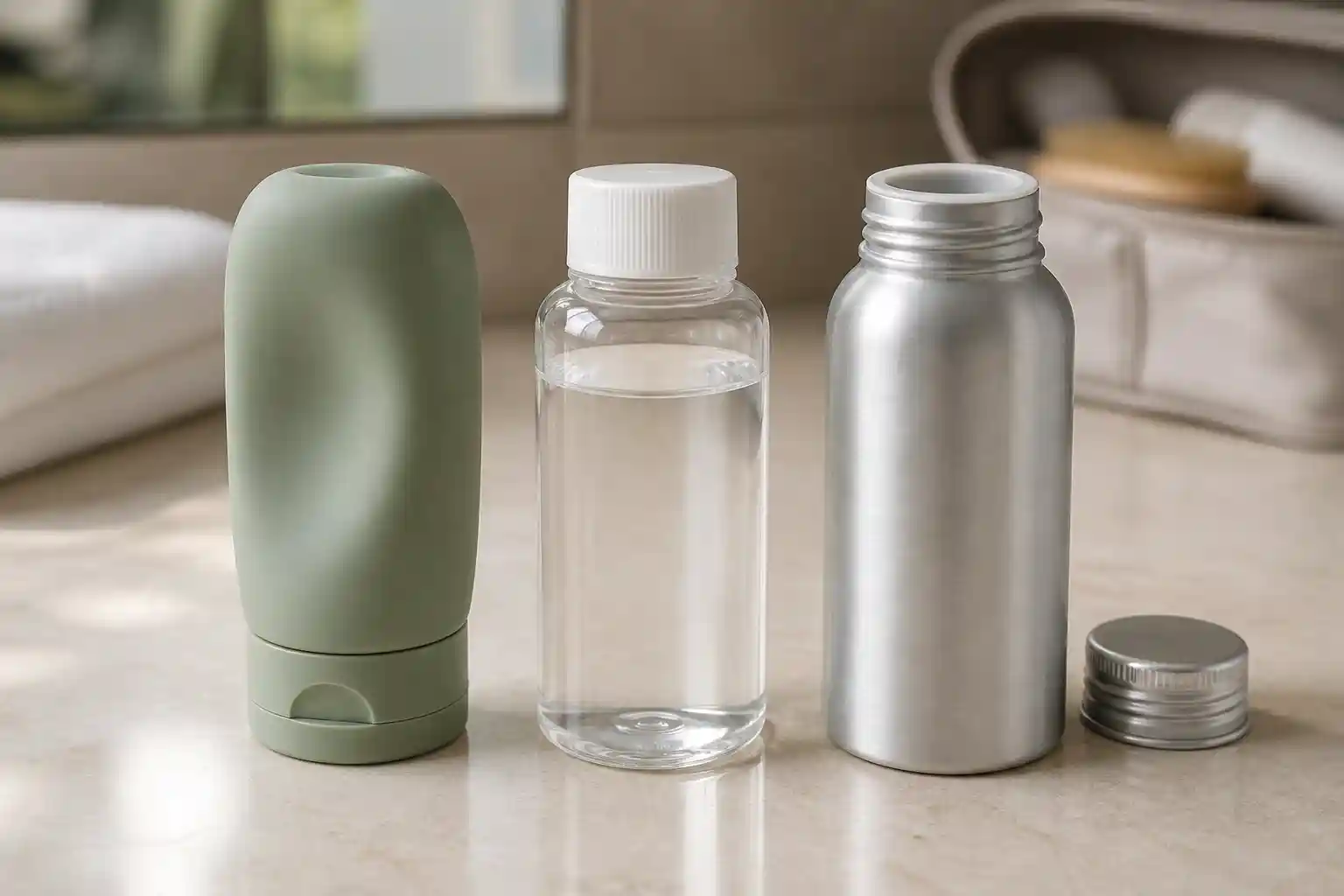
Silicone, hard plastic and aluminum travel bottles are not interchangeable, and the difference is not marketing. Silicone flexes under pressure and resists cracking, hard plastic (usually HDPE) holds a tighter screw seal and is easiest to clean, and aluminum is the lightest option but relies entirely on an internal lining that can degrade over time. None of the three is the universal right answer. Which one is good for you depends on what you are decanting into it and how you treat it between trips.
Silicone: flexible, but not for everything
Silicone's main advantage is that it flexes. A squeeze bottle with silicone walls can bulge slightly under internal pressure instead of forcing liquid past the seal, which connects directly to why bottles leak on planes in the first place. It also tolerates temperature swings better than most plastics, so it is less likely to warp in a hot car trunk or a cold cargo hold.
The trade-off is porosity. Silicone has a microscopically textured surface compared to hard plastic, and that texture can hold onto oils and fragrance compounds even after a normal wash. This is the reason silicone bottles sometimes carry a "ghost smell" of whatever product lived in them last, and it is also the reason mold tends to establish itself under a silicone gasket rather than in the smooth part of the bottle. Silicone is also genuinely difficult to see through, which matters more than it sounds like when you are trying to tell if a bottle is actually empty.
Hard plastic (HDPE): the reliable middle option
HDPE and similar rigid plastics are the material most people already own without thinking about it, since it is what most drugstore travel bottles are made from. The screw-top seal on a rigid bottle is generally more secure than a flexible bottle's cap, because the threads compress evenly against a wall that will not deform. That predictability is the main advantage.
The trade-off is durability under stress. Rigid plastic does not flex, so a bottle that gets crushed at the bottom of a packed bag, or dropped on a hard floor, is more likely to crack or hairline-fracture than a silicone equivalent. A cracked bottle fails completely and immediately, rather than developing a slow leak you can catch early.
Aluminum: light, but the whole story is the liner
Aluminum bottles are the lightest of the three by a meaningful margin, which matters if you are trying to keep a packing cube or dopp kit under a weight target. Aluminum itself is also widely recyclable.
Aluminum is not inert against every liquid, so bottles intended to hold personal care products or drinks are lined internally, usually with a food-grade coating or an interior plastic layer, to keep the metal from contacting the contents directly. That lining is the part that actually determines the bottle's lifespan. If it degrades, flakes, or wears thin at a seam, the metal underneath is exposed. This is a manufacturer specification question, not something we can verify without testing, so treat any specific liner claim as something to confirm on the product's own listing before you rely on it for anything you put on your skin or in your mouth.
The decision, reframed around what actually goes wrong
Most comparisons stop at "which is more premium." The more useful question is which failure mode you are trying to avoid, because each material fails differently.
| If your priority is… | Choose | Because |
|---|---|---|
| Surviving being crushed in a packed bag | Silicone | Flexes instead of cracking under pressure |
| A seal you can trust without checking it every time | Hard plastic (HDPE) | Rigid threads compress evenly; least prone to a partial seal |
| Minimum weight | Aluminum | Lightest by material, but only as good as its liner |
| Easiest to see when it's actually clean | Hard plastic, clear | Silicone's texture and opacity hide residue; clear plastic does not |
| Storing something with strong essential oils or fragrance | Hard plastic over silicone | Silicone's porosity absorbs and re-releases scent more readily |
| Lowest long-term replacement cost from cracking | Silicone | Most resistant of the three to impact damage |
What nobody selling bottles will tell you
Every silicone bottle brand markets flexibility as a pure upside. It is, for surviving impact. It is also the same property that makes silicone hold onto smells and makes mold harder to spot, because you cannot always see through the wall the way you can with clear plastic. A hard plastic bottle that looks slightly cloudy is telling you something a silicone bottle of the same age would be hiding. Neither material is dishonest about this on its own packaging, because neither manufacturer has a reason to bring it up.
What we have not tested
We have not run silicone, plastic and aluminum bottles side by side through repeated wash cycles, drop tests, or long-term storage. This comparison is built from published material properties and manufacturer specifications, not first-hand results. If you already own bottles in more than one material, your own experience with how each one has aged is worth more than any general comparison, including this one.
FAQ
Is silicone actually safer than plastic?
"Safer" depends on what you mean. Food-grade silicone and HDPE plastic are both widely used for personal care and food contact. Neither is inherently unsafe when used as intended; the practical differences are durability, cleanability and how each one seals under pressure, not chemical safety.
Can I put essential oils in a silicone bottle?
Concentrated essential oils can interact with silicone over time and contribute to that lingering-smell issue. A hard plastic or glass container is generally the more conservative choice for concentrated oils.
Does aluminum make liquids taste or smell metallic?
Only if the internal liner has worn through and the liquid is in direct contact with the metal, which is a sign the bottle needs replacing, not a normal characteristic of a lined bottle.
Which material is best for hot climates or a hot car?
Silicone tolerates temperature swings with the least risk of warping. Hard plastic can soften or warp at high heat over time; aluminum conducts heat fastest, which can matter for temperature-sensitive products.
Do I need to match every bottle in my kit to one material?
No. Many travelers mix materials deliberately, hard plastic for oils and fragrances, silicone for lotions and conditioners that benefit from squeezability.
This article may contain affiliate links; see our Affiliate Disclosure. Read more about our sourcing approach on About us.