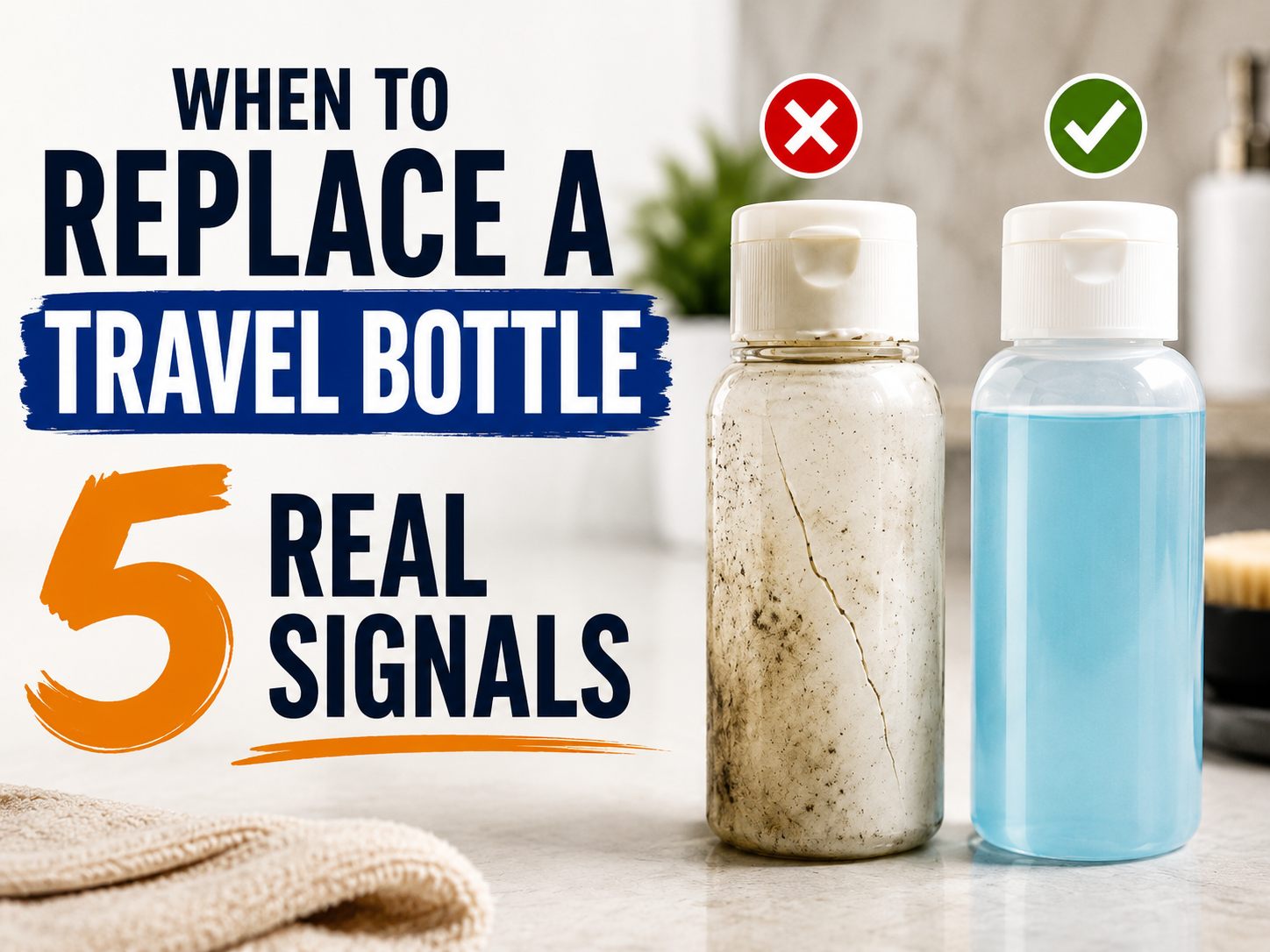
A refillable travel bottle is finished when it fails in a way cleaning cannot fix: a seal that no longer compresses evenly, a crack you can feel with a fingernail, mold that returns immediately after a full clean, or, for aluminum, visible wear through the internal lining. A cloudy or slightly stained bottle is not automatically one of these. Cloudiness alone is usually cosmetic. This article is not medical advice; for a genuine health concern, see a clinician, and read our Disclaimer for how we approach topics like this one.
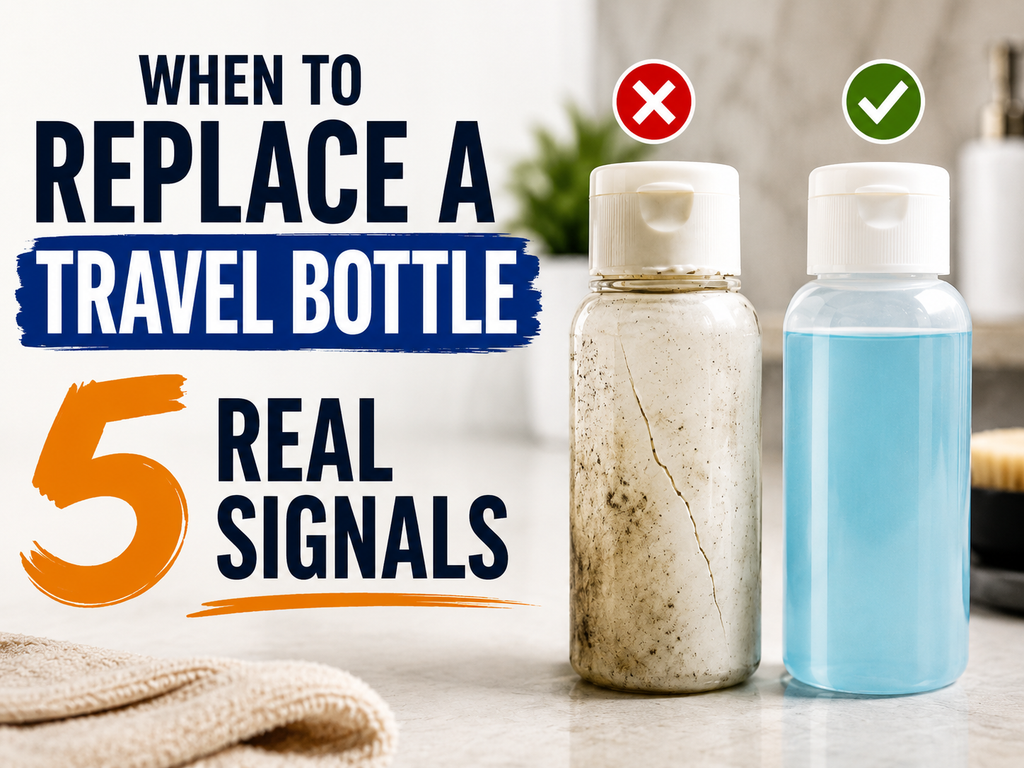
The five real replace signals
1. The seal no longer compresses evenly. Run a finger around the rim while the cap is off. If you can feel a flat spot, a warp, or unevenness in the rim itself, no amount of careful sealing technique will fully compensate. This connects directly to the mechanism in why travel bottles leak: pressure exploits exactly this kind of gap.
2. A crack, even a hairline one. Rigid plastic and aluminum bottles fail suddenly rather than gradually once a crack starts, because the material cannot flex to absorb further stress at that point. A crack that is not actively leaking today can leak the next time the bottle is compressed in a packed bag.
3. Mold that returns within days of a full clean. As covered in mold in a travel bottle, mold that keeps coming back after a thorough disassembly and clean usually means spores have anchored to a degraded surface, most often a worn gasket, that cleaning alone cannot fully reach anymore.
4. Persistent odor that survives a full clean. A smell that is still present after a complete wash, dry and, where applicable, a vinegar soak has usually worked its way into the material itself rather than sitting on the surface. This is more common in silicone, given its porosity, than in hard plastic.
5. Visible wear on an aluminum liner. If the interior coating of an aluminum bottle looks flaked, thinned, or scratched through to bare metal, that is a manufacturing-specific concern worth checking against the product’s own listing, and it is the clearest case for replacing rather than continuing to use the bottle.
The decision that actually matters: clean it once more, or replace it
The honest answer, more often than gear sites tend to admit, is clean it once more. A bottle that looks cloudy, has a faint smell, or has simply been used for a while without a deep clean is very often salvageable with the full routine described in mold in a travel bottle: full disassembly, a proper soak, and complete air drying. Replace it when one of the five signals above is present, not on cosmetic appearance or a fixed age alone.
| Situation | Clean it | Replace it |
|---|---|---|
| Cloudy but rim feels even and no crack | Yes | Not yet |
| Faint smell, hasn’t had a full deep clean recently | Yes | Not yet |
| Mold returns within days of a thorough clean | Already tried | Yes |
| Rim has a flat spot or the cap won’t seat evenly | No fix | Yes |
| Any crack, hairline or otherwise | No fix | Yes |
| Aluminum liner visibly worn or flaking | No fix | Yes |
Rough lifespan by material, as general guidance
There is no single, precise, universally correct figure for how long a travel bottle lasts, and any source that gives you one exact number without qualifying frequency of use and care is presenting more precision than the situation actually has. As general packaging-industry guidance rather than a specific tested figure, reusable bottles in regular travel rotation are commonly discussed in terms of a rough one to two year working life, with heavier use, frequent dishwashing, and rough handling pushing toward the shorter end, and gentle care extending it. Rigid materials like aluminum and hard plastic often outlast that range if the seal and, for aluminum, the liner remain intact; the signals above matter more than the calendar.
What this looks like in practice
If you are standing in a bathroom holding a sticky, slightly discolored travel bottle, the sequence is: check the rim for an uneven seal or crack first, since those are disqualifying on their own. If neither is present, run the full clean described in our mold article. If it comes out clean, smell-free and the cap seats evenly, it is still a usable bottle, discoloration and all. If mold comes straight back or the smell survives the clean, that is your answer.
What we have not tested
We have not run accelerated aging tests on bottle materials, and we have not tracked a set of bottles through repeated real-world trips to measure exactly when each failure signal appears. This guidance is built from how each material is known to fail (flexible versus rigid mechanics, aluminum liner construction) and general packaging-industry maintenance guidance, not a controlled study of our own. If you use a bottle heavily and it has never shown any of the five signals above, there is no reason to replace it on a schedule alone.
FAQ
Is it safe to keep using a bottle that just looks a bit cloudy?
Cosmetic cloudiness by itself, without an uneven seal, a crack, or persistent mold or odor after a full clean, is generally not a safety issue. It is worth a deeper clean, not necessarily a replacement.
How long should one aluminum bottle actually last?
Longer than plastic or silicone in most cases, since aluminum itself does not fatigue the way flexible materials do. The limiting factor is the internal liner; once that visibly wears, the bottle should be replaced regardless of how the exterior looks.
Does a bottle need replacing just because it’s been used for a year?
Not automatically. Age alone is a weaker signal than the condition of the seal, the material, and whether mold or odor persists after a proper clean. A gently used bottle can outlast a general guideline; a heavily used one can fail sooner.
What should I do with a bottle I’m replacing?
Check your local recycling guidance for the specific material, since aluminum, HDPE plastic and silicone are typically handled differently by curbside programs. We are not a disposal authority; a municipal recycling site is the accurate source for your area.
Can a bottle fail even if I’ve never seen mold or a leak?
Yes. A worn seal or a degraded aluminum liner can be present before either mold or a visible leak shows up. Checking the rim by feel periodically catches this earlier than waiting for a symptom.
See our sourcing approach on About us and our Disclaimer for topics like this one.