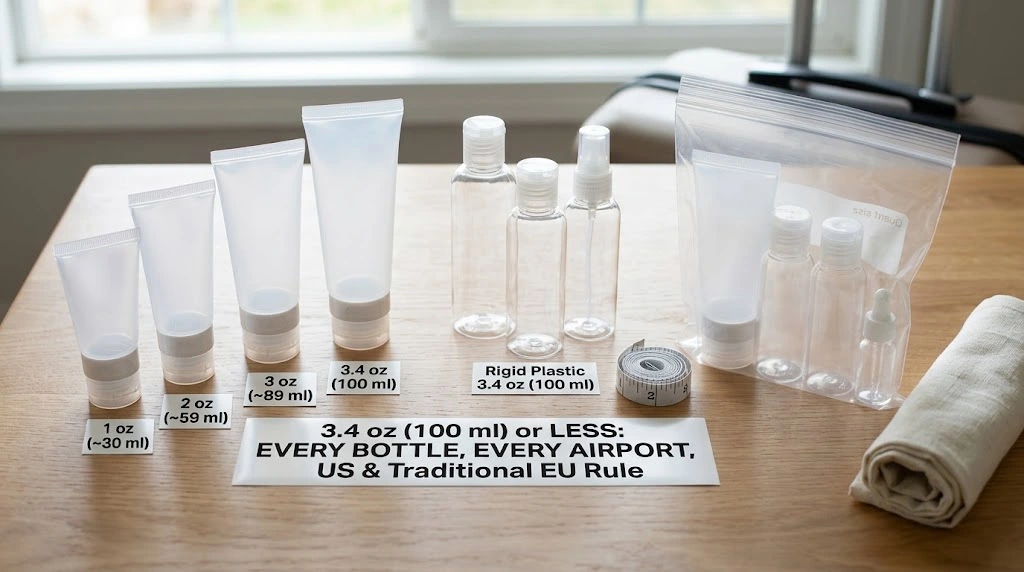
Travel bottles are sold in 1 oz, 2 oz, 3 oz and 3.4 oz (100 ml) sizes because 3.4 oz is the largest single-container size TSA allows in carry-on liquids at every US airport, and the smaller sizes exist to fit more products into the one quart-size bag travelers are limited to. A 3 oz bottle isn’t “safer” at a US checkpoint than a 3.4 oz one; both clear the same limit. What actually changes the answer is where you’re flying from. The United States, the United Kingdom and the European Union each set their own container-size rule, and several airports are running a different limit than their own country’s standard because of newer scanning equipment. There is no single global number, and this article won’t pretend there is.
The US Rule: 3.4 oz (100 ml) Per Container
As reported on TSA’s own pages (checked 2026-08-18), the standing US rule is that each liquid, gel or aerosol container in carry-on baggage must hold 3.4 ounces (100 ml) or less, and every container has to fit inside one quart-size, resealable, transparent bag, one bag per traveler. TSA has stated that container size is what’s screened, not how much liquid is actually inside it: a mostly-empty 6 oz bottle still gets pulled, because the container itself exceeds the limit. Prescription and over-the-counter medications, along with formula, breast milk and baby food, are treated as exemptions from the standard container limit, generally allowed in reasonable quantities and declared separately at screening. Rules change, and this is a US-only figure. Check tsa.gov before you fly, not this page, for the number that applies on your travel date.
The UK Rule: Not One Number
The UK does not currently run a single hand-luggage liquids limit. Per the UK government’s own hand-luggage guidance (fetched 2026-08-18), rules for carrying liquids “depend on the airport,” and travelers are directed to check their specific departure airport, any connecting airport, and their return airport before flying, because the requirement isn’t uniform across the country. Several UK airports still run the traditional 100 ml per container limit inside a single small transparent bag, while others have moved to a higher per-container allowance after installing newer CT-based security scanners, with reporting describing limits as high as 2 liters at some locations. Because this genuinely varies airport to airport and is still changing, the only responsible instruction here is: look up your specific departure airport’s current rule before you pack, not a number quoted on a blog.
The EU Rule: 100 ml Is Still the Baseline, With Exceptions Opening Up
The European Union’s own citizen guidance page (fetched 2026-08-18) states the standard cabin-baggage rule plainly: no container may hold more than 100 ml, and containers must be carried in a transparent bag with a maximum capacity of 1 liter. That page also directs travelers to check their specific airport’s website before flying, which matters because reporting through 2026 describes a small but growing number of EU airports piloting higher container limits, up to roughly 2 liters, at security lanes equipped with newer CT scanners capable of imaging a sealed container’s contents in more detail than older X-ray equipment. Where that upgraded equipment isn’t installed, or at a different lane in the same airport, the 100 ml baseline still applies. A flight connecting through an airport with relaxed screening still has to clear standard screening again if it’s headed to the United States, since TSA’s own rule governs US-bound security regardless of where the trip started.
Why “Container Size” and Not “Amount Inside” Is the Rule Everywhere
This is the detail that gets buried on most pages about travel bottle sizes, and it’s the same across every jurisdiction covered above: security screening is checking the container’s rated capacity, not the fill line. A 4 oz bottle with half an ounce of shampoo left in it still exceeds a 3.4 oz limit and still gets pulled at a US checkpoint. This is why choosing bottles rated at or under the actual limit matters more than “just filling it partway” in a bigger bottle. If a bottle doesn’t have its capacity marked on it, that’s a reason to measure it before a trip, not to guess. PackRefills builds pages like this one from primary sources rather than a lab test we haven’t run; our sourcing approach is on our about page.
A Working Chart of Common Travel Bottle Sizes
| Marked size | Metric equivalent | Common use |
|---|---|---|
| 1 oz | ~30 ml | Serums, concentrated products, sample-style fills |
| 2 oz | ~59 ml | Face wash, lighter lotions |
| 3 oz | ~89 ml | Shampoo, conditioner, body wash |
| 3.4 oz | 100 ml | The largest size that clears the US limit; also the EU and traditional UK baseline |
Every size in this chart fits comfortably under both the US 3.4 oz figure and the EU/traditional-UK 100 ml figure, since 3.4 oz and 100 ml are close enough to be treated as the same practical ceiling. What changes is not which of these bottles you can carry, but how many containers total fit in the one bag your departure airport requires, if it requires one at all. Sizing a whole kit rather than a single bottle is its own decision; see what belongs in a refillable travel bottle kit for how the sizes in this chart map to a full set of products.
What Nobody Selling Bottles Tells You: The Rule Can Relax and Still Trip You Up
The genuinely useful thing about the newer 2-liter allowances showing up at some UK and EU airports isn’t that they let you pack more. It’s that they create a false sense of security for the next leg of a trip. A traveler who packs a 500 ml container at a departure airport running the relaxed rule, then connects through, or lands at, an airport still running the 100 ml or 3.4 oz standard, will have that container confiscated at the second checkpoint, because the return or connecting airport’s rule is the one that governs there, not the one they started under. The safest practical habit, until relaxed rules are close to universal, is to pack to the strictest limit on the full itinerary, not the most generous one. Rules on this page reflect what the sources above stated as of the date noted; see our disclaimer for how we handle rules that change after publication.
Choosing a Container Type at Each Size
A rigid bottle and a flexible tube can both be built to the same rated capacity, and the checkpoint doesn’t care which one you bring. What differs is how completely each one empties and how it handles cabin pressure; see silicone travel tubes vs rigid bottles for that comparison. If you spot a rule on this page that’s changed since the verification date above, our contact page reaches the editorial team.
FAQ
Is a 3 oz bottle safer than a 3.4 oz bottle at a US checkpoint?
No. Both clear the US 3.4 oz (100 ml) limit. There’s no advantage to a smaller size once a container is already under the ceiling.
Does the checkpoint check how full my bottle is?
No. The screening limit is based on the container’s rated capacity, not how much liquid is actually inside it. A large bottle that’s mostly empty is still treated as a large bottle.
Are UK and EU liquid limits the same as the US?
The EU’s baseline and the traditional UK baseline are both close to the US 3.4 oz (100 ml) figure, but neither the UK nor the EU applies one number at every airport anymore. Some airports allow larger containers after installing newer scanners; others don’t. Check your specific departure airport.
Can I pack a bigger bottle if I’m flying from an airport with the relaxed rule?
Only if every airport on your itinerary, including a connection or your return leg, allows it. A container that clears a relaxed checkpoint can still be confiscated at a stricter one later in the same trip.
Where should I check the current rule before I fly?
The authority that actually governs the checkpoint you’re walking through: tsa.gov for US airports, the UK government’s hand-luggage guidance for UK airports, or the departure airport’s own website. Not a travel blog, and not this article, past its stated verification date.