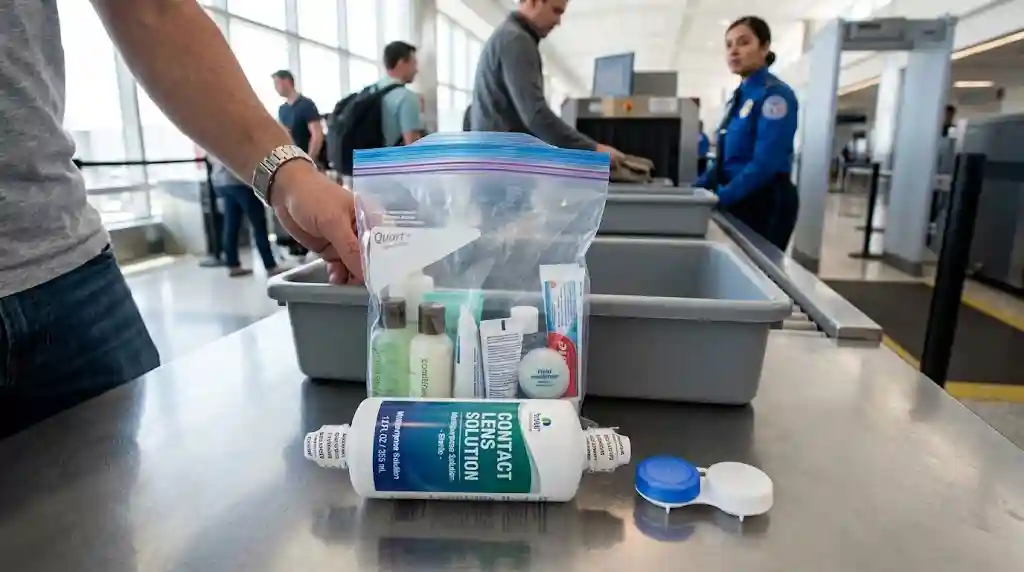
A contact lens solution bottle over 3.4 oz (100 ml) can travel in US carry-on baggage as a medically necessary liquid, but it must be declared to a security officer at the checkpoint and screened separately from the standard liquids bag, and declaring it is not a guarantee it clears screening. As reported on TSA’s own pages (checked 2026-08-18), oversized medically necessary liquids that alarm during additional testing may still be denied, and TSA’s own recommendation is to travel with a 3.4 oz or smaller bottle in carry-on when possible and put any larger bottle in checked baggage instead. The other question travelers ask, whether it’s fine to decant solution into a small non-sterile travel bottle, has a more straightforward answer: don’t. Sterility is the entire function of the product, and a container that hasn’t been sterilized undoes it.
The Standard Rule: Under 3.4 oz Is the Simple Path
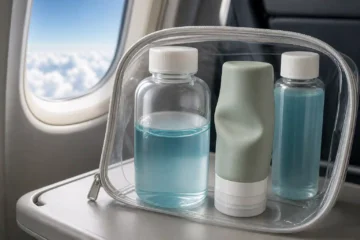
If a contact lens solution bottle is 3.4 oz (100 ml) or smaller, it’s treated like any other liquid in carry-on baggage: it goes in the one quart-size resealable bag alongside everything else, no declaration needed. This is the least complicated option for most trips, and it’s why most contact lens solution is sold in a travel-size bottle to begin with, sterile-sealed by the manufacturer rather than decanted by the traveler. For the general size limit that governs every other liquid in the same bag, and why the number differs by country, see travel bottle sizes explained.
The Medically Necessary Exemption, and What It Actually Means
TSA allows medically necessary liquids, including contact lens solution, in quantities larger than 3.4 oz beyond the standard limit, as reported on TSA’s own pages (checked 2026-08-18). The mechanism is a declaration, not an automatic pass: the traveler tells a security officer the liquid is medically necessary before or during screening, and the officer inspects it, which can include additional testing of the liquid itself. This is different from a formula or breast milk exemption, which is also declared but doesn’t typically involve chemical testing of the liquid. Solution has ingredients, including certain preservatives and cleaning agents, that TSA’s own guidance notes can register on the equipment used to test liquids at the checkpoint, and a liquid that alarms during that testing may not be allowed through regardless of the declaration. None of this means solution is treated with suspicion by default. It means the exemption is a process with a possible negative outcome, not a blanket allowance, and it’s worth knowing that before you’re standing at the checkpoint with a flight to catch.
What TSA Actually Recommends
TSA’s own stated guidance, as reported on its pages (checked 2026-08-18), is to keep contact lens solution in carry-on to a 3.4 oz or smaller container where possible, and to pack any larger quantity in checked baggage rather than relying on the medically necessary declaration. That’s a meaningfully different piece of advice than “you’re always allowed a big bottle if you declare it,” and it’s the version most travel blogs leave out. If your trip length genuinely requires more solution than fits a standard travel bottle, checked baggage is the lower-friction option; the medically necessary declaration is the option for when checked baggage isn’t practical, not the default first choice. This site covers the checkpoint mechanics rather than eye-care advice; our editorial scope is on our about page.
Why You Should Not Decant Solution Into a Travel Bottle
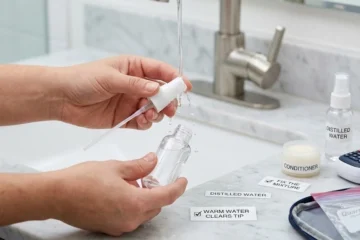
Contact lens solution is manufactured and packaged as a sterile product specifically because it comes into direct contact with a lens that then goes onto the surface of the eye. A travel bottle, even a clean-looking one, is not sterile in the way the manufacturer’s original packaging is, and pouring solution into it introduces a real risk of contamination that the original sealed bottle was designed to prevent. This is different from most other travel-bottle contents, like shampoo or lotion, where decanting into a clean container carries no meaningful risk; the general refilling routine covered in how to refill travel size bottles does not apply to solution for this reason. For solution, the safer approach is a travel-size bottle of the product, sealed by the manufacturer, or a full-size bottle small enough to meet the standard container limit on its own. If a smaller manufacturer-sealed size isn’t available for your specific solution, that’s a conversation for your optometrist about what alternative product or approach they’d recommend, not something to solve by decanting.
Saline Solution, Multipurpose Solution, and Rinsing Water Are Not Interchangeable
These three liquids look similar and are not the same product, and using the wrong one is a genuine eye-health question rather than a packing question, which is why this section routes you to your optometrist rather than telling you what to use. Multipurpose solution is formulated to clean, rinse, disinfect and store lenses. Saline solution is typically for rinsing only and does not disinfect. Tap water or bottled drinking water is neither sterile nor formulated for contact with lenses at all. Packing the wrong one, or running out and substituting one for another mid-trip, is a decision to make with your optometrist’s guidance, not a workaround this article can responsibly suggest. If you wear contacts and travel often, ask your optometrist in advance what to do if you run out mid-trip, before it happens at 11pm in a hotel room.
Contact Lens Cases: The Overlooked Half of This Kit
A lens case gets less attention than the solution bottle, but it has its own refill problem: a case that’s never fully dried between uses can hold onto residue and, over enough cycles, biofilm, in the same way a bottle cap can. Rinse the case with solution, not water, after each use, leave it open to air-dry, and treat a case as a routinely replaced item on the schedule your optometrist recommends, generally every one to three months, rather than a permanent piece of travel gear.
How This Fits the General Container Size Rule
Contact lens solution’s exemption is specific to it being medically necessary, not a general size exception for other products in the same bag. Rules described here reflect what TSA’s own pages stated as of the date noted above; see our disclaimer for how we handle rules that change after publication.
If you notice a rule on this page that has changed, our contact page reaches the editorial team directly.
FAQ
Can I bring a full-size bottle of contact lens solution in carry-on?
Only by declaring it as a medically necessary liquid at the checkpoint, and declaring it does not guarantee it clears screening. TSA’s own recommendation is a 3.4 oz or smaller bottle in carry-on where possible, with larger quantities in checked baggage instead.
Is it safe to decant contact lens solution into a small travel bottle?
No. Solution is manufactured sterile specifically because it contacts a lens that goes on the eye, and a non-sterile travel bottle undoes that. Use a manufacturer-sealed travel size instead.
Can I use saline solution instead of multipurpose solution if I run out?
That’s a question for your optometrist, not a packing decision. Saline and multipurpose solution are formulated differently and are not simply interchangeable.
Do I need to declare contact lens solution if the bottle is under 3.4 oz?
No. A bottle at or under the standard limit goes in your regular liquids bag like any other travel-size product, no declaration needed.
How often should I replace a contact lens case when traveling?
Follow your optometrist’s recommended replacement schedule, generally every one to three months, and rinse with solution rather than water, air-drying fully between uses.