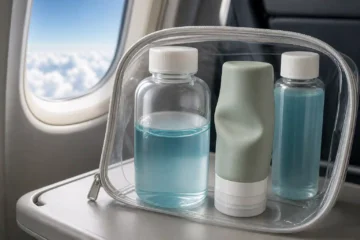
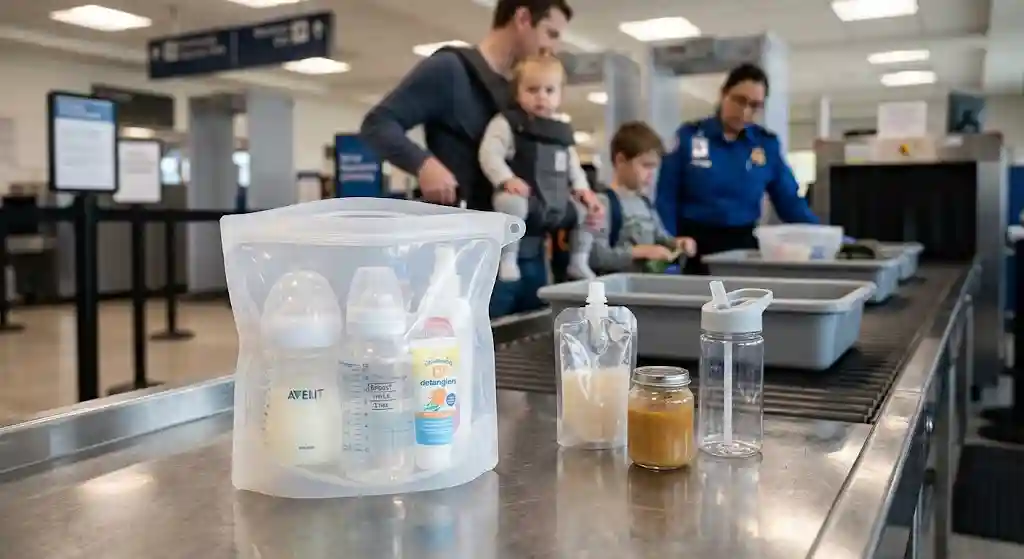
A child’s shampoo, sunscreen and bubble bath are ordinary liquids at a US checkpoint: 3.4 ounces (100 ml) per container, inside one quart-size bag, and TSA states the limit as one bag per passenger, so a ticketed child has their own allowance rather than borrowing yours. Formula, breast milk, toddler drinks and baby or toddler food are the exception. TSA allows them in carry-on in quantities larger than 3.4 ounces and does not require them to fit in the quart bag at all, provided you tell the officer and take them out for separate screening. Verified 2026-08-22.
Last verified: 2026-08-22. Liquids rules differ by country and change without notice. Every figure below is attributed to the authority that publishes it, and you should confirm the rule for your own departure airport before you pack.
The Short Version, Sorted by What Is Actually in the Bottle
| What is in it | US carry-on treatment | Where it goes |
|---|---|---|
| Formula, breast milk, toddler drinks, baby and toddler food including puree pouches | Exempt from the 3.4 oz container limit and from the quart bag, per TSA | Loose in the bag, declared, removed for separate screening |
| Kids’ shampoo, bubble bath, sunscreen, lotion, detangler | Ordinary liquids | 3.4 oz or smaller containers, in a quart bag |
| A child’s prescription or over-the-counter medicine | TSA treats medically necessary liquids as exempt in reasonable quantities | Declared at the checkpoint |
| Water in a kids’ water bottle | Not exempt | Empty before screening, refill after |
The sorting question is never how old the child is or how small the bottle looks. It is what the liquid is for.
Whose Quart Bag Does a Child’s Bottle Count Against
TSA’s liquids rule, as published on tsa.gov and checked on 2026-08-22, is 3.4 ounces (100 ml) or less per container, all containers inside one quart-size resealable bag, one bag per passenger. The pages we could read state the allowance per passenger and do not carve out an age exception, so a child holding a boarding pass is a passenger with their own quart bag. In practice that means a family of four traveling with children in their own seats has four quart bags of ordinary toiletries between them, not one.
What we could not verify is the lap infant case, where a child under two travels without a purchased seat. No TSA page we located addresses whether that child carries a quart-bag allowance of their own. TSA runs a public help channel, AskTSA, and that question belongs there rather than on a packing blog. It is also academic more often than it sounds, because the liquids an infant actually needs are exempt anyway.
Container capacity is what gets screened, not how much liquid is inside, which is why a half-empty 6 oz bottle of kids’ conditioner still fails while a full 3 oz one passes. Our breakdown of travel bottle sizes covers why the marked capacity is the number that matters and where the 3.4 oz figure comes from.
Formula, Breast Milk and Toddler Drinks Clear a Different Path
This is the part most pages about kids’ travel bottles either skip or get wrong, and it is the one with a real answer published by the authority itself.
TSA’s own guidance for traveling with children states that formula, breast milk, toddler drinks and baby or toddler food, including puree pouches, are allowed in carry-on baggage in quantities greater than 3.4 ounces or 100 ml, and do not need to fit within a quart-size bag. TSA describes these as medically necessary liquids. The procedure it publishes is specific:
- Tell the officer at the beginning of screening that you are carrying these items in excess of 3.4 ounces.
- Remove them from the carry-on so they can be screened separately from everything else.
- Expect that officers may need to test the liquids for explosives or concealed prohibited items.
- TSA states that screening will never include placing anything into a medically necessary liquid.
- If you do not want the items X-rayed or opened, TSA’s instruction is to tell the officer, and additional screening steps are used instead.
- TSA also states that a child does not have to be present or traveling with you for you to bring breast milk, formula and related supplies.
Then there is the sentence that changes which container you pack, and almost nobody quotes it. TSA advises that formula and breast milk be transported in clear, translucent bottles rather than in plastic bags or pouches, because liquids in bags or pouches may not be screenable by the Bottle Liquid Scanner, in which case you may be asked to open them for alternate screening such as explosive trace detection or vapor analysis.
Read that as a packing instruction rather than a rule. The container you choose decides whether the exempt liquid goes through a machine or gets opened on a metal table while a line builds behind you. A rigid, clear, translucent bottle is the format the equipment is built to read. A soft pouch, a milk storage bag or an opaque insulated flask is not, and each of those is a candidate for being opened.
Ice packs, freezer packs and gel packs used to cool these items are permitted in carry-on by TSA, along with gel or liquid-filled teethers and canned, jarred or processed baby food.
Outside the United States the Numbers Are Not the Same
One country’s rule is not a global rule, and family liquids are where the differences bite hardest.
United Kingdom. The UK government’s hand luggage guidance (fetched 2026-08-22) says you can take baby food, baby milk and sterilized water for the journey, that there is no legal limit on how much, and that you should check with your airport anyway. Individual containers of breast milk must hold no more than 2,000 ml. Each container is screened at the security point and staff might need to open containers. Two conditions differ sharply from the US: frozen breast milk is not allowed in hand luggage, though it is allowed in hold luggage, and formula milk, sterilized water and baby food require the baby to be traveling with you, while breast milk does not.
Canada. CATSA states that if you are traveling with an infant younger than two years of age (0 to 24 months), you may bring baby food, milk, liquid formula, water, juice and other baby items in carry-on in quantities greater than 100 ml, and that all baby food and drinks including formula must be presented to the screening officer for inspection. Gel and ice packs are permitted when they are being used to refrigerate those items for an infant under two. For powdered formula, CATSA advises against metal-lined containers in carry-on and notes that powders may need additional screening.
So the same bottle of breast milk is exempt in all three places, but the US frames the exemption around what the liquid is, the UK caps the individual container at 2,000 ml and bars it frozen, and Canada frames it around accompanying a child under two. Pack to the strictest rule on your whole itinerary, including the return leg, and check the departure airport for each leg separately.
Choosing Travel Bottles for Kids: What Survives a Toddler and a Dishwasher
Material choice for a kids’ bottle is a durability and cleaning question, not a checkpoint question. Security does not care what the container is made of.
Two things are worth knowing before you read a label.
“BPA-free” on a children’s bottle is a weaker signal than it looks. The US Food and Drug Administration amended its food additive regulations so that they no longer provide for the use of BPA-based polycarbonate resins in baby bottles and sippy cups, after petitions in 2012 and 2013. FDA is explicit that an amendment made on the grounds of abandonment is not a safety finding: it reflects that the industry had already stopped using the material. So a BPA-free claim on a modern baby bottle describes what the market did over a decade ago rather than a distinguishing feature of that product.
Dishwasher tolerance is a manufacturer specification, not a material property. Two bottles molded from the same plastic can carry different instructions depending on the cap, the valve and the print on the outside. Read the marking on the base and follow it, including “top rack only” if that is what it says. For how the common materials behave when they are dropped, squeezed and heated, our comparison of silicone, plastic and aluminum travel bottles covers what fails first in each.
For cleaning and sanitizing anything a baby feeds from, use the CDC’s guidance on cleaning, sanitizing and storing infant feeding items rather than general bottle advice, including ours. It covers dishwasher and hand-washing routines, when sanitizing matters more, and air-drying before reassembly.
What Leaks in a Bag That Gets Thrown Around
Kids’ bottles fail in ways adult toiletry bottles do not, because of what is on top of them.
- Straw and spout lids are not seals. A straw lid has a deliberate opening with a valve behind it. Valves are consumables, they harden, and a hardened valve weeps.
- Push-button sippy lids hold pressure until they do not. The button is a spring closure holding a small seal against a seat, and any grit on that seat is a leak path.
- Pouches split at the corners under compression in a packed bag, and they are the format most likely to be opened at screening anyway.
- Headspace is the actual mechanism. Air trapped above the liquid expands as cabin pressure falls in flight and pushes product past the weakest closure. That is not a defect in a cheap bottle, it is physics acting on the air you sealed in.
The fix is fill level and closure type rather than price, which is the same mechanism set out in our guide to why travel bottles leak on a plane. For a child’s kit specifically: carry the water bottle empty through security and fill it after, transport exempt milk in a rigid clear bottle rather than a bag, and put anything with a valve in its own sealed pouch inside the bag.
One Bag, Three People, and Who Carries What
A shared family kit is an inventory problem before it is a gear problem. Three sensible habits, none of which need a purchase.
Split by allowance rather than by person. Ordinary toiletries go in the quart bags, and every ticketed traveler has one. Exempt items travel together in one accessible outer pocket, because you will be pulling them out at the checkpoint and you do not want to be excavating.
Label everything, because in a family kit the containers are identical and the consequences are not. A bottle with no label is the one somebody guesses about.
Share the products, not the containers. One 3.4 oz bottle of the family shampoo beats three 1 oz bottles of it, and that space buys you the things that genuinely cannot be shared. If you are building a kit from a multipack, what belongs in a refillable travel bottle kit goes through which pieces earn their space and which stay in the drawer.
When the Trip Is Over
The bottles that come back from a family trip are the worst case for storage: milk residue, juice, sunscreen, and a valve nobody took apart. The state a bottle goes into a drawer in decides what you find next time, and our guide to storing travel bottles between trips covers the empty, washed, dry and open routine that prevents most of it.
What We Did Not Verify, and What We Will Not Advise
We have not flown with any of this gear, tested any bottle, or run anything through a checkpoint. PackRefills builds pages like this one from named primary sources, which is the standard described on our about page.
Two honest gaps. First, tsa.gov and fda.gov both refuse our automated research tool, so the TSA and FDA statements above were read from those agencies’ own pages as surfaced in search results on 2026-08-22 rather than fetched directly. They are stable, long-standing positions and they are consistent across TSA’s own pages, but open tsa.gov yourself before you fly, because we cannot promise a page has not changed since. The UK government and CATSA pages were fetched directly on the same date. Second, we found no TSA statement covering the quart-bag allowance of a lap infant, and we have not invented one.
We also will not tell you anything about infant feeding. Nothing on this page addresses how to prepare formula, how long milk keeps, what temperature it should be, or what is safe for a baby to drink. Those questions go to your pediatrician, and to the CDC and FDA. Our subject is the container and the checkpoint, and it stops there.
FAQ
Do travel bottles for kids count against my liquids allowance?
Ordinary kids’ toiletries do, but each ticketed passenger gets their own quart bag under TSA’s rule, so a child in their own seat has their own allowance. Formula, breast milk, toddler drinks and baby food do not count against anyone’s bag, because TSA exempts them from both the 3.4 oz container limit and the quart bag.
How much formula or breast milk can I bring through a US checkpoint?
TSA allows formula, breast milk, toddler drinks and baby or toddler food in carry-on in quantities greater than 3.4 ounces, treating them as medically necessary liquids allowed in reasonable quantities. You must tell the officer at the start of screening and remove the items to be screened separately. Rules change, so confirm at tsa.gov before you travel.
What kind of bottle should I put breast milk or formula in for the airport?
TSA advises clear, translucent bottles rather than plastic bags or pouches, because liquids in bags and pouches may not be screenable by the Bottle Liquid Scanner and you may then be asked to open them for alternate screening. A rigid clear bottle is the format that screens fastest.
Does my child have to be with me for the exemption to apply?
It depends on the country. TSA states that a child does not need to be present or traveling with you to bring breast milk, formula and related supplies. UK government guidance requires the baby to be traveling with you for formula milk, sterilized water and baby food, though not for breast milk, and it does not allow frozen breast milk in hand luggage at all. Canada frames the exemption around accompanying an infant under two.
Are kids’ water bottles allowed through security?
Empty, yes. Water is not an exempt liquid, so send the bottle through empty and fill it at a fountain after the checkpoint. That is also the easiest way to avoid a bottle being emptied for you in front of a tired child.