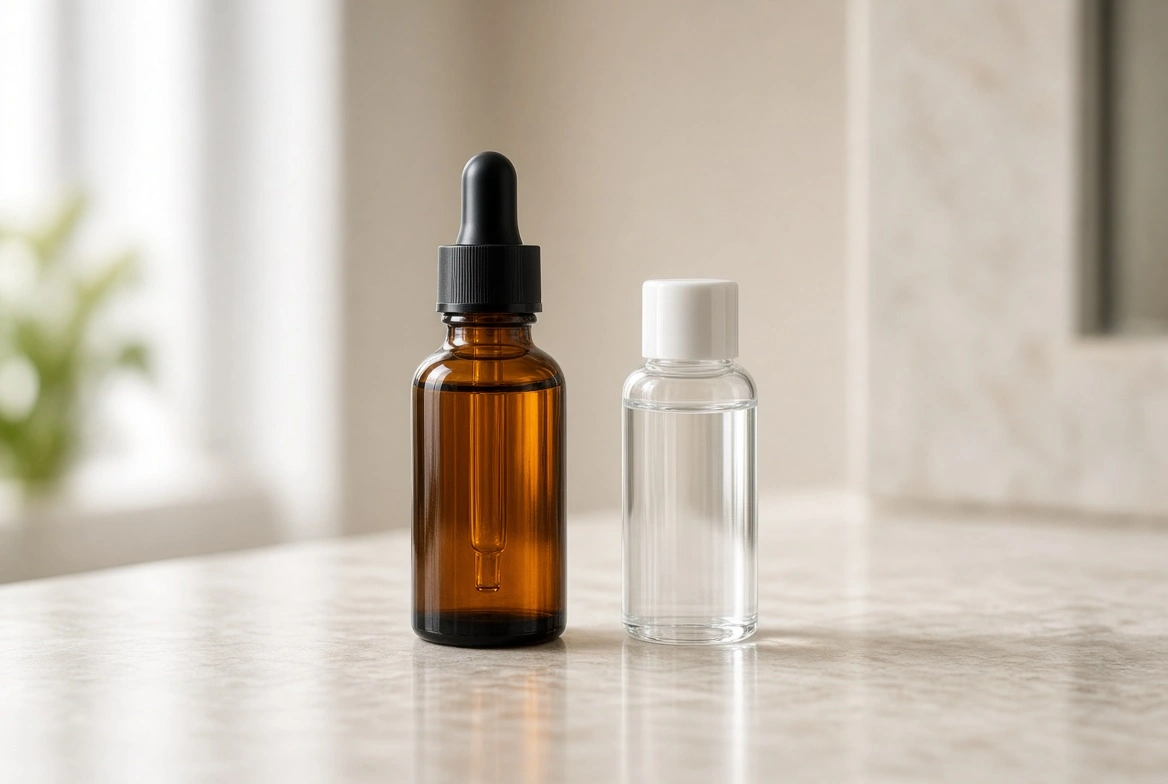
The worry is specific and it is a reasonable one. Your serum came in dark glass with a dropper, that packaging presumably exists for a reason, and you are about to put it in a small clear bottle for a week.
This page will not tell you whether your particular product survives that. It cannot, and neither can any general article, and the reason is the whole first section. What it can tell you is what those packaging features are for, so that you can ask the right question of the source that does know.
What the packaging is doing
Skincare packaging is not decorative, and three features come up repeatedly.
Colored or opaque glass. Amber, cobalt, black. This is about light. Some formulations are affected by light exposure and the packaging is designed to limit it.
An airless pump. A bottle where the product is pushed out by a rising base rather than by air entering to replace what left. This is about air. A conventional pump or dropper bottle admits air every time it is used; an airless one is designed not to.
A dropper versus a pump. A dropper is opened fully each time and the pipette is dipped back into the product. A pump is not opened at all in normal use.
Read those three together and a pattern appears: the more elaborate the packaging, the more the formulator was trying to keep something away from the product. Usually light, air, or contamination, and often all three.
That is a signal, and it is the most useful thing on this page. A product sold in plain clear plastic with a screw cap is telling you something different from one sold in opaque glass with an airless pump.
The question this page cannot answer
Whether decanting a specific product changes it is a formulation question, and formulations differ.
No general article knows what is in your bottle, how it was stabilized, what the manufacturer tested it in, or how long it is intended to last once opened. Any page that tells you a category of product is fine to decant, or is not, is making a claim about products it has never seen.
So no ingredient is named here as stable or unstable, no shelf life is stated, and no timeframe is given. Those numbers exist for specific products and they belong to the people who made them.
The label is the source. Storage instructions, any period-after-opening indication, and anything the manufacturer says about the container are on the packaging or on the manufacturer’s own page. Where the label says something, that is the answer. Where it says nothing, you are making a judgment, and the sections below are about making it a smaller one.
If you want certainty rather than a judgment, there is one option that removes the question entirely and it is not clever: buy the smallest size the manufacturer sells, or use a sample sachet. No decanting, original packaging, no question.
If you are going to decant
Assuming you have read the label and decided to go ahead, these reduce what you are exposed to.
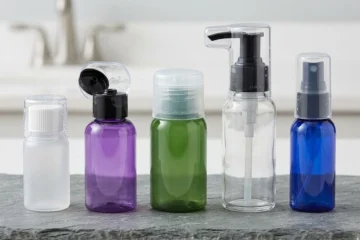
Match the packaging you are leaving. If it was in opaque glass, a clear bottle is a different environment. If it was airless, a dropper is a different environment. You cannot always match it and you can get closer than a random travel bottle.
Decant only what you need for the trip, and no more. This is the single highest-value habit here: less product, less time, less exposure, and less thrown away if you are wrong.
Use it and do not keep the remainder. A decanted portion is not a second stock of the product. When the trip ends, that container gets emptied and washed.
Clean and dry the container completely first. A container with water in it is a container that has diluted your product, and one with residue in it is worse. How to clean silicone travel bottles and get the smell out covers the cleaning side, and the drying is the part people rush.
Fill it as full as the closure allows if air is the concern, which is the opposite of the usual advice for pressure. Those two considerations genuinely conflict and how to fill and close a travel bottle so it survives the flight covers the pressure half. If you are flying, the pressure argument wins on the practical grounds that a leaked bottle is a certain loss and everything else is a maybe.
Do not decant back and forth. Once it has left the original container, it does not return to it.
Label it, with the date. This is a decanted product with no packaging and no printed information on it, and in a fortnight you will not remember when you filled it.
The dropper problem specifically
Droppers have an issue that is separate from everything above and is worth naming.
The pipette goes back into the bottle after touching your skin or your hands. Whatever is on it goes in with it. That is true of the original bottle too, and it becomes more relevant in a small decanted quantity that has already been through more handling.
Two practical responses: do not touch the pipette to your face, and treat a decanted dropper bottle as short-lived rather than as storage.
The general hygiene consideration is the same one that governs everything refillable, and its extreme case is worth knowing: mold in a travel bottle covers where contamination starts and what to do about it, and the rule when you find any is that a container is a cheap object.
What to carry it in
Practical rather than chemical, and short.
Glass is heavy and breaks. For a carry-on, that is a real consideration. If glass matters for your product, protect it properly.
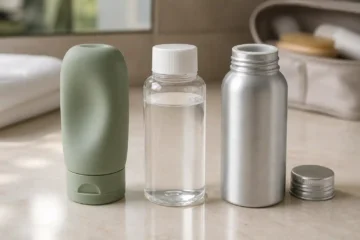
Small plastic and silicone bottles vary in how much air they admit and in what they are intended for. The bottle’s own instructions are worth reading, and what you should not put in a silicone travel bottle covers the compatibility question generally.
The closure is what fails, not the container. A serum leaking into a wash bag is a closure story, and the mechanism is in why travel bottles leak on a plane.
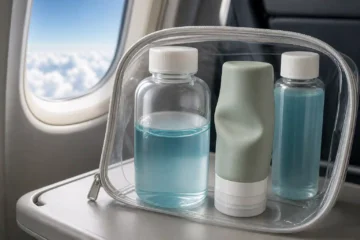
Everything goes in a sealed bag anyway, and thin liquids separately from thick ones.
Prescription and medicated products
A separate category, and the answer is short.
Anything prescribed, medicated or regulated stays in its own packaging. That packaging carries the labeling, the batch information and the instructions, and decanting it removes all of that.
If you are unsure whether a product falls into this category, the pharmacist who supplied it is the right person to ask, and it is a one-minute question.
The short version
- Colored glass, airless pumps and closed dispensing are there to keep light, air or contamination away from a formulation.
- Elaborate packaging is a signal about the product. Plain packaging is a different signal.
- Whether your specific product survives decanting is a formulation question. No general claim is made here.
- The label and the manufacturer are the source. Where they say nothing, you are making a judgment.
- Buying the smallest size or using a sample removes the question entirely.
- If you decant: match the packaging where you can, take only what the trip needs, clean and dry properly, label with the date, and do not keep the remainder.
- Prescribed and medicated products stay in their own packaging.