TSA's own FAQ states that "formula, breast milk, juice in quantities greater than 3.4 ounces or 100 milliliters are allowed in carry-on baggage and do not need to fit within a quart-sized bag," and that "you do not need to travel with your child to bring breast milk," read on 7 September 2026. The same page adds the part that summaries drop: "remove these items from your carry-on bag to be screened separately from the rest of your belongings." The exemption is from the container limit and from the quart bag. It is not an exemption from screening, and the screening that follows is what this page is mostly about.
This page describes a screening procedure. It is not feeding or medical advice. Anything about the milk itself, how it is stored, how long it keeps or what to feed an infant is a question for your pediatrician, a lactation consultant or your own health service. Nothing here is a reason to change any of that.
Last checked: 7 September 2026. These are Transportation Security Administration rules for airports in the United States. Other countries' screening authorities set their own limits and their own procedures, including for infant liquids. Rules change without notice, so open tsa.gov before you fly.
What Is Exempt, in TSA's Own Words
TSA states this in several places and the coverage is slightly wider on the children's page than on the FAQ, so both are worth reading.
| TSA page, read 7 September 2026 | What it covers |
|---|---|
| FAQ, Breast milk, formula and juice exempt from the 3-1-1 liquids rule | Formula, breast milk and juice in quantities greater than 3.4 oz or 100 ml, allowed in carry-on and not required to fit within a quart-sized bag. States that breast milk and formula are considered medically necessary liquids |
| TSA Cares, Traveling with Children | Formula, breast milk, toddler drinks, and baby and toddler food including puree pouches, in quantities over 3.4 oz. Ice packs, freezer packs, gel packs and liquid-filled teethers allowed in carry-ons |
| What Can I Bring, Baby Formula and Breast Milk | Carry-on "Yes (Special Instructions)", checked bags "Yes", with the same special instruction |
Two details are easy to miss. TSA's FAQ says breast milk and formula are considered medically necessary liquids, which is the category the exemption sits inside rather than a separate rule of its own. And TSA's children page states that your child or infant does not need to be traveling with you to bring breast milk and cooling accessories, which answers a question a lot of parents flying without the baby arrive with.
For the ordinary rule these liquids are being excused from, our read of the 3-1-1 rule and what each of its numbers limits sets it out.
The Two Things You Do at the Checkpoint
TSA's traveling with children guidance describes the procedure as two actions, both before anything goes into the X-ray tunnel.
- Inform the TSA officer at the start of screening if you are carrying these items in amounts over 3.4 ounces.
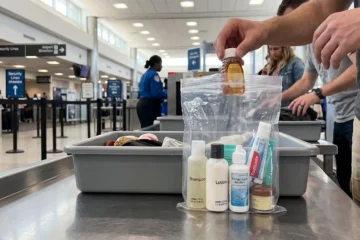
- Remove them from your carry-on so they can be screened separately from the rest of your belongings.
That is the whole of it, and the timing is the part that matters. A declaration made after the bag is on the belt is a declaration made too late, and the screening has already started down a different path.
What the Extra Screening Actually Involves
This is the section most articles skip, and it is the one a parent is actually anxious about. Here is what TSA publishes about it.
X-ray is the default, and TSA addresses the safety question directly. Its children page states that TSA X-ray machines are not harmful to food or medicines. That sentence is on TSA's own page, and we are quoting it rather than paraphrasing it, because it is the exact claim parents want to check.
Officers may test the liquid. TSA states that it may test liquids for explosives or prohibited items. It also states that screening will not involve placing anything into the liquid. The testing happens on the outside of the container, not in the milk.
Pouches and plastic bags are the awkward case. TSA's guidance notes that liquids in plastic bags or pouches may require alternate screening, giving Explosive Trace Detection and Vapor Analysis as examples. That is the mechanism behind the recommendation on the same page: use clear, translucent bottles for formula and breast milk when possible. The advice is not aesthetic. It is that a rigid transparent bottle can be screened by the equipment designed for bottles, and a flexible pouch often cannot, so the pouch takes the longer route.
You may decline the X-ray, and TSA publishes what follows. Its guidance says that if you do not want your items X-rayed or opened, notify the officer, and additional steps will be taken to clear the liquid, including Advanced Imaging Technology screening and additional or enhanced screening of your other carry-on property. We are stating that as TSA states it and taking no position on it. It is a published option with a published consequence, and the choice belongs to the traveler.
Private screening can be requested. TSA's guidance states that a traveler may request private screening at any point in the process.
The Sentence That Governs All of It
TSA prints a standing line on the baby formula item page, the breast milk item page and every other item page we read: "The final decision rests with the TSA officer on whether an item is allowed through the checkpoint."
So this page will not tell you that a quantity will be accepted, that a container will not be opened, or that a screening will be quick. The exemption is real and it is published. The outcome at your checkpoint is the officer's, applying it on the day.
The one thing we will say plainly is what not to do about that. Declaring accurately and early is the procedure TSA publishes, and it is the procedure that produces the boring outcome. Misstating what you are carrying to avoid the extra screening is not a shortcut we would describe, and it is not one worth taking with an infant's food in the bag.
Cooling, Ice Packs and Things That Have Started to Melt
TSA's gel ice packs page, read 7 September 2026, gives the general rule and then the medical exception, and both are relevant here.
The general rule is that frozen items are allowed through the checkpoint if they are frozen solid when presented for screening, and that a partially melted or slushy item falls back under the 3-1-1 liquids rule. The exception is stated in TSA's own words: "medically necessary gel ice packs in reasonable quantities are allowed regardless of their physical state of matter (e.g., melted or slushy) with or without the presence of breast milk."
TSA's children page separately lists ice packs, freezer packs, gel packs and liquid-filled teethers as allowed in carry-ons, and states that the cooling accessories may be brought whether or not the child is traveling with you. The page also says to notify officers so medical ice packs can be inspected.
TSA publishes no ounce or count figure for "reasonable quantities," and we are not inventing one.
What Is Not Exempt, and Still Counts Against the Quart Bag
The exemption is specific. It covers formula, breast milk, juice, toddler drinks and baby and toddler food. It does not cover the rest of the bag.
A parent's own shampoo, sunscreen, toothpaste and moisturizer are ordinary liquids under the 3.4 ounce container rule, and so are a child's, once you are past the exempt categories. Our read of what TSA counts as a liquid covers the gels, creams and pastes the rule catches, which is a wider category than the word suggests.
Whose allowance a child's ordinary bottle counts against is its own question, and we work through it in the piece on travel bottles for kids and the liquids allowance. If you are sizing the adult side of the bag around a bulky exempt item, what each travel bottle size actually holds is the calculation to run at home rather than in the security line.
Three Authorities, Not One
Clearing the checkpoint is one of three separate questions, and only the first is TSA's.
| Who decides | What they decide |
|---|---|
| TSA | Whether items pass the security checkpoint at a US airport |
| Your airline | What may be carried, stored, warmed or used in the cabin, under its own conditions of carriage |
| The destination or transit country | Its own security rules on infant liquids, and any rules on bringing food across its border |
TSA's pages describe screening. They do not speak for an airline's cabin policy and they do not speak for another country's authority. If you are connecting or returning through a non-US airport, that leg is screened under different rules and the infant liquids provisions are not identical everywhere.
How We Checked This
We have not flown with any of this, tested anything or run anything through a checkpoint. This page is desk research from TSA's own pages, read on 7 September 2026, and the quoted sentences are TSA's wording rather than ours.
What we deliberately left out: any quantity figure, because TSA states these liquids are allowed in quantities greater than 3.4 ounces without publishing a ceiling, and any figure for reasonable quantities of ice packs, because none is published. We have also left out everything about the milk itself. How long expressed milk keeps, at what temperature, and what is appropriate for a given infant are clinical questions, and the pediatrician, midwife or lactation consultant who knows the child is the person to ask.
FAQ
How much breast milk or formula can I bring through TSA?
TSA states that formula, breast milk and juice in quantities greater than 3.4 ounces or 100 milliliters are allowed in carry-on baggage and do not need to fit within a quart-sized bag. It publishes no upper figure on the pages we read. The final decision rests with the TSA officer on whether an item is allowed through the checkpoint.
Does my baby have to be with me to bring breast milk?
No. TSA's FAQ states that you do not need to travel with your child to bring breast milk, and its traveling with children page says the same for cooling accessories. Read 7 September 2026.
Will TSA open my breast milk or put something in it?
TSA states that it may test liquids for explosives or prohibited items, and that screening will not involve placing anything into the liquid. Officers may ask you to open a container that cannot be cleared by the screening equipment.
Is X-ray screening safe for breast milk and formula?
TSA's traveling with children page states that TSA X-ray machines are not harmful to food or medicines. It also states that if you do not want your items X-rayed or opened you should notify the officer, after which additional steps including Advanced Imaging Technology screening and enhanced screening of your other carry-on property are taken.
Why does TSA recommend clear bottles instead of pouches?
TSA's guidance notes that liquids in plastic bags or pouches may require alternate screening such as Explosive Trace Detection or Vapor Analysis, and recommends using clear, translucent bottles for formula and breast milk when possible. It is a screening-speed recommendation, not a requirement.