
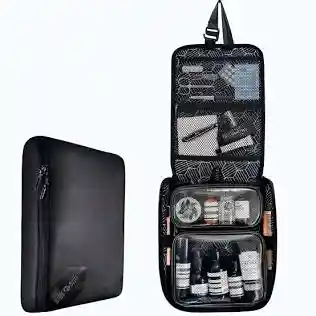
The bag is decided by four facts about your trip, not by a feature list: how many nights of product it has to hold, whether the bathroom you are heading for has counter space, whether you are carry-on only or checking a bag, and whether the bag has to hang. Answer those four and the form factor falls out on its own. Most people own three toiletry bags and use none of them because all three were bought against a picture of travel rather than against the trip they actually take, which is usually the same trip, three or four times a year.
What This Page Is and Is Not
We have no test rig, no product access and no bags on a shelf here. This site does not run rankings and does not publish a verdict on any brand, because a verdict implies a test we have not done.
What this page does instead is give you the criteria, in the order they actually constrain the decision, so that you can apply them to what is in front of you in a shop or already in your cupboard at home. That is a smaller promise than a top ten, and it is the one we can keep. It also means the honest answer for a good number of readers is to buy nothing: if you take one trip a year and the pouch you own zips shut, the bag is not your problem.
Question One: How Many Nights, and How Much Product Per Night
Capacity is the variable everyone gets wrong, in both directions. The common failure is buying for the longest trip you might ever take, then carrying that volume on every weekend.
The useful way to size a bag is to lay out what you genuinely use in a day, count the nights, and notice that most toiletries do not scale with the trip. A toothbrush is one toothbrush at two nights and at fourteen. What scales is the consumables: shampoo, conditioner, body wash, sunscreen, and whatever you apply by the pump. So the honest question is not "how big a bag for two weeks" but "how much of the four or five things that scale do I need, and can I get them in smaller containers." Our breakdown of what a travel bottle set should include is the same exercise from the container end.
A bag that is slightly too small forces that discipline every time you pack. A bag that is comfortably too big fills up, because empty space in a soft bag is an invitation.
Question Two: Is There a Counter, or Is There Not
This is the single most predictive question and almost nobody asks it before buying.
A hotel bathroom with a wide vanity means the bag can be a simple container: open it, put it down, take things out. A cruise cabin, a hostel shower block, an aircraft lavatory, a camper van and a great many older city hotels give you a sink rim about the width of your hand and nowhere dry to set anything down. In those rooms the bag has to become the shelf, which is what a hanging bag with a hook is for and the only reason it justifies its bulk.
The mistake is treating the hook as a bonus feature. It is not a bonus. It is a structural commitment: a bag built to hang and be seen into is deeper, heavier and has more internal panels than a bag built to be opened flat, and you carry that weight on every trip whether or not there is a rail to hang it from. Decide which room you are actually going to.
Question Three: Carry-On Only, or Checking a Bag
This question changes the bag's job rather than its size.
If you are carry-on only in the United States, your liquids under 3.4 oz have to come out of your bag and go through the checkpoint in a clear quart-size bag, and TSA's own travel checklist suggests keeping that bag in the front pocket of your carry-on for accessibility. That means two objects, not one: the regulated quart bag, and the toiletry bag that holds everything not in it. A toiletry bag that swallows the quart bag deep inside a zipped compartment costs you time at the belt. The details of what has to be in the quart bag are in our read of the 3-1-1 rule.
If you are checking a bag, screening stops being the constraint and containment starts. Nothing has to come out at speed, larger containers are possible within the limits that apply to checked baggage, and the failure mode shifts from the checkpoint to what a leak does to your clothes at altitude.
One bag rarely serves both patterns well. If you do both, the workable answer is usually a plain quart bag that lives permanently in the carry-on, and a toiletry bag chosen for whichever trip type you take more often.
Question Four: Does It Have to Hang, or Just Stand Up
If question two said yes to hanging, there is still a second decision, and it is the one that ruins hanging bags.
The hook and the loop are the part that fails. A hanging bag loaded with full bottles puts its entire weight on one small attachment point and on the seam that anchors it, swinging every time you take something out. That is where the stitching pulls, and it is also where a bag that is fine at home fails on the trip it was bought for. If you are buying a hanging bag, the thing worth examining in the shop is not the number of pockets, it is whether the hook anchors into a reinforced panel or into a single layer of lining fabric.
The alternative for a small bathroom is often overlooked: a bag with a flat, weighted base that stands open on its own, so it can sit on a closed toilet lid or a narrow ledge without tipping. It does less than a hanging bag and it fails in fewer places.
The Two Failure Points That Decide How Long a Bag Lasts
Fabric is what gets marketed. Zips and seams are what break.
The zip is the highest-stress moving component in the bag, and it is the part that meets grit, dried toothpaste and product residue. A coil zip that has been contaminated stops running smoothly, gets forced, and then either separates behind the slider or loses teeth. The seams are the second point: a bag that is stuffed harder than it was built for pulls at the corners where the panels meet, and on a hanging bag at the hook anchor as described above.
That has a direct buying consequence. Between two bags in the same shape, the one with a heavier zip that runs cleanly by hand, and with seams that are bound or taped rather than raw, is the better bag, regardless of what the outer fabric is called. It is also why zips and seams, not fabric, are the honest answer to "will this survive."
Matching the Answers to a Shape
| Your trip | What the bag has to do | Shape that usually follows |
|---|---|---|
| Two or three nights, hotel with counter, checked bag | Hold a small kit, open flat | A simple flat pouch or compact kit |
| Weekend, carry-on only | Keep the quart bag reachable, hold the rest | A small kit plus a separate quart bag |
| A week or more, counter space unknown | Hold consumables, become a shelf if needed | Hanging bag, reinforced hook |
| Hostel or shared bathroom | Carry everything down a corridor, get wet, drain | Open caddy or a bag that tolerates water |
| Long trip, checked, fragile items inside | Contain a leak, protect what breaks | Larger bag, internal compartments, wipeable lining |
| One trip a year | Zip shut | The one you already own |
Read the table as a starting point rather than a rule. The row that applies to most people is the one they take most often, not the most demanding one.
The Layer Underneath the Bag
A toiletry bag is a container for containers, and the containers inside it do most of the work. This is the part the bag comparisons skip, because the same companies sell both shapes and neither shape is the reason trips get ruined.
A bag with a wipeable lining limits the damage from a leak. It does not prevent one, and it does not stop product reaching your clothes if the bag is packed loose in a suitcase. What prevents a leak is the closure on the bottle, and our read of why travel bottles leak covers the mechanisms, most of which are about pressure change and a worn seal rather than about the bag. What limits the spread is a second barrier around anything that can pour.
The same goes for the state the kit is in when you leave. A bag that was packed damp grows the problem it will hand you next trip, which is why how you store travel bottles between trips matters more than what they are stored in.
What We Deliberately Are Not Telling You
No dimensions, no capacities in liters, no weights and no prices appear on this page, because we have not measured any bag and we do not publish a number we have not read on the maker's own specification. No brand is recommended or criticized here.
If you want measurements, take them from the manufacturer's own listing for the specific model you are looking at, and check the date on it. If you want a comparative verdict, take it from a reviewer who has physically used the bags and says so.
FAQ
What size toiletry bag should I get?
Size it against the four or five consumables that scale with trip length, not against the trip itself. Most items in a kit are the same at two nights and at fourteen. A bag that is slightly tight enforces discipline every time you pack; a comfortably large bag fills up, because empty space in a soft bag gets used.
Is a hanging toiletry bag worth it?
It is worth it when the bathroom has no dry counter space, which is common in cruise cabins, hostels, camper vans and older hotels. It is not free: a hanging bag is deeper and heavier than the equivalent flat kit, and you carry that on every trip. Decide by the rooms you actually stay in.
Do I need a clear toiletry bag for flying?
In the United States, the clear quart-size bag requirement applies to your liquids, aerosols and gels at the checkpoint. It is a separate object from the toiletry bag that carries everything else. Rules outside the United States are set by that country's own security service and differ.
What actually makes a toiletry bag last?
The zip and the seams, not the fabric. The zip meets grit and product residue and is the highest-stress moving part. Seams pull at the corners when a bag is overstuffed, and on a hanging bag at the hook anchor. Between two similar bags, choose the one whose zip runs cleanly and whose seams are bound rather than raw.
Should I just buy a new one?
Often not. If the bag you own zips shut, holds what you take, and suits the bathroom you are going to, replacing it changes nothing. The upgrades that genuinely change a trip are usually to the containers inside the bag, not to the bag.