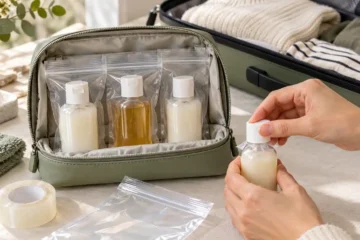
Here is how to pack a wet swimsuit when checkout is in an hour: rinse it in fresh water, press out the water by rolling it tightly inside a towel, then seal it in a waterproof bag with the opening facing up and pack that bag on top of your luggage, away from paper and electronics. The goal is not to dry the suit. It is to remove as much free water as you can, then contain what is left, then unpack it the moment you arrive.
That covers the suit. Departure day usually has two other wet things in it, the razor you used that morning and the toiletry bag that sat on a wet counter, and most swimsuit packing advice stops before it reaches them. This guide covers all three, plus what happens to moisture once it is sealed inside a bag for a travel day.
A note on how we wrote this: it is desk research. We did not run a timed drying test or put bags through a flight, and we will not describe anything here as tested. Where a rule comes from TSA, we quote TSA's own page and give the date we read it.
Why a wet swimsuit is a containment problem, not a drying problem
On a normal departure morning there is no time to dry a swimsuit. Swim fabric holds water in the knit and in any lining or padding, and a suit that feels "mostly dry" to the touch can still wet a cotton T-shirt pressed against it for a few hours.
So the job splits into three parts, and each one is doing something different:
- Remove free water. Water you can squeeze out is water that cannot leak later.
- Contain the rest. Whatever stays in the fabric has to be kept away from things it can damage.
- Release it at the other end. A sealed bag keeps water in. That protects your clothes during the trip and works against the suit once the trip is over.
The third part is the one people skip, and it is where the musty smell comes from. The EPA's guidance on household mold is written for homes, not luggage, but the principle carries over: according to the EPA's Brief Guide to Mold, Moisture and Your Home (read September 23, 2026), "none of them will grow without water or moisture," and the agency advises drying water-damaged items "within 24-48 hours to prevent mold growth." A suit sealed wet in a bag and forgotten in a suitcase for several days is the situation that advice is warning about.
Step by step: how to pack a wet swimsuit at checkout
1. Rinse it in fresh water
Salt, pool chemicals, sand and sunscreen are all still in the fabric after a swim. Rinsing in the sink or shower gets them out before they sit in a sealed bag for a day. Use the water temperature your suit's care label asks for, and do not add hotel soap unless the label allows it.
2. Squeeze, do not wring
Press the suit between your hands or against the side of the sink. Twisting it hard puts strain on the stretch fibers and the seams, and it does not remove much more water than pressing does.
3. Roll it in a towel and press
Lay a dry towel flat, lay the suit on it, roll the towel up tightly from one end, then press or kneel on the roll. The towel pulls water out of the suit through direct contact, which is why this step does more than any amount of shaking. If you are checking out of a hotel, use one of the room's towels and leave it behind in the bathroom, not in your bag.
4. Seal it in a waterproof bag, opening up
A purpose-made wet bag, a dry bag or a heavy zip-top bag all do the same basic job: they stop liquid water from moving into the rest of your luggage. Squeeze the air out, close the seal fully, and pack the bag so the seal faces up. Any water that pools inside collects at the bottom, away from the closure. If all you have is a thin bag, use two, one inside the other, with the openings facing opposite ways.
5. Put it on top, away from the vulnerable items
Pack the bagged suit last, at the top of the main compartment or in an outer pocket. Keep it away from books, paper documents, electronics and leather shoes, which are the things a small seep would actually ruin. If you use cubes, a dedicated cube for wet or used items keeps it in one place; our guide on choosing a packing cube system by category or by day covers where that cube fits in the bag.
What not to do with a wet swimsuit
A few common moves work against you:
- Do not put it in a compression bag with dry clothes. A roll-up compression bag works by pushing air out under pressure, and the same pressure pushes water out of wet fabric and into everything packed around it. Our explainer on what roll-up compression bags actually do goes through the mechanism. A wet suit gets its own bag, not a shared one.
- Do not wrap it in a dry T-shirt as a "buffer." Cotton absorbs water from the suit, and then you have two wet items.
- Do not seal it in a mesh bag and assume it will dry in the suitcase. Mesh lets air move, which helps in an open space such as a beach bag or a car. Inside a closed suitcase there is very little air to move, and mesh does nothing to stop water reaching the clothes beside it.
- Do not leave it sealed after you arrive. This is the one that causes the smell.
Mesh bag vs wet bag vs zip-top bag
Each container solves a different part of the problem. We have not tested specific products, so this compares the types, not brands.
| Container | What it does well | Where it falls short | Best use on departure day |
|---|---|---|---|
| Waterproof wet bag or dry bag | Stops liquid water reaching other items; reusable | Traps humidity, so the suit stays damp inside | Packing in a suitcase or backpack for a travel day |
| Heavy zip-top bag | Cheap, sealable, easy to double up | Seal can weep if squeezed or packed seal-down | Backup when you have no wet bag |
| Mesh bag | Lets air circulate so the suit keeps drying | Does not stop water reaching other items | Beach bag, car trunk, or hanging in a room |
| Hotel laundry bag | Available in the room | Thin plastic, easy to puncture, often no real seal | Last resort, doubled, inside another bag |
The practical answer for most trips: waterproof for the journey, then mesh or a hanger as soon as you can open the bag.
The razor you used this morning
A razor that went into the shower with you comes out wet, and a wet blade shut in a closed case or cap for a day of travel is holding water against metal. Shake it, tap it against the edge of the sink, and pat the handle and the area around the blade dry with a towel, without wiping along the edge. Then cap it and pack it in your toiletry bag, not loose in a pocket where it can soak into fabric.
Which bag it can go in depends on the type of razor, and this is where TSA's rules matter. As of September 23, 2026, TSA's What Can I Bring? page for disposable razors lists them as allowed in both carry-on and checked bags, with the note that "Any sharp objects in checked bags should be sheathed or securely wrapped to prevent injury to baggage handlers and inspectors." Loose blades are different. TSA's razor-type blades entry, read the same day, states: "Box cutters, razor blades not in a cartridge are prohibited in carry-on." For a safety razor, TSA's entry says it "is allowed through the screening checkpoint without the blade. The blade must be removed prior to entering the screening checkpoint." These rules can change, so check TSA's live page before you fly.
Electric razors are a separate case: wet or not, do not seal a damp electric razor in a bag. Dry the head and the body with a towel and leave the head cover off until you pack, if the design allows.
The damp toiletry bag
The toiletry bag is often the wettest thing in your luggage on departure day, and it rarely gets any attention. It sat on a wet bathroom counter, the toothbrush went back into it wet, and a bottle may have been left open over the sink.
Before you zip it:
- Tip it out and wipe the inside. A lining with standing water in it will pass that water to everything in the bag and to the suitcase around it.
- Close every bottle and check the caps. A loose cap on a shower gel is a leak waiting for the cabin pressure change. If your bottles leak even when closed, our guide on whether expensive travel bottles are worth it covers what actually changes with a better seal.
- Shake the toothbrush and give it a case with ventilation if you have one. A brush sealed wet in a closed tube is the same containment problem as the swimsuit, on a smaller scale.
- Put the whole kit inside a sealed bag if the lining is still damp. It is the same logic as the suit: contain now, air it out on arrival.
If you are carrying liquids through security in the same kit, the rules on the bag itself are a separate question from the damp one. We cover TSA's wording in does a toiletry bag have to be clear.
What to do the moment you arrive
The containment step only works if someone opens the bag again. When you get where you are going:
- Take the swimsuit out of its bag first, before you unpack anything else.
- Rinse it again if it smells of chlorine or sunscreen, then press it in a towel.
- Dry it flat or hanging, somewhere with air movement and out of direct sun. Check the care label; some suits should not go in a dryer.
- Turn the wet bag inside out and let it dry too. A bag packed away damp starts the next trip damp.
- Open the toiletry bag, stand it open, and let the lining air out.
If you are going straight on to another stop rather than home, repeat the same routine: dry overnight, then contain again in the morning.
Planning ahead for the next departure day
The easiest wet swimsuit to pack is the one you did not swim in that morning. If your last swim can be the day before you leave, the suit gets a full night to dry. Bringing a second suit on a beach trip means one can dry while you wear the other. Packing a dedicated wet bag, rather than hoping for a spare plastic bag in the room, means step four is already solved. None of this needs a new purchase if you already own a heavy zip-top bag that seals well.
Frequently asked questions
Can I put a wet swimsuit in my carry-on?
A swimsuit is clothing, and we could not find a TSA page that treats a wet one differently from a dry one. The practical issue is containment: seal it in a waterproof bag so it does not wet the rest of your carry-on, and pack it where you can reach it on arrival.
How long can a wet swimsuit stay sealed in a bag?
We have not tested this and will not give a number for fabric. The EPA's household guidance, read September 23, 2026, advises drying wet items within 24 to 48 hours to prevent mold growth. Treat a sealed wet suit as something to open on the day you arrive, not at the end of the week.
What is the best way to dry a swimsuit quickly before packing?
Rinse it, squeeze it without wringing, then roll it tightly in a dry towel and press. That removes most of the free water. It will still be damp, so it still needs a waterproof bag.
Should I use a mesh bag or a waterproof bag for a wet swimsuit?
For a suitcase on a travel day, a waterproof bag, because mesh does not stop water reaching your dry clothes. Switch to mesh or a hanger once you arrive and can let air reach the suit.
Can I pack a wet razor in my carry-on?
Disposable razors are allowed in carry-on bags per TSA's page read on September 23, 2026, while loose razor blades not in a cartridge are not. Dry the razor, cap it, and pack it in your toiletry bag either way.