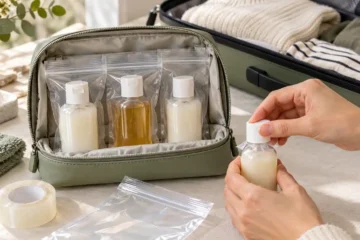
A travel toiletry checklist works best as a standing list you run the day you get home, not the night before you leave. Unpack the kit, then check four things for every item: is there enough left for the next trip, is it still in date, is the container still sealing, and does it still pass the checkpoint rule you fly under. Top up or replace anything that fails, dry and store the kit, and it is ready to go. The checklist below is organized by category, with the specific thing to check for each.
Last checked: September 23, 2026. This is desk research. We have no test rig and no product access, and nothing here was tested by us. Where a rule or a care instruction matters, we quote the organization that publishes it.
Why a standing travel toiletry checklist beats a fresh list every trip
Most toiletry packing lists online are written for the night before departure: a long inventory of everything you might want. That is useful once. For anyone who travels more than a couple of times a year, the problem is different. The kit already exists. What goes wrong is that it comes home half used, sits in a cupboard, and gets opened again the night before the next trip, which is the worst possible time to discover an empty toothpaste tube or a bottle with a split cap.
The mechanism behind a standing checklist is simple: you move the checking from departure day to return day. On return day you have time, the shops are open, and you still remember what ran low. Nothing in the kit is urgent yet. A missing item costs a line on your shopping list rather than a detour through an airport shop.
It also changes what you are checking. A departure list asks "do I have it?" A restock list asks "will it last the next trip, and will it still work?" Those are better questions, because the item you forget is rarely the one that is missing. It is the one that is present but empty, expired, dried out or leaking.
The travel toiletry checklist, by category
Run this list with the kit emptied onto a towel. The "restock when" column is a trigger, not a rule: set it to your own trip length.
| Category | What to check on return day | Restock or replace when |
|---|---|---|
| Liquids in travel bottles (shampoo, conditioner, body wash, lotion) | Level in each bottle; residue or crust around the cap and seal | The bottle would not cover your usual trip length, or the seal is weeping |
| Oral care | Toothpaste tube level; toothbrush bristles; floss remaining | Bristles are frayed or splayed, or the paste would not last another trip |
| Shaving and grooming | Blade edge and rust; shaving cream or gel level; deodorant | The blade drags or shows rust, or the deodorant stick is near the base |
| Skin and sun | Moisturizer level; sunscreen expiration date; lip balm | Past the printed date or the period-after-opening mark, or nearly empty |
| Medications | Quantity versus your next trip plus a margin; labels intact | Talk to your pharmacist before a trip if a refill is due while you are away |
| Tools and small items | Nail clippers, tweezers, hair ties, cotton swabs, bandages | Anything you used up or had to borrow on the trip |
| The kit itself | Inner lining, zippers, the clear liquids bag | The zipper skips, the lining is stained or damp, or the liquids bag is torn |
Liquids and gels
These run out unevenly. Shampoo and body wash tend to go first because they are used daily and in larger amounts; hair product and face serum often come home nearly full. Check each bottle against your usual trip length rather than refilling everything to the top by habit. A bottle refilled over old residue is where film and smell start, so rinse and dry any bottle before topping it up, and look at the seal and the threads while it is empty.
Oral care
The toothbrush is the easiest item to overlook because it always looks present. The American Dental Association's consumer site, MouthHealthy, which we read on September 23, 2026, says to "replace your toothbrush every three to four months, or sooner if the bristles are frayed." A standing kit that only comes out for trips can hold the same brush far past that point without anyone noticing, so check the bristles every time you unpack.
Shaving and grooming
Look at blades under a light. A blade that sat damp inside a closed kit can rust at the edge even if it looks fine at a glance. Deodorant sticks and solid bars shrink in ways that are hard to judge from the outside, so twist the stick up or lift the bar out and look.
Skin and sun
Two dates matter here. If your sunscreen shows an expiration date on the pack, read it and replace the product once that date has passed. Many cosmetics instead carry a period-after-opening symbol, a small open jar printed with a number and the letter M, meaning the number of months the product is intended to be used after it is first opened. Decanting a product into a travel bottle removes that label from view, so note the original opening date somewhere you will see it, such as a strip of tape on the bottle.
Medications
Count what is left against the length of your next trip plus a margin for delays, and keep medications in their labeled containers. We do not advise on doses or timing. If a refill falls due while you will be away, raise it with your pharmacist before you travel.
The five-minute reset: what to do the day you unpack
The table is the inventory. This is the order that makes it quick:
- Empty the kit onto a towel. Everything out, including the small pockets where a single cotton swab or a spare hair tie hides.
- Wipe and dry the kit. Damp is the main enemy of a closed kit. Leave it open to air while you work.
- Sort into three piles: fine as is, top up, replace. Use the table's triggers.
- Rinse any bottle you will refill, and leave it upside down to dry fully before filling.
- Write the shopping list now, while you remember what ran low.
- Repack only what is dry. A toothbrush or a travel towel that goes back in damp will not be damp alone for long.
If you pack with cubes, put the finished kit in the same cube and the same position every time, so it becomes a fixed part of the system described in our guide to choosing a packing cube system.
What the checkpoint cares about, and what it does not
Restocking is also the moment to check that the refilled liquids still fit the rule you fly under. For US airports, the Transportation Security Administration sets it. On its TSA Liquids, Aerosols, and Gels Rule page, which we read on September 23, 2026, TSA says you are "allowed to bring a quart-sized bag of liquids, aerosols, gels, creams and pastes" in carry-on bags, in containers of "3.4 ounces (100 milliliters) or less per item." The same page says containers larger than that should go in checked baggage, and that the rule does not apply to medications and infant or child nourishment, which TSA covers on separate pages.
Two practical points for the restock:
- The container size is what counts, not how full it is. A large bottle that is nearly empty is still a large bottle. When you top up, keep carry-on liquids in containers at or under the limit.
- Check the bag, not just the bottles. A torn or stretched liquids bag is easy to miss. Whether that bag has to be transparent at all is a separate question, which we cover in Does a Toiletry Bag Have to Be Clear?
Rules change, and airports outside the US set their own. Check the authority for the airport you are leaving from before each trip rather than relying on what was true last time.
Refill or replace: reading the bottles
The travel bottles themselves need checking as much as what is inside them. The signs worth looking for are mechanical: a cap that no longer clicks or seats fully, threads that feel worn, a valve that stays open, a crack at the shoulder of the bottle, residue that will not rinse out, or a smell that survives washing. Any one of those is a reason to retire the bottle rather than refill it.
This is also where the checklist can save money. If your bottles are sealing and clean, refill them: you do not need anything new. If they keep failing, the question becomes whether a pricier set would last longer or a cheap multipack is fine to replace often. We work through that trade-off in Are Expensive Travel Bottles Worth It, or Is a Multipack Fine? without naming a winner, because we have not tested them.
Storing the kit between trips
How the kit spends the weeks between trips decides what state it comes out in. Three habits help:
- Store it dry and open. Zip it closed only once everything inside is fully dry.
- Keep the toothbrush out of a closed case at home. MouthHealthy advises: "do not routinely cover toothbrushes or store them in closed containers," and to store the brush upright to air dry. A travel cover is for the journey. Between trips, the brush dries better outside it.
- Store liquids upright and away from heat. A cupboard shelf is better than a hot car trunk or a sunny windowsill.
Some frequent travelers keep a fully duplicated kit, a second toothbrush, second deodorant and filled bottles, that never leaves the suitcase. That removes the packing step entirely, but it makes the standing checklist more important, not less, because a kit that is never unpacked is also never inspected.
What this checklist cannot do
It cannot tell you what your skin, hair or teeth need, and it does not replace advice from a dentist, pharmacist or doctor. It cannot tell you how long a specific product lasts after decanting; the maker's label is the source for that, and once the product is in a travel bottle you have to carry that information across yourself. It cannot guarantee a checkpoint outcome: TSA's page states the rule, and the officer at the checkpoint applies it. And it is built from desk research and published guidance, not from testing products ourselves. We will not describe something as tested when it was not.
What it can do is move the small discoveries, the empty tube, the frayed brush, the weeping cap, from the night before you fly to a quiet evening at home.
FAQ
What should be on a travel toiletry checklist?
At minimum: oral care (toothbrush, toothpaste, floss), hair and body wash, deodorant, shaving items, skin care including sunscreen, any medications, and small tools such as nail clippers and tweezers. For restocking, the list matters less than the check: enough for the next trip, still in date, container still sealing, and within the rule you fly under.
How often should I restock my toiletry kit?
Every time you come home from a trip. Checking on return day gives you time to buy what ran low and to dry the kit before it is stored, instead of discovering problems the night before you leave.
Should I keep my toothbrush in a travel case between trips?
The ADA's MouthHealthy site advises against routinely covering toothbrushes or storing them in closed containers, and recommends storing them upright to air dry. A case is useful in transit. At home, take the brush out and let it dry.
Does TSA care how full my travel bottles are?
TSA's liquids rule is written in terms of container size: 3.4 ounces (100 milliliters) or less per item, in a quart-sized bag, per TSA's page as read on September 23, 2026. Containers larger than that should go in checked baggage, whether or not they are nearly empty.
Do I need to buy new travel bottles every few trips?
Not by default. If a bottle still seals, rinses clean and has no cracks or lingering smell, refilling it is fine. Replace it when a cap stops seating, threads wear, a valve stays open or residue will not wash out.