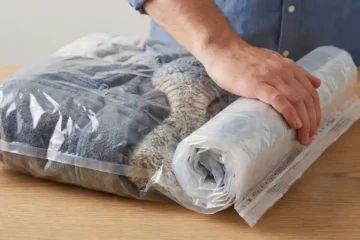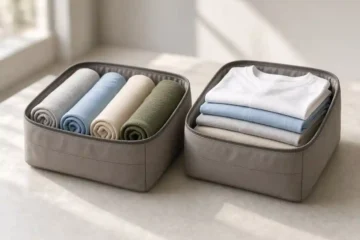
How to pack for two climates in one carry-on: split the bag into three zones. A shared core holds everything you use in both places. One cube holds the items only the hot stop needs, another holds the items only the cold stop needs. Compress whichever climate cube is idle, keep it low at the wheel end, and keep the active one on top. The bulkiest item travels on you, not in the bag. The hard part is not choosing what to bring; it is that half of your luggage sits unused at each stop, and you still have to carry it. This is desk research; we have not tested any bag or cube for this article.
A note on scope: this page is about fitting two sets of things into one volume. What you choose to wear is yours to decide, and we do not cover it here.
Why a Two-Climate Trip Breaks a Normal Packing Plan
A one-climate trip has a simple shape: everything in the bag is in use, and the bag empties and fills in rotation. A two-climate trip, say a beach and then mountains, adds three problems.
- Dead volume. At every stop, one climate's items are idle. They still take space and still add weight.
- Uneven bulk. Cold-weather items are usually thicker and loftier than hot-weather ones. The cold half of the bag can take up far more space than the hot half, even if it has fewer items.
- Different consumables. Sunscreen at one stop, heavier moisturizer or lip balm at the other. Both need to clear the checkpoint in the same quart bag, or travel in a checked bag.
The packing guides that rank for this question mostly answer a different one: which garments to choose. That is a real question, but it does not solve the bag. Even the most carefully chosen set of clothing still has to fit, stay findable and swap over at the halfway point.
How to Pack for Two Climates: The Three-Zone System
Zone 1: the shared core
Everything you use in both climates goes here: sleepwear, underwear, the toiletry bag, chargers, documents. This is the part of the bag that is always active. Pack it in the middle of the case, where it is easy to reach whichever climate you are in.
The bigger the shared core, the less dead volume you carry. The ranking guides lean toward items that work in both places, which is the same idea stated as a container problem: every item that moves from a climate cube into the core is one less item sitting idle half the trip.
Zone 2: the hot-climate cube
Items only the hot stop needs. They tend to be thin and light, and they compress little because there is little air in them. One medium cube often holds them.
Zone 3: the cold-climate cube
Items only the cold stop needs. These are the bulky, air-filled things: insulated layers, thick knits, a warm hat. They are the reason two-climate trips overflow a carry-on, and they are also the items that compress best, because most of their volume is trapped air.
If you already use cubes, the three zones fit either of the common systems we describe in one cube per category or one cube per day. The climate split simply sits on top: per-category cubes for the core, and one cube per climate for everything else.
Compress the Idle Cube, Not the Active One
This is where most of the space comes back, and the rule is simple: compress only the climate you are not in.
When you leave for the hot stop, the cold cube is idle. Squeeze the air out of it, with a compression cube or a roll-up bag, and put it at the bottom. It will not be opened until you move on, so it does not matter that it is tight and awkward to repack.
When you move to the cold stop, reverse it. The cold cube comes out and expands; the hot cube, now idle, gets rolled and compressed and goes to the bottom.
Two things to know about compression before relying on it:
- It works on air, not fabric. A puffy insulated layer shrinks a lot when squeezed; a pair of thin cotton trousers barely changes. We explain the mechanism in compression without a pump.
- It does not make anything lighter. A compressed bag of warm layers weighs exactly what it did uncompressed. If your airline weighs carry-ons, compression gets things into the bag but not under the limit.
Keep insulated items compressed only for the travel days where you need the space, then let them out at your stop. For how long a particular item can safely stay compressed, check its care label or the maker's own care instructions.
The Bulkiest Item Travels on You
The single largest volume in a two-climate bag is usually the warmest outer layer. Carrying it on your body, or over your arm, for the travel days removes it from the bag entirely. Most of the guides that rank for this question suggest it in one form or another. For a hot-to-cold trip, that can mean carrying a warm layer through a hot airport; it is uncomfortable for an hour and frees a large share of the bag.
The same applies to footwear. A heavy pair for the cold stop is a rigid shell that cannot be compressed. Wearing it on travel days and packing the lighter pair costs less space than the other way round.
Weight and Placement When the Bag Changes Shape
Because the bag changes between stops, its balance changes too. A few placement rules keep it steady throughout:
- The compressed idle cube goes low, at the wheel end of a roller or against the back panel of a backpack. Compressed items are dense. Density belongs low and close to the support.
- The active cube goes on top or wherever the bag opens first, so you reach it without unpacking.
- The shared core goes in the middle, between the two.
- Leave a small margin. A two-climate bag is at its fullest on the swap day, when one cube is freshly compressed and the other has just been used and packed loosely. If the bag only closes with effort on day one, it will not close on swap day.
Liquids for Two Climates
The liquids problem is small but real: two climates can mean two sets of toiletries, and they share one carry-on allowance.
At the time of writing, TSA's liquids, aerosols and gels rule (read September 27, 2026) allows "a quart-sized bag of liquids, aerosols, gels, creams and pastes in your carry-on bag," in "travel-sized containers that are 3.4 ounces (100 milliliters) or less per item." TSA's page for sunscreen (read the same day) lists it in carry-on as "Yes (Less than or equal to 3.4oz/100 ml allowed)" and in checked bags as "Yes." Rules change without notice; check tsa.gov before you fly.
Ways to make one quart bag cover two climates:
- Share where you can. One moisturizer that suits both stops takes one slot instead of two.
- Decant rather than buy travel sizes of everything. Thick products such as sunscreen need a container with a wide enough opening; our guide to travel containers for thick products covers which ones empty.
- Buy the bulky consumable at the stop that needs it, if it is easy to find there. A full-size bottle of sunscreen is heavy, and the cold stop does not need it.
- Put the second climate's liquids in a checked bag if you are checking one anyway.
Heat is also a factor for the containers themselves. A bottle left in a hot car or a beach bag warms up, and both the liquid and the air inside the bottle expand. That puts pressure on the cap in much the same way a cabin pressure change does, a mechanism we cover in why travel bottles leak on a plane. Keep the liquids bag out of direct sun at the hot stop.
Wet Items at the Swap Point
If the hot stop involves water, the swap day often comes with something damp: a swimsuit, a quick-dry towel. Give it its own sealed bag for the travel day only, and keep it away from the cold cube, which is about to be unpacked. Hang it at the next stop. A damp item sealed in with insulated layers for a long transfer is how a cold-climate cube starts to smell.
A Two-Climate Packing Order
- Lay everything out by zone: shared, hot only, cold only.
- Move anything that could work in both climates into the shared pile. Every move shrinks the dead volume.
- Pick the bulkiest item and set it aside to wear or carry on travel days.
- Pack the cold cube and the hot cube. Compress the one you will not use first.
- Place the idle cube low, the core in the middle, the active cube on top.
- Plan the liquids for both stops inside one quart bag, or move one set to checked luggage.
- Close the bag. If it only closes with force, remove something now, because swap day will be worse.
FAQ
How do you pack for two different climates in one carry-on?
Split the bag into a shared core, a hot-climate cube and a cold-climate cube. Compress whichever climate cube you are not using, keep it low in the bag, and wear the bulkiest item on travel days.
Do compression cubes help when packing for two climates?
Yes, mostly for the cold-weather items, because their volume is trapped air. Compression makes the idle cube smaller but not lighter, so it helps with space, not with a weight limit.
Where should the unused climate's items go in the bag?
Low in the bag: at the wheel end of a roller or against the back panel of a backpack. Compressed items are dense, and dense items belong close to whatever supports the bag.
Can I bring sunscreen in my carry-on?
At the time of writing, TSA lists sunscreen in carry-on at 3.4 oz (100 ml) or less, in your quart-size liquids bag, and allows it in checked bags. Check TSA's own page before you fly.
How do I stop the bag from overflowing halfway through the trip?
Leave a small margin on day one. The bag is fullest on the day you switch climates, when one cube has just been compressed and the other has just been packed loosely.