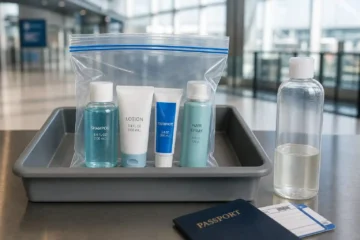
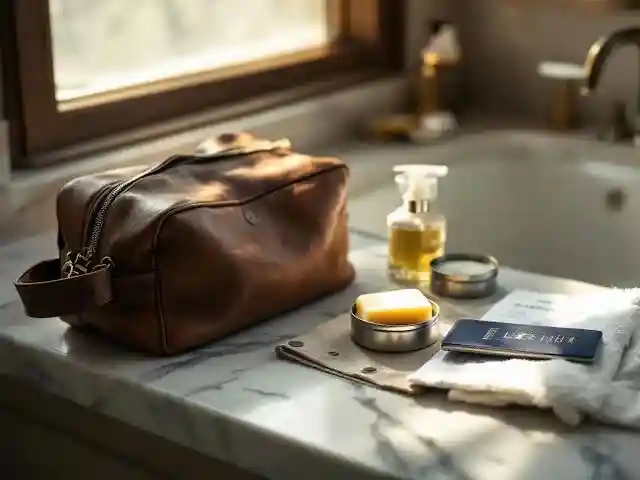
A shampoo bar, a bar of soap, a solid stick deodorant and solid makeup are not liquids, aerosols, gels, creams or pastes, so TSA’s 3-1-1 rule does not apply to them and they do not go in your quart bag. That is not a loophole or a trick. It is the rule working as written: the rule constrains a category of substance, and a solid is outside the category. Switching a few products to their solid form is the only method that reliably empties the quart bag, because it removes items from the rule instead of shrinking them under it.
Last checked: 7 September 2026. These are Transportation Security Administration rules and they apply to airports in the United States. Other countries’ security services set their own container limits, their own bag requirements and their own screening procedures. Rules change without notice, so open tsa.gov before you fly.
What TSA’s Rule Actually Constrains
TSA’s Liquids, Aerosols, and Gels Rule page, read on 7 September 2026, states: “You are allowed to bring a quart-sized bag of liquids, aerosols, gels, creams and pastes in your carry-on bag and through the checkpoint.” Those items must be in “travel-sized containers that are 3.4 ounces (100 milliliters) or less per item.”
Read the list of nouns. Liquids, aerosols, gels, creams, pastes. A solid bar is none of them. Nothing in that sentence caps how much of a non-listed substance you may carry, and nothing requires it to be in the bag.
This is the same mechanism our longer read of what TSA counts as a liquid works through from the other direction: the hard cases are hard because a substance can sit near the boundary. Solids are the easy case. They sit well clear of it.
The Proof Is in TSA’s Own Item List, and It Splits by Form
The most useful evidence for this is not a rule page at all. It is TSA’s What Can I Bring tool, which lists the same product several times, once per physical form, with different rulings attached. Read on 7 September 2026:
| TSA item entry | Carry-on ruling |
|---|---|
| Deodorant (Aerosol) | “Yes (Less than or equal to 3.4oz/100 ml allowed)” |
| Deodorant (Liquid) | “Yes (Less than or equal to 3.4oz/100 ml allowed)” |
| Deodorant (Solid) | “Yes” |
| Bar Soap | “Yes” |
| Solid Makeup | “Yes” |
| Toothpaste | “Yes (Less than or equal to 3.4oz/100 ml allowed)” |
One product, deodorant, three entries, and the solid one is the only one without a volume attached. That is the whole argument in a single row of a government table. It is also why “is deodorant allowed” is an unanswerable question until someone says which deodorant.
What Solids Do Not Get You
Here is the part the enthusiastic version of this advice leaves out. Coming out of the liquids rule does not mean coming out of screening, and for one common class of solid there is a published threshold that has nothing to do with 3-1-1.
TSA’s guidance on powders, and the note carried on its Solid Makeup entry, states that “Powder-like substances greater than 12 oz. / 350 mL must be placed in a separate bin for X-ray screening,” that these may require additional screening, and that containers may need to be opened. TSA suggests putting non-essential powders over that size in checked baggage for convenience.
There is a stricter international layer on top. TSA’s powder policy states that from an international last point of departure to the United States, powder-based substances in carry-on baggage greater than 350 mL or 12 oz may require additional screening, and that powders over that size which “cannot be resolved at the central checkpoint will not be allowed onto the cabin of the aircraft and will be disposed of.”
So loose powder foundation, a large tub of protein powder and bulk bath salts are solids, and they are still capable of costing you time or the item.
Toothpaste Tablets and the Gap in the List
Toothpaste tablets are the single most searched item in this category, and TSA does not publish an entry for them under that name. On the What Can I Bring list read on 7 September 2026, we found one toothpaste entry, for the paste, capped at 3.4 oz in carry-on. We found no separate bar shampoo entry either.
We are not going to fill that gap with a confident ruling, because we cannot. What we can say is what the rule text does and does not cover, which is the paragraph above: the rule names liquids, aerosols, gels, creams and pastes, and a dry compressed tablet is not obviously any of them. What we can also say is that TSA prints the same sentence on item page after item page, including the bar soap and solid makeup entries we read: “The final decision rests with the TSA officer on whether an item is allowed through the checkpoint.”
If you want a ruling on a specific product before you travel, TSA runs a public help channel, AskTSA, and that is a better use of five minutes than any packing article, this one included.
The Swap That Actually Empties the Bag
The quart bag is a fixed volume, so every item you remove from it is space returned. Solids are the only swap that removes items rather than shrinking them, and a small number of swaps does most of the work.
The candidates, in rough order of how much liquid volume they displace, are shampoo, conditioner, body wash, deodorant and sunscreen. Shampoo and conditioner are usually the two largest bottles in anyone’s kit, which is why swapping those two alone changes the picture more than swapping four small ones. If you still carry liquids after the swap, our breakdown of what genuinely fits at 1 oz, 2 oz, 3 oz and 3.4 oz covers how much product each size holds, and building a travel bottle set starts from the same constraint.
Sometimes the honest answer is to buy nothing. If your trip is three days and you already own small bottles that seal, a bar is a change of habit, not a rescue.
The Problem Solids Create, and Nobody Sells You the Fix
A used bar is wet. That is not a security problem, it is a luggage problem, and it is the reason people try a shampoo bar once and go back.
A wet bar sealed in a non-porous container stays wet for the whole flight, softens at the edges, and arrives as a soft-cornered puck stuck to the lid. Left loose it wets whatever it touches. The two workable answers are a vented or slotted container that lets the surface dry, or a genuine dry-out window: unwrap it on the counter as soon as you arrive and let the outer layer harden before it goes back in the bag.
This is the containment layer generally, and it is the same discipline as storing travel bottles between trips: the failure happens after the trip, not during it.
Three Rules, One Bag, Different Authorities
It is worth being clear about who sets what, because these get merged and they should not be.
TSA’s 3-1-1 rule governs liquids, aerosols, gels, creams and pastes at a United States checkpoint, and it is the rule solids sit outside of. TSA’s powder guidance is a separate screening procedure with its own 12 oz and 350 mL threshold, and solids can land inside it. The Federal Aviation Administration sets the limits that apply to certain toiletry articles in checked baggage, which is a different bag and a different regime again.
Outside the United States, none of the three follows you. The container limit at your return airport is set by that country’s own authority, and the treatment of solids and powders is one of the areas that varies. Read the security or hand baggage page published by each departure airport’s own authority, for every leg including connections, and pack to the strictest rule on the trip.
How We Checked This, and What We Left Out
We have not flown with any of this, tested any product, or run anything through a checkpoint. This page is desk research from TSA’s own pages, read on 7 September 2026: the Liquids, Aerosols, and Gels Rule page, the 3-1-1 FAQ, the powders FAQ, and the What Can I Bring entries for bar soap, solid makeup, the three deodorant forms, toothpaste and shampoo.
Deliberately left out, because TSA does not publish it: any quantity cap on solid toiletries in carry-on, any ruling on toothpaste tablets or shampoo bars as named items, and any promise about how a given officer will read a given product. Also left out is the FAA checked-baggage figure, which belongs to a different regime and is quoted from its own source elsewhere on this site rather than paraphrased here.
The 3-1-1 rule itself is the page to read next if what you actually need is the liquids you are still carrying.
FAQ
Do solid toiletries count toward the TSA liquid limit?
No. TSA’s rule covers liquids, aerosols, gels, creams and pastes, and a solid is none of those. TSA’s own What Can I Bring list makes the distinction visible: Deodorant (Solid) is listed as “Yes” with no volume attached, while Deodorant (Aerosol) and Deodorant (Liquid) are both capped at 3.4 oz or 100 ml in carry-on. Read on 7 September 2026.
Can I bring a shampoo bar in my carry-on?
A shampoo bar is a solid, and the 3-1-1 rule as TSA words it does not reach solids. We found no separate bar shampoo entry on TSA’s item list on 7 September 2026, so there is no product-specific ruling to quote. TSA states that the final decision rests with the officer at the checkpoint, so we cannot promise an outcome.
Is there a limit on how many shampoo bars or soap bars I can pack?
TSA publishes no quantity cap for solid toiletries in carry-on. Practical limits are your bag’s space and weight, and your airline’s carry-on allowance, which is the airline’s rule and not TSA’s.
Are toothpaste tablets allowed through security?
TSA’s What Can I Bring list, read on 7 September 2026, carries one toothpaste entry, for paste, limited to 3.4 oz or 100 ml in carry-on. There is no separate entry for tablets. Ask AskTSA if you want a ruling on a specific product before you fly.
Do powders have their own rule?
Yes, and it is separate from 3-1-1. TSA states that powder-like substances greater than 12 oz or 350 mL must be placed in a separate bin for X-ray screening and may need additional screening. Traveling to the United States from an international last point of departure, powders over that size that cannot be resolved at the checkpoint will not be allowed into the cabin and will be disposed of.