When a travel bottle empties into your bag, people replace the bottle. The bottle almost never failed. The lid did, and the lid is the part nobody looks at when buying.
This page is about what each closure type is actually built to do, which ones have a moving part that can be pushed open, and how to find out about yours before a trip rather than after one.
No product is named and nothing is ranked here. This site has tested nothing, and a closure comparison written without having used the products would be a guess dressed as a verdict. What it can give you is the mechanism, which is stable, and a test that takes a day.
The question a closure has to answer
Not “does it seal”, because they all seal on a shelf.
Does it stay closed when the pressure inside is higher than the pressure outside, while something is pressing on it.
That is the actual situation in a bag. Cabin pressure changes with altitude, so a bottle filled at ground level has air in it that wants to expand. A bag has weight on top of it. And a soft bottle gets squeezed by everything around it.
A closure that holds against a hand and fails against that combination is the normal case, not an unusual one. The full mechanism is in why travel bottles leak on a plane, and the important part is that the pressure is not doing the whole job: it is the pressure plus something pressing on the closure.
The types, and what each is for
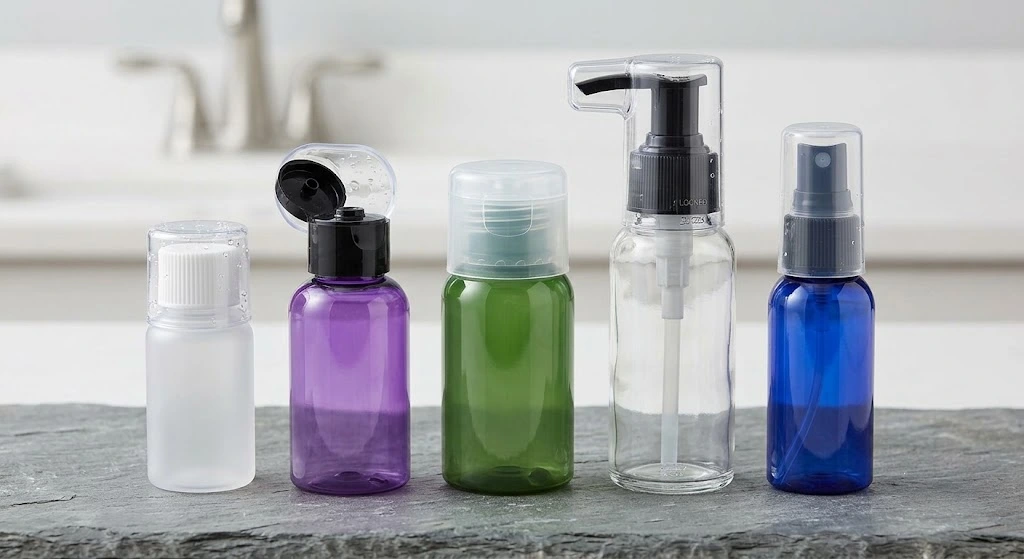
A screw cap. The simplest and the one with the fewest ways to fail. No moving part, and the seal is the entire cap face pressed against the bottle neck. Its weakness is that it depends on being done up properly and on the sealing surface being clean and undamaged.
For travel it is the most conservative choice, and the cost is that you have to unscrew it every time.
A disc top. A screw cap with a small hinged disc that presses down to open a hole. Convenient, and the disc is a moving part with a small sealing area. Whether it holds depends on the specific product’s design, and the failure mode is that the disc gets pressed open by something in the bag.
A flip cap. A hinged lid over a spout. Same category of question as a disc top and usually with a larger opening. A flip cap that clicks positively shut is a different object from one that closes loosely, and you can tell which you have by feel.
A pump. The most convenient in use and the one with the most moving parts. Most pumps have some way of being locked, usually by turning the head, and a pump that is not locked can be pressed by anything above it. A pump also has an internal tube full of product that has nowhere to go when the air below expands.
A spray or mist head. Similar to a pump, with the addition that the head can clog, which is a separate problem covered in hair misters for travel.
A squeeze tube with a sealed end. No closure to fail at the far end at all, which is why tubes behave well in bags. The opening is the only failure point.
The pattern across all of them: the more convenient a closure is to use one-handed, the more moving parts it has, and the more ways there are for something in a bag to operate it.
What actually decides it, whichever type you have
Four things matter more than the category.
Whether it locks. A pump that locks is a different proposition from one that does not. A flip cap that clicks positively is different from one that rests closed. Check for a positive locked state; if there is not one, the closure depends entirely on nothing pressing it.
Whether there is an inner seal. Many travel bottles have a separate liner or membrane inside the cap, and that liner is doing most of the sealing. If it is missing, hardened, or has come out in a wash, the closure is now relying on plastic against plastic.
Whether the sealing surfaces are clean. Product dried on the rim of the bottle or on the cap face is the most common cause of a closure that used to work and now does not. This is a maintenance problem rather than a design one, and it is covered in how to clean silicone travel bottles and get the smell out.
Whether the threads are worn. A cap that no longer tightens firmly is finished, and when a refillable bottle is finished covers the other signals alongside it.
The test that answers it for your bottle
Since no page can rank these for you, here is the substitute, and it costs a day.
- Fill the bottle as you would for a trip, with the actual product, at the actual fill level you use. Fill level matters and how to fill and close a travel bottle so it survives the flight covers why.
- Close it the way you would close it in a hurry. Not carefully. That is how it will actually be closed.
- Put it in a sealed clear bag, upside down, on a plate.
- Put something on top of it. A book. That is the pressure a closure experiences in a packed bag and it is the variable a static test misses.
- Leave it overnight, and look at the bag rather than the bottle.
Anything visible in the bag is a failure and the bottle does not travel. Nothing visible is not a guarantee, because you have not reproduced the pressure change, but it eliminates the closures that were never going to work.
Do this once, per bottle, when you buy it. It is the only comparison that is about your bottles rather than about somebody’s opinion.
The habits that make any closure survive
Wipe the rim and the cap face before closing. Ten seconds, and it removes the most common cause of failure.
Do not overfill. Air needs somewhere to go.
Lock anything lockable, and if a pump does not lock, it goes in a bag of its own or does not travel.
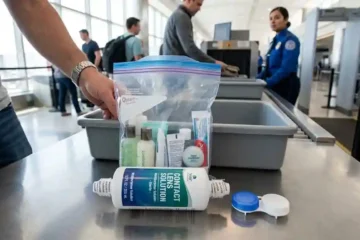
Bag everything anyway. Not because your closures are bad, but because the cost of being wrong is your clothes. Every bottle in a sealed bag, thick products separately from thin ones.
Store bottles cap-up between trips, empty, dry and open. Storing refillables between trips covers why an empty bottle stored closed is the one that comes out sticky and unpleasant next time.
What this page will not do
It will not name a best closure or a best product. That would require having used them, and this site has used nothing.
It will not give you a failure rate. No such figure has been read at a source here, and a number invented for this subject would be exactly the kind of thing that gets repeated.
It will not tell you your particular bottle is fine. The overnight test tells you that, and it tells you about the bottle in your hand rather than about a category.
The short version
- The lid fails, not the bottle. Buy for the lid.
- The real question is whether it stays closed under pressure while something presses on it.
- Fewer moving parts is more reliable. Screw caps are conservative; pumps and spray heads have the most to go wrong.
- What actually decides it: does it lock, is the inner seal present, are the surfaces clean, are the threads worn.
- Run the overnight test with a weight on top. That is the only comparison about your bottles.
- Wipe the rim, do not overfill, lock what locks, and bag everything regardless.