For hostel shower caddy travel, the right caddy is decided by the shower you will actually use: a hanging mesh caddy with a hook suits stalls with a hook or rail and no shelf, a small open tote suits bathrooms with a shelf or bench, and a zipped dry bag suits campsites and bare floors where nothing should touch the ground. Whatever the shape, it has to carry everything down a corridor in one hand, drain fast, and dry before you pack it. This is desk research: we have not tested any caddy, and we name and price none. What follows is the mechanism behind each choice.
Why a Shared Bathroom Needs a Different Kit
At home, toiletries live on a shelf next to the shower. In a hostel dorm, a campground wash block or a shared bathroom down a hall, they live in your bag, and every shower becomes a small trip:
- The carry. Everything goes from your locker or bunk to the shower and back, often past other people, usually with a towel and clean clothes in the other hand.
- The stall. Some stalls have a hook, some a shelf, some a bench outside the door, and some nothing at all. A wet floor is the only surface you can count on.
- The return. The kit comes back wet, and it has to go back into a backpack or locker with things that should stay dry.
The pages that rank for this search are mostly product listings and hostel tips articles that recommend "a caddy" and stop. None of them match the caddy to the bathroom, which is the actual decision. That is what this page does.
Four Caddy Shapes and the Bathroom Each One Suits
| Caddy shape | Best bathroom for it | Strength | Weakness |
|---|---|---|---|
| Hanging mesh caddy with a hook | Stalls with a hook, rail or showerhead pipe, and no shelf | Keeps everything off the floor and in reach; mesh drains | Useless if there is nothing to hang it on; a small hook may not fit a thick rail |
| Open tote or basket | Bathrooms with a shelf, bench or counter | Fast to grab from; easy to carry by a handle | Must sit somewhere; on a wet floor it collects water and grime |
| Zipped mesh pouch | Mixed or unknown bathrooms | Closes for the walk back; drains through the mesh | Items tumble together inside; hard to hang if it has no loop |
| Roll-top or zipped dry bag | Campsites, wash blocks with bare floors, beach showers | Seals out dirt and rain on the walk; doubles as a wet bag | Holds water inside if packed wet; nothing drains |
If you do not know what the bathroom will look like, the hanging mesh caddy with a sturdy hook covers the most cases, because a hook, rail or door top is more common than a clean shelf. If most of your trip is campsites, a dry bag that can also hang from a loop is the more flexible choice.
What Makes a Caddy Work in a Hostel Shower
These are features you can check on a listing or in a shop, without needing a test.
- A hook that opens wide enough. A hook that only fits a thin towel rail will not go over a thick shower pipe or a stall door. Some caddies use a loop or strap instead, which wraps around more shapes.
- Drainage at the bottom. Mesh or drain holes let water out. A solid-bottomed pouch holds a puddle, and that puddle comes back to your bag with you.
- Separate pockets for the small things. A razor, a toothbrush and a bar of soap rattling around one compartment is how a razor ends up in your hand the wrong way.
- One handle that carries all of it. If you need two hands for the caddy, you have none left for a towel and clothes.
- A way to close it for the walk back. A zip or drawstring keeps a wet bottle from falling out in a corridor.
- Flat when empty. It has to pack into a backpack alongside everything else on travel days.
What Goes In It
A shared-bathroom kit is smaller than a home shower shelf. Most people carry:
- Shampoo and conditioner, or a combined product, in small bottles
- Body wash or a bar of soap in a case
- A toothbrush and toothpaste
- A razor with a cover
- Flip-flops or shower shoes, worn rather than carried
- A quick-dry towel and a change of clothes, carried separately
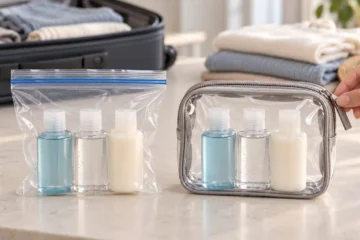
Small refillable bottles make this kit lighter and keep it under the checkpoint limit if you fly with it. At the time of writing, TSA's liquids, aerosols and gels rule page, read on September 25, 2026, describes "travel-sized containers that are 3.4 ounces (100 milliliters) or less per item" in "a quart-sized bag." Rules change without notice; check tsa.gov before you fly. A caddy that goes to the shower every day tests the bottle closures harder than a flight does, and flip caps and pumps behave differently when they are knocked around wet. We compare the closure types in pump, flip cap or disc top: which closure survives a suitcase.
The Toothbrush Problem in a Caddy
The toothbrush is the one item in a shower caddy with a hygiene rule behind it. The American Dental Association's toothbrush care guidance, read on September 25, 2026, states: "Store toothbrushes in an upright position after use and allow them to air dry. Storing a moist toothbrush in a closed container promotes microbial growth more so than leaving it exposed to the open air." It also states that "Toothbrushes should not be shared."
That creates a conflict with a zipped caddy. A wet brush zipped into a closed pouch with other wet items is exactly the storage the ADA describes as promoting microbial growth. Practical ways around it, in a shared bathroom:
- An elastic loop on the outside of a hanging caddy keeps the brush upright and open to the air while the caddy hangs.
- A vented toothbrush cover protects the head in transit without sealing it, where a solid cap would trap moisture.
- Let it dry before sealing. If the caddy has to close for the walk back, open it again once you are at your bunk.
For anything beyond storage, such as how often to replace a brush, the ADA and your dentist are the sources to follow.
Getting Wet Things Back Into a Dry Bag
This is where shared-bathroom kits go wrong. A caddy that comes back wet and goes straight into a backpack spreads that water to everything near it, and a damp caddy packed for a travel day can sit closed for many hours.
- Hang it to drain at the bunk, from a bed frame, locker door or hook, instead of putting it away wet.
- Shake out the bottles and wipe the caps before they go back in, so soap residue does not glue a cap shut or leave a film.
- On departure day, if it is still wet at checkout, keep it in a separate wet bag or dry bag and pack it on the outside of your pack, away from electronics and clothes.
- At the next stop, open it up again so it can finish drying.
Damp, closed containers are where mold starts, and a caddy that never dries fully is a candidate. Our guide to mold in a travel bottle covers where it begins and how to stop it, and the same logic applies to the pockets of a caddy. Between trips, the bottles themselves should be emptied and dried the way we describe in how to store travel bottles between trips.
Campsites and Wash Blocks
Campground bathrooms add two problems that hostels usually do not: the walk is often outdoors, and the floor is often concrete, sand or mud.
- Nothing on the floor. A dry bag or caddy with a loop that can hang from a door or hook keeps your kit off a surface you would not put a toothbrush on.
- Weather on the walk. A roll-top dry bag keeps rain and dust out between tent and wash block, which mesh does not.
- Cold water and bars of soap. A soap case with drainage lets a bar dry between uses. A sealed case left wet turns the bar soft.
- Shared sinks. At a busy wash block, a caddy you can hang or hold means you are not setting items down on a wet counter.
Do You Need a Caddy at All?
Sometimes not. If the trip is short, the bathroom is private or has a good shelf, or you already own a toiletry bag with a hook and drainage, that bag may do the job. The case for a separate caddy gets stronger the longer the trip, the more shared bathrooms you use, and the more often you carry your kit down a corridor. A toiletry bag that you already own and that closes, drains and hangs is a caddy. Buying a second one only makes sense if yours fails one of the six checks above.
FAQ
What kind of shower caddy is best for hostels?
It depends on the bathroom. A hanging mesh caddy with a wide hook suits stalls with a hook or rail and no shelf, which is common in shared bathrooms. For campsites, a dry bag that can hang from a loop keeps kit off the floor and out of the rain.
Do hostels provide toiletries?
Many shared bathrooms do not provide a full set of toiletries the way hotels often do, so most travelers bring their own. Check the listing for the place you are staying.
Can I keep my toothbrush in a closed shower caddy?
The ADA, in guidance read on September 25, 2026, states that storing a moist toothbrush in a closed container promotes microbial growth more than leaving it exposed to the air. An outside loop or a vented cover lets it air dry.
How do I pack a wet shower caddy?
Hang it to drain first. If it must go in wet, put it in a separate wet bag or dry bag, pack it away from clothes and electronics, and open it to dry at your next stop.
Can I take my shower caddy bottles through airport security?
In a carry-on, TSA's 3-1-1 rule, read on September 25, 2026, limits each container to 3.4 ounces (100 mL) inside a quart-sized bag. Check tsa.gov before you fly.